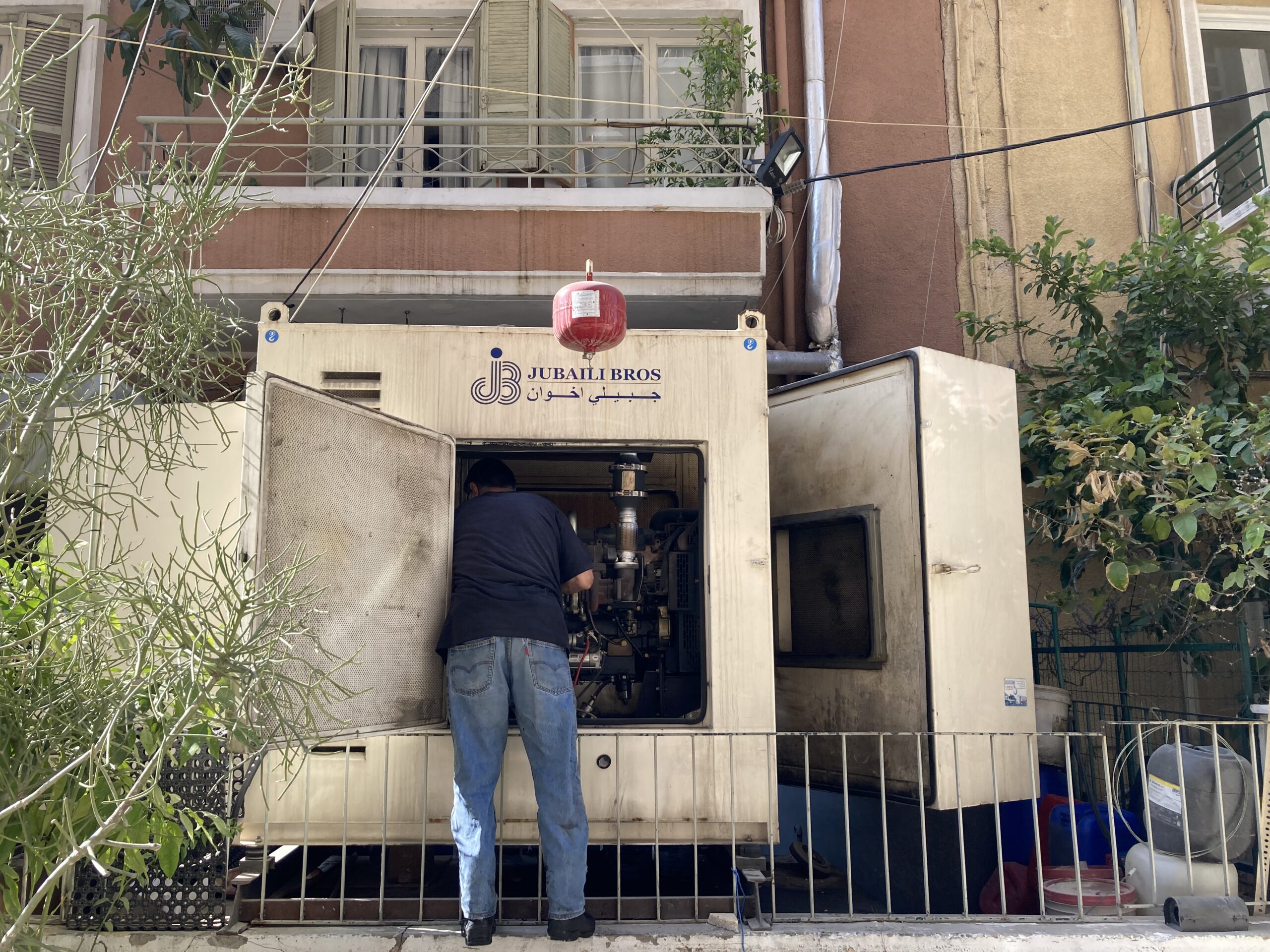
Ali is one of the last diesel generator operators in Baalbek, a town nestled next to ancient Roman ruins in the rural Beqaa Valley of Lebanon. Until about 2023, he operated six large 600-kilovolt-ampere diesel generators supplying backup electricity to some 2,000 households in Baalbek’s Douris neighborhood. He bought 100,000 liters of diesel a month. Today, he has just one smaller generator and his fuel purchases have declined by 96 percent.
Ali is no outlier. There used to be thirty other generator owners in his area, and now there are only four. They had built a business where the Lebanese state had failed. Now, they’re folding—but not because Lebanon’s electricity grid is back online. Rather, a revolution in solar energy has swept through rural Lebanon, making their services unnecessary.
For decades, networks of private generator operators had been treated as an untouchable fixture of Lebanon’s political economy.1 Yet in villages and small towns, this system has unraveled with little fanfare. Generator networks did not disappear through confrontation or reform, but through a double shock: rapid impoverishment hollowed out demand, while increasingly affordable solar systems allowed households to opt out of subscription-based backup generators.
At the same time, in dense urban areas of Lebanon, more people than ever are relying on diesel generators, in large part because dense housing and limited roof space constrain solar substitution.
Such are the contours of Lebanon’s accidental solar revolution.2 Many of the aspects of this remarkable transition should hearten a green energy enthusiast. Yet the unevenness of the switch to solar also illustrates the complexities of sudden and sweeping changes to energy systems that can have unexpected consequences, especially when they occur outside of state planning.
This report draws on two years of PhD fieldwork, including over one hundred interviews with solar energy companies, government officials, civil society organizations, international aid organizations, and citizens to understand the political, economic, and technological dynamics that shaped Lebanon’s rapid adoption of solar energy systems in the wake of an extended energy crisis in 2021. It traces how and why a system of neighborhood backup electricity known as Ishtirak vanished without protest or enforcement, and why this transition has unfolded unevenly across space, producing a bifurcated energy landscape: an increasingly solar-powered countryside alongside ever-more diesel-reliant coastal cities.
The disruption of orthodox visions of how electricity infrastructure and markets function has profound implications for policymakers. In rural Lebanon, energy transition has unfolded outside formal planning frameworks, reshaping demand, pricing, and provision through millions of household-level decisions rather than through reform or regulation. From a technical and environmental perspective, the rapidly expanding stock of solar systems already installed across the country constitutes a significant generation asset that it would be irrational to exclude from any future electricity system. And importantly, similar trends of crisis-induced decarbonization are unfolding elsewhere in the world.3
But for policymakers and donors, the challenge is how to adapt planning, regulatory, and investment models to an electricity landscape that has already changed—one in which affordability, security, and sustainability can no longer be pursued through conventional infrastructure and utility business models alone.
Why Diesel Generators Replaced the Grid
From its founding in 1964 until the outbreak of the civil war in 1975, the state utility, Electricité du Liban (EDL), supplied electricity around the clock, even exporting surplus power to neighboring Syria. The war marked a structural break. Destruction, the weaponization of infrastructure, and Lebanon’s constrained ability to import electricity created a persistent gap between electricity supply and demand.4
At the same time, electricity consumption rose. Periods of relative calm during the fifteen-year civil war coincided with construction booms driven by internal displacement and the growing electrification of everyday life.5 Refrigerators, air conditioning, and household appliances became commonplace. The result was chronic load shedding: the deliberate cutting of power to prevent total grid collapse. Starting during the civil war, regular interruptions in state-supplied electricity became the norm.6
It was in this context that neighborhood diesel generators emerged. Initially, households and businesses that could afford it relied on small private generators. As outages became longer and more frequent, these individual solutions gave way to larger diesel generators supplying entire buildings, streets, or neighborhoods through dedicated wiring. What began as an improvised wartime fix gradually hardened into a semipermanent system of local electricity provision.7
This model became known as ishtirak, literally meaning “subscription.” Households came to rely on two parallel sources of electricity: cheap but unreliable power from a loss-making state utility, and more expensive but dependable backup electricity from neighborhood generators. This dual energy regime became embedded in everyday life.8
What began as an improvised wartime fix gradually hardened into a semipermanent system of local electricity provision.
A defining feature of the ishtirak system was its billing logic. Rather than charging by kilowatt-hour, most operators sold electricity through flat-rate subscriptions based on amperage—2.5, 5, or 10 amperes—akin to purchasing bandwidth in an Internet plan. This simplified billing and stabilized revenues for operators while shifting consumption risk onto customers. For households, generator electricity became a predictable, if costly, monthly expense. Over time, the word Ishtirak entered the Lebanese vernacular as shorthand for generator electricity, while dawleh (“state”) came to denote power supplied by EDL.
In dense urban areas, neighborhood generators became highly profitable. Estimates suggest that the sector generated revenues of roughly $2 billion annually, ironically almost identical to the yearly losses of EDL.9 In lucrative neighborhoods, the return on investment for a large diesel generator could be less than six months.
Several factors underpinned this profitability: subsidized diesel (until 2021), flat-rate subscription billing, and, crucially, the social and political capacity to collect bills. Unlike EDL, which struggled to enforce payment, generator operators could rely on proximity, social pressure, and political backing to ensure compliance.
Unlike the national grid, which relies on high- and medium-voltage transmission lines to move electricity across long distances, the networks of neighborhood diesel generators distribute electricity directly through low-voltage feeder lines. This technical choice imposes a strict physical constraint: beyond roughly 200–300 meters, transmission losses become too high to remain economical.10 As a result, operators sought to concentrate as many customers as possible close to the generator and developed a strong interest in defending monopolized territories against competitors. Practices ranged from cutting the cables of rival generators that encroached on a given area to, in rarer cases, violent clashes between operators.11 Such conflicts were almost always between generator operators rather than between operators and customers.
Mafia or Municipal Service?
As generator operations became more lucrative, they also became more tightly entangled with local power structures. Close connections with political factions, aggressive fee collection, and the defense of territorial monopolies contributed to their reputation as a “generator mafia.”12
At the same time, the oscillation between cheap but unreliable state electricity and expensive but dependable ishtirak power reflected broader features of Lebanon’s political economy. The dysfunction of state institutions carved out lucrative private markets, increased households’ reliance on local patronage, and provided revenue streams for sectarian political actors who controlled neighborhoods or extracted rents from generator operations.13
But not all diesel generators in Lebanon operated according to the same economic logic, nor did they wield the same degree of political power. In rural and more sparsely populated areas, ishtirak systems were often run on a nonprofit or semi-collective basis. In many villages, the generator network was operated by municipalities, religious associations, or community groups, sometimes supported by political patrons or by members of the village diaspora.14 In these settings, long transmission distances, low customer density, and limited purchasing power made purely profit-driven generator operations far less viable than in dense urban neighborhoods.
These differences were reflected in billing practices. While for-profit generators overwhelmingly relied on flat-rate subscription models based on amperage, nonprofit or communal generators more often billed customers by meter, according to actual electricity consumption. Metered billing reduced revenue volatility for households and made it more attractive for customers to retain a generator connection as a form of backup power, rather than as a primary source of electricity. In 2018, parliament passed a law obliging generators to install electricity meters; however, adoption of metered billing remains patchy, particularly in less affluent areas.15
Irrespective of ownership structure and business model the people operating neighborhood generators reject the “mafia” label.16 From their perspective, they perform a dirty and thankless task that is made necessary by the state’s dysfunction. While the association between generators, patronage, and political power is real, treating all ishtirak operations as equally lucrative or mafia-esque flattens these important distinctions.
Generator Networks Quietly Collapse
In the fall of 2021, a fuel crisis led to a near-total blackout in Lebanon. While power shortages had long been part of everyday life since the outbreak of the civil war in 1975, what was new was the scale of the disruption and the response it triggered.17 From the summer of 2021 onward, households and businesses sought to increase their energy security by installing off-grid solar systems.18
The fuel crisis was closely tied to Lebanon’s broader financial collapse, which began in 2019.19 As the state ran out of foreign currency, it became unable to sustain fuel subsidies. This led to supply disruptions, delays in offloading fuel from tankers, and widespread hoarding driven by fears that fuel would either run out or become unaffordable once subsidies were lifted.20 The resulting shortages affected both EDL and the system of neighborhood diesel generators that had long provided backup electricity.21
From 2021 onward, private diesel generators, which had become such an integral part of everyday life that they even shaped the Lebanese vernacular for electricity, quietly began to vanish from much of the countryside. In Baalbek, where much of the author’s dissertation research was conducted, only four of roughly thirty generator operators remained in early 2023.22 The reduction in the number of operators in Baalbek was not a consolidation. Most had simply packed up and sold both their generators and their microgrid cables.23
This quiet collapse was driven by a two-pronged dynamic. First, many households, impoverished by Lebanon’s financial crisis, could no longer afford the rising cost of diesel-generated electricity.24 Second, off-grid solar home systems became cheap enough to directly outcompete the ishtirak. As households unsubscribed, generator businesses gradually lost their revenue base and quietly dismantled their operations.
While generators in villages and small towns were disappearing, the opposite was happening in Lebanon’s dense coastal cities.
This process, however, was geographically uneven. While generators in villages and small towns were disappearing altogether, the opposite was happening in Lebanon’s dense coastal cities. There, diesel generators came to carry more electrical load than ever before: multistory buildings lack sufficient roof space to install a self-sustaining number of solar panels.25 Thus, diesel generators disappeared from the countryside, but not the cities.
The collapse of the generator economy across the countryside also became visible in the surge of second-hand equipment on the market. On Facebook Marketplace and OLX (a platform similar to Craigslist), diesel generators and kilometers of cabling were offered at steep discounts. “A generator you bought for $60,000 is now worth only $10,000,” Ali said.26
This pattern was repeated in smaller towns and villages around Baalbek. Farther north, in Youmine, the local generator was run as a side business by the owner of the local supermarket, but then reduced its output and eventually stopped operating in mid-2022.
Similar stories circulated in surrounding villages. In Chaat, a few miles northwest of Youmine, the local generator shut down in early 2022.27 Elsewhere, some rural generators attempted to hold out by narrowing their customer base to specific high-volume users. This was the case in Qaa, a village with many large farms in the Beqaa’s northeast. There, the generator drastically reduced and rescheduled its operations, supplying electricity only for a few hours in the morning and evening to farmers who still relied on diesel power to pump water from deep wells. In the meantime, most had installed large solar arrays to run their pumps directly on sunlight.28
The suddenness and apparent ease with which neighborhood generators vanished from rural life is readily explained by those who are now looking for work. First, operators lost a substantial share of their customers to poverty. Second, dramatic price drops in Chinese photovoltaic components made solar electricity more competitive than diesel-generated power.
Infeasible Economics
Lebanon’s financial and political crisis not only toppled governments but also laid bare the country’s fiscal fragility. Citizens first lost access to their bank savings and then saw their purchasing power evaporate through currency devaluation.29 As households became poorer, generator operators faced a double bind. With an almost entirely absent national grid, they had to extend their hours of operation, while the end of fuel subsidies meant that diesel, and thus the electricity they sold, became dramatically more expensive.
As prices were dollarized, generator electricity became unaffordable for a growing share of society. Meanwhile, the cost of off-grid solar equipment had fallen by roughly 90 percent over the past decade.30
Crucially, the competitive advantage of solar was made particularly visible through the generator’s flat-rate billing model. Fixed monthly payments for ishtirak electricity greatly simplified cost-benefit calculations for households considering solar installation: dividing the upfront cost of a solar system by the monthly generator fee made the payback period immediately legible.
At the same time, the surge in demand for solar electricity gave rise to a highly competitive local solar market. In the context of the economic crisis, many Lebanese entrepreneurs rushed into solar installation and retail. As a result, solar systems were not only readily available but increasingly offered at competitive prices, aggressively marketed, and bundled with installation, maintenance, and financing options. Solar was not just cheaper: it was visible, accessible, and actively promoted.31
The sudden and quiet end of ishtirak in rural areas underscores that the popular image of a generator “mafia” is misleading. The power of generator operators did not primarily rest on coercion. Customers were not forced to subscribe to an ishtirak—not subscribing simply meant living with darkness or bearing the cost and inconvenience of maintaining a private generator. Operators therefore concentrated their power on defending territorial monopolies against in-kind competition.
At the same time, there is a risk in romanticizing generator operators as politically powerless or benign. These businesses had previously defended their economic interests and territories with considerable force. In 2015, generator operators in Zahle resisted attempts by Assad Nakkad, the CEO of Electricité du Zahle, to put them out of business.32 One solar entrepreneur described how, when he explored setting up a solar-powered microgrid in the village of Ain, the local generator operator bluntly warned that his panels would not survive a single day.33
When one solar entrepreneur explored setting up a solar-powered microgrid in the village of Ain, the local generator operator bluntly warned that his panels would not survive a single day.
When violence did occur, however, it was almost exclusively between operators rather than between operators and customers. Such a micro-monopolistic business model was effective at defending against rival generators, but it was entirely ill-equipped to resist individual acts of unsubscribing and self-provisioning. What changed after 2021 was that solar home systems became both more reliable, because they were independent of fuel supply chains, and cheaper, once diesel subsidies were lifted.
What is striking is how little resistance accompanied the disappearance of generators from rural and suburban areas. Generator operators mounted little opposition to solar adoption because off-grid solar systems were installed household by household, leaving no clear adversary to confront.
Solar Hijacks Patronage Networks
One key political effect of off-grid solar is the domestication of energy-related tensions. When households disconnected from the ishtirak’s diesel microgrid, they also emancipated themselves from their social and economic relationship with the neighborhood generator operator. For the hundreds of thousands of households that installed solar panels, an inverter, and batteries, electricity increasingly became a domestic affair.
In some respects, off-grid solar home systems are poor vehicles for distributing patronage. Once installed, they require little maintenance and minimal recurring support. This contrasts sharply with networked infrastructures, such as generators, health care, or education, which enable ongoing political leverage through selective access, discounts, and enforcement. At the same time, however, the upfront cost of solar home systems has kept energy independence far beyond the reach of many Lebanese households. As a result, many families relied on existing networks of support and patronage to overcome the initial hurdle of investing in solar.34
The power void created by the disappearance of the ishtirak was thus at least partially filled by already established avenues of support: the diaspora on the one hand, and sectarian or political charitable organizations on the other.
The first, and most familiar, response to failing public services in Lebanon has long been assistance from relatives overseas. As Lebanon’s economy contracted, remittances rose to an estimated 30 percent of GDP in 2023.35 The economics of solar home systems, replacing a recurring monthly bill with a one-time investment, made them an especially attractive target for diasporic support.
In this sense, solar home systems functioned as household-scale “sustainable development projects.” These acts of support rarely rewired family relationships. Instead, they reinforced established patterns in which state failures are compensated through transnational family networks.
A second source of financial support for rural solarization came from sectarian and political charitable organizations. As elsewhere, such institutions in Lebanon often pick up the slack where state services fail.36 Unlike nongovernmental organizations dependent on international donors, they are frequently able to quickly respond to urgent local needs.
This capacity was clearly visible during the energy crisis of 2021. As more affluent households secured energy access through solar power, poorer households increasingly suffered from energy poverty. Charitable organizations responded rapidly to what had become one of their constituents’ most pressing needs: electricity.
These interventions ranged from small-scale initiatives, such as local Islamic associations using zakat donations to finance basic solar systems for poor households, to large-scale programs run by institutions such as Al-Qard Al-Hasan (AQAH), Hezbollah’s microfinance bank.37
AQAH offers interest-free loans and was quick to introduce dedicated solar loan programs. Customers were required to provide gold jewelry as collateral, but repayment schedules were explicitly matched to households’ former generator subscription costs. If a family had previously paid $50 per month for a 2.5-ampere connection, AQAH structured repayments at roughly the same level over a period of up to two years.38
While loan officers were reluctant to disclose precise figures, they described demand as enormous. This assessment was echoed by local solar contractors, one of whom estimated that roughly half of the 1,000 systems he installed in a single year were financed through AQAH’s solar loan program.39 Yet this form of intervention does not constitute a durable source of patronage: once installed, a solar home system requires little ongoing support, making it a comparatively weak instrument for sustaining long-term political-economic dependence.
The breakdown and ensuing unaffordability of generator electricity in rural areas did not produce a political vacuum. Instead, it reactivated familiar mechanisms through which households navigate the absence of state services. Electricity politics did not disappear with the diesel generator; rather, they migrated into households, transnational family networks, and political charitable institutions.
Grid Defection and the Future of Infrastructure
Lebanon’s recent experience recalls earlier shifts in electricity governance. Before the 1960s, electricity provision in the country was fragmented among private concession holders. During the presidency of Fouad Chehab (1958–64), electrification became a nation-building project, extending centralized infrastructure into rural areas despite questionable economic viability.40 Centralized electricity was not only a technical system but also a political project, one that tied peripheral regions into a shared national grid.41
Today, the costs of maintaining networked infrastructure in low-density areas have again become visible. Cheap solar kits have pushed rural neighborhood generator networks out of business. While these generator operations were generally less economically and politically powerful than their urban counterparts, their disappearance nonetheless illustrates the political-economic force that technological change can unleash. In village after village, a familiar dynamic unfolded: a handful of customers unsubscribed, revenues declined, prices rose for remaining users, and further defections followed. The process ended with operators dismantling their networks and selling off generators. What played out at the scale of villages and small towns in the Beqaa closely mirrors what is commonly described as a “utility death spiral” in larger, centralized electricity systems.42
Centralized electricity was not only a technical system but also a political project, one that tied peripheral regions into a shared national grid.
These dynamics are no longer confined to the countryside. Initially, the spread of solar reduced demand on the national grid, allowing EDL to provide marginally better service. Increasingly, however, this appears less like recovery than a gradual loss of relevance. In spring 2023, when parliament dollarized EDL’s tariffs, thousands of households cancelled their connections altogether, a process widely described as grid defection.43 As the news outlet Megaphone reported at the time, citizens queued outside EDL offices to sever ties with the utility.44 As with neighborhood generators, grid defection threatens to undermine the economic basis of centralized provision even as the need for reliable electricity remains acute, raising the specter of a national-scale utility death spiral.
Urban generator owners, however, are unlikely to fade away in the same way. While rural generators have largely vanished, diesel generators have increased and consolidated their position in Lebanon’s dense coastal cities. Density matters. Urban environments reduce transmission costs and provide large, concentrated customer bases, making generator operations more profitable.45 At the same time, dense urban architecture limits available roof space, constraining the capacity of highly local solar installations to meet high electricity demand, particularly for air conditioning.
Thus, while solar panels now crowd urban rooftops as well, they rarely capture sufficient energy to entirely displace generators. Technical and market forces alone, then, are unlikely to eliminate urban dependence on diesel generators, or the political and economic power of those who operate them.
Sustaining the Solar Revolution
As Ali met with the author at Baalbek’s Café Odeon in the spring of 2023, the generator owner was already looking for a way out of the business that had quite literally positioned him at the center of his neighborhood. His generators were being sold off, and his microgrid had been transformed into a pile of cables in a warehouse, waiting for a buyer. There were no protests, no intersections blocked by burning tires, and no political intervention. A fixture of everyday life, and of Lebanon’s political economy, was simply fading away.
The demise of neighborhood diesel generators in rural Lebanon offers a broader lesson about the political economy of electricity provision. It illustrates how quickly entrenched systems can unravel when technological change intersects with crisis. What decades of regulatory efforts, protest, and international projects failed to achieve occurred quietly, through a combination of impoverishment and technological substitution. Ali’s generators did not disappear because they were outlawed or defeated, but because they were rendered obsolete.
This case also foregrounds the costs, and opportunity costs, of centralized, networked infrastructures, especially where states lack the fiscal and political capacity to maintain them. In the past, there was no meaningful alternative to grid extension as a strategy of rural electrification. Central grids were expensive, technically demanding, and often financially loss-making at the periphery. Yet they became dominant not because they were efficient, but because they were the only scalable means of integrating rural populations into national economic and political life. Electrification was not merely a service provision strategy; it was a form of statecraft. Extending the grid signaled territorial control, national inclusion, and developmental ambition. Diesel generators were never conceived as an alternative model of electrification, but were rather an improvised substitute once the state’s grid became unreliable. Only when generator networks began to collapse after 2021 did the underlying cost structure of rural electrification become fully visible: the true expense of maintaining centralized infrastructure is often obscured by subsidies, debt, and political compromise.
Today, affordable photovoltaic systems make a form of electricity subsistence viable, at least temporarily. Whether this arrangement can be more than a stopgap remains an open question. Calculated per kilowatt-hour, off-grid solar will likely never outperform the economies of scale of utility-scale systems.46 It also amplifies energy inequality, enabling energy abundance for those with space and capital while leaving poorer households in a state of near-constant energy scarcity. Further, these systems require discipline, adaptation to diurnal cycles, and acceptance of scarcity during nights and cloudy days. Living according to the rhythm of the sun may carry eco-romantic appeal from afar, but it is often less palatable in practice.
Yet the story need not end in fragmentation. Much depends on whether the newly constituted Energy Regulatory Authority proves capable of thinking beyond inherited models of centralized control.47 The task is not to dismantle the decentralized solar surge, but to harness it. Hundreds of megawatts of privately financed photovoltaic capacity now exist across the country. These investments represent real generation assets that should not be stranded. A forward-looking regulatory framework could gradually reintegrate distributed solar into a rehabilitated national grid, design compensation mechanisms that reward injection rather than isolation, and prioritize support for poorer households that remain energy-insecure.
Just as important, however, are the behavioral transformations that accompanied this technological shift. Lebanese households and firms have, under duress, developed new forms of energy literacy: load management, demand planning, storage optimization, and an everyday awareness of scarcity. This accumulated know-how is a social asset as valuable as the panels themselves. The challenge for the state is therefore both technical and cultural: to reconnect wires without extinguishing the hard-won culture of efficiency that crisis has produced.
No one should romanticize a collapse as severe as Lebanon’s economic and energy breakdown. Yet crises can reorder systems in ways that incremental reform rarely achieves—especially in this case, because they opened space to move beyond the subsidy regimes, import cartels, and rent structures that long underpinned Lebanon’s fossil-fuel political economy.48 The risk now is not that Lebanon lacks solar capacity, but that institutional inertia allows this new infrastructure to harden into a permanently fractured energy landscape. Left unintegrated, distributed solar will continue to sustain islands of relative abundance alongside zones of scarcity, reinforcing inequality rather than contributing to a more coordinated and just system. It took nearly two decades for the Energy Regulatory Authority to move from legislation to existence. One can only hope that integrating the country’s distributed energy future will not require a similar wait. What happens next will determine whether Lebanon’s accidental solar revolution remains a coping mechanism—or becomes the foundation of a more resilient and nationally coordinated energy order.
This report is part of “Networks of Power,” a project led by Century International fellow Zachary Cuyler, which aims to map Lebanon’s evolving energy sector and assess the prospects for energy justice.
Header Image Caption: Part of the UNESCO World Heritage site roman ruins stand in the city of Baalbek on November 4, 2024, in the Beqaa Valley of Lebanon. Source: Ed Ram/Getty Images
Notes
- Joanne Randa Nucho, Everyday Sectarianism in Urban Lebanon: Infrastructures, Public Services and Power (Princeton, NJ: Princeton University Press, 2016).
- Zachary Davis Cuyler and Marc Ayoub, “The Future of Lebanon’s Unlikely Solar Revolution,” The Century Foundation, September 15, 2025, https://tcf.org/content/commentary/the-future-of-lebanons-unlikely-solar-revolution/.
- Camillo Stubenberg, “Crisis-Induced Decarbonization: How Infrastructure Breakdown and Cheap Solar Are Driving Energy Transitions in the Absence of Policy,” Austrian Institute for International Politics, 2026, https://www.oiip.ac.at/publikation/crisis-induced-decarbonization-how-infrastructure-breakdown-and-cheap-solar-are-driving-energy-transitions-in-the-absence-of-policy/.
- Katarina Uherova Hasbani, “Electricity Sector Reform in Lebanon: Political Consensus in Waiting,” Center on Democracy, Development, and the Rule of Law, working paper, 2011, http://cddrl.fsi.stanford.edu/publications/electricity_sector_reform_in_lebanon_political_consensus_in_waiting.
- Eric Verdeil, “Electricite et Territoires: Un Regard Sur La Crise Libanaise,” Revue Tiers Monde 198, no. 2 (2009): 27–40.
- Eric Verdeil, “Beirut: The Metropolis of Darkness and the Politics of Urban Electricity Grid,” in Energy, Power and Protest on the Urban Grid. Geographies of the Electric City (New York: Routledge, 2016), 155–75.
- Michael F Davie, “La gestion des espaces urbains en temps de guerre: circuits parallèles à Beyrouth,” Reconstruire Beyrouth: Les paris sur le possible (Marseille: Études sur le Monde arabe, 1991).
- Eric Verdeil, “Beirut: The Metropolis of Darkness and the Politics of Urban Electricity Grid,” in Energy, Power and Protest on the Urban Grid. Geographies of the Electric City (New York: Routledge, 2016), 155–75.
- Ali Ahmad, “Distributed Power Generation for Lebanon. Market Assessment and Policy Pathways,” World Bank, 2020, https://documents1.worldbank.org/curated/en/353531589865018948/pdf/Distributed-Power-Generation-for-Lebanon-Market-Assessment-and-Policy-Pathways.pdf.
- Generator owners, interviews with the author, Beirut, November 2022.
- Michel Hallak, “Two Injured in Tripoli Shooting over Private Generators,” L’Orient Today, April 5, 2023, https://today.lorientlejour.com/article/1333816/two-injured-in-tripoli-shooting-over-private-generators.html.
- Eric Verdeil, “Beirut: The Metropolis of Darkness and the Politics of Urban Electricity Grid,” in Energy, Power and Protest on the Urban Grid. Geographies of the Electric City (New York: Routledge, 2016), 155–75; Ali Ahmad, “Distributed Power Generation for Lebanon. Market Assessment and Policy Pathways,” World Bank, 2020, https://documents1.worldbank.org/curated/en/353531589865018948/pdf/Distributed-Power-Generation-for-Lebanon-Market-Assessment-and-Policy-Pathways.pdf. See also Charlie Lawrie, “Fossil Fuel Dependency Is the Real Cause of Lebanon’s Energy Crisis,” The Century Foundation, February 13, 2026, https://tcf.org/content/report/fossil-fuel-dependency-is-the-real-cause-of-lebanons-energy-crisis/.
- Joanne Randa Nucho, Everyday Sectarianism in Urban Lebanon: Infrastructures, Public Services and Power (Princeton, NJ: Princeton University Press, 2016).
- Ali Ahmad, “Distributed Power Generation for Lebanon. Market Assessment and Policy Pathways,” World Bank, 2020, https://documents1.worldbank.org/curated/en/353531589865018948/pdf/Distributed-Power-Generation-for-Lebanon-Market-Assessment-and-Policy-Pathways.pdf.
- “Lebanon’s Generator Sector: The Known Workings of a Once Illegal, Largely Unregulated Industry,” L’Orient Today, December 21, 2021, https://today.lorientlejour.com/article/1285477/lebanons-generator-sector-the-known-workings-of-a-once-illegal-largely-unregulated-industry.html.
- Interviews with the author, Beirut, Baalbek, Tripoli, November 2022.
- “‘Cut Off From Life Itself’: Lebanon’s Failure on the Right to Electricity,” Human Rights Watch, March 9, 2023, https://www.hrw.org/report/2023/03/09/cut-life-itself/lebanons-failure-right-electricity.
- Fouad Gemayel, “Le photovoltaïque résidentiel au Liban, mode d’emploi,” L’Orient-Le Jour, November 8, 2021, https://www.lorientlejour.com/article/1280739/le-photovoltaique-residentiel-au-liban-mode-demploi.html; Alix Chaplain and Éric Verdeil, “Governing Hybridized Electricity Systems: The Case of Decentralized Electricity in Lebanon,” Journal of Urban Technology 30, no.2 (2023): 55–78, https://doi.org/10.1080/10630732.2022.2105587; Rouba Bou Khzam, “Lebanon’s Solar Revolution,” Executive Magazine, January 3, 2024, https://www.executive-magazine.com/special-report/lebanons-solar-revolution.
- Ugo Panizza and Fadi Hassan, “Understanding the Lebanese Financial Crisis,” Financial Times, December 20, 2019, https://www.ft.com/content/282eba28-9ed9-4b8f-8cc8-50d2096a400a#:~:text=Understanding%20the%20Lebanese%20financial%20crisis,destabilised%20the%20Lebanese%20financial%20system.
- Sunniva Rose, “Why Are There Fuel Shortages in Lebanon?,” The National, September 19, 2021, https://www.thenationalnews.com/mena/2021/09/19/why-are-there-fuel-shortages-in-lebanon/.
- “‘Cut Off From Life Itself’: Lebanon’s Failure on the Right to Electricity,” Human Rights Watch, March 9, 2023, https://www.hrw.org/report/2023/03/09/cut-life-itself/lebanons-failure-right-electricity.
- Generator owner, interview with the author, Baalbek, April 2023
- Generator owner, interview with the author, Baalbek, April 2023
- ““‘Cut Off From Life Itself’: Lebanon’s Failure on the Right to Electricity,” Human Rights Watch, March 9, 2023, https://www.hrw.org/report/2023/03/09/cut-life-itself/lebanons-failure-right-electricity; Souad Lazkani, “Power Generator Subscription In Lebanon Doubles In Price,” 961, July 12, 2021, https://the961.com/power-generator-subscription-price-doubles/.
- Charles Lawrie and Camillo Stubenberg, “Friend or Foe? Diesel Generators and the Global Energy Transition,” Preprint.org, March 25, 2025, https://doi.org/10.20944/preprints202503.1845.v1; Yara El Murr and Julia Choucair, “Privatizing the Sun: The Dark Side of Lebanon’s ‘Solar Revolution,’” Public Source, October 11, 2022, https://thepublicsource.org/lebanon-solar-privatization.
- Generator owner, interview with the author, Baalbek, April 2023.
- Resident of Chaat, interview with the author, Chaat, March 2023.
- Bachir Matar, Mayor of Qaa, interview with the author, Qaa, March 2023.
- Ugo Panizza and Fadi Hassan, “Understanding the Lebanese Financial Crisis,” Financial Times, December 20, 2019, https://www.ft.com/content/282eba28-9ed9-4b8f-8cc8-50d2096a400a#:~:text=Understanding%20the%20Lebanese%20financial%20crisis,destabilised%20the%20Lebanese%20financial%20system.
- Hannah Ritchie, “Solar Panel Prices Have Fallen by Around 20% Every Time Global Capacity Doubled,” Our World in Data, June 12, 2024, https://ourworldindata.org/data-insights/solar-panel-prices-have-fallen-by-around-20-every-time-global-capacity-doubled.
- “Lebanon Is Turning to Solar Energy, but Are There Risks?,” L’Orient Today, September 13, 2022, https://today.lorientlejour.com/article/1311288/lebanon-is-turning-to-solar-energy-but-are-there-risks.html.
- Ali Ahmad et al., “From Dysfunctional to Functional Corruption: The Politics of Reform in Lebanon’s Electricity Sector,” Anti-Corruption Evidence (ACE) Research Consortium, working paper no. 30 (2020).
- Interview with the author, Beirut, November 2022.
- Camillo Stubenberg, “Under the Patronage of the Sun: The Technopolitics of Lebanon’s Rushed Energy Transition,” PhD Dissertation, Cornell University, 2025, https://doi.org/10.7298/h371-yp35.
- “Lebanon Received $6.7 Billion in Remittances in 2023,” L’Orient Today, May 22, 2024, https://today.lorientlejour.com/article/1414730/lebanon-receives-67-billion-in-remittances-in-2023.html.
- Melani Cammett, Compassionate Communalism: Welfare and Sectarianism in Lebanon (Ithaca: Cornell University Press, 2014).
- Khader Hassan, “A Black Hole in Lebanon’s Electricity Sector Is Hiding Job Vacancies . . . And Day Laborers Are Waiting” (in Arabic), Al-Modon, June 4, 2024, https://www.almodon.com/economy/2024/6/4/ثقب-أسود-بـ-كهرباء-لبنان-يخفي-الوظائف-الشاغرة-والمياومون-ينتظرون.
- Interview with the author, Baalbek, November 2022.
- Interview with the author, Baalbek, March 2023.
- Ziad Abu-Rish, “On Power Cuts, Protests, and Institutions: A Brief History of Electricity in Beirut (Part One),” Jadaliyya, April 22, 2014, https://www.jadaliyya.com/Details/30564.
- Tarek Abou Jaoude, “Chehabism Revisited: The Consequences of Reform in Lebanon,” Middle Eastern Studies 57, no. 5 (2021): 810–32, https://doi.org/10.1080/00263206.2021.1891891.
- Gretchen Anna Bakke, The Grid: The Fraying Wires between Americans and Our Energy Future (Manhattan: Bloomsbury USA, 2016).
- “Thousands of Lebanese Households Unsubscribe from EDL,” L’Orient Today, March 13, 2023, https://today.lorientlejour.com/article/1331291/thousands-of-lebanese-households-unsubscribe-from-edl.html.
- “Goodbye EDL Meters,” Megaphone, posted March 29, 2023, by Megaphone, YouTube, https://www.youtube.com/watch?v=8g0tuvRGFtI.
- Charles Lawrie and Camillo Stubenberg, “Friend or Foe? Diesel Generators and the Global Energy Transition,” Preprint.org, March 25, 2025, https://doi.org/10.20944/preprints202503.1845.v1.
- “Renewable Power Generation Costs in 2024,” International Renewable Energy Agency, 2025, https://www.irena.org/Publications/2025/Jun/Renewable-Power-Generation-Costs-in-2024.
- “Lebanon Appoints Long-Delayed Electricity Regulator After Two Decades,” LIMS, September 30, 2025, https://limslb.com/news-58466/.
- Charlie Lawrie, “Fossil Fuel Dependency Is the Real Cause of Lebanon’s Energy Crisis,” The Century Foundation, February 13, 2026, https://tcf.org/content/report/fossil-fuel-dependency-is-the-real-cause-of-lebanons-energy-crisis/.