In 2022, the family of Rola, a resident of Beirut, faced an unpleasant reality.1 Lebanon’s state utility, Electricité du Liban (EDL), had all but collapsed during the country’s 2021 economic crisis, and blackouts rolled across the country for hours every day. Private neighborhood diesel generator services had long been a fixture in Lebanon, but were now becoming the only option during long periods without grid electricity. And the cost of subscribing to them kept increasing every month.
Like many middle-class families, Rola’s turned to solar, which was growing cheaper every year. Solar panels provided an obvious escape hatch from the crisis. However, like some 50 percent of Lebanon’s population, Rola’s family lived in a dense urban area, and had to figure out the best way to take advantage of the technology with limited roof space that they shared with many other neighbors. It was a classic problem of managing the commons: none of the neighbors had ever really thought about how the roof of an apartment building might be equitably divided for solar energy.
After many long discussions, the apartment building neighbors settled on collectively financing the installation of a metallic roof structure—a kind of skeleton on which each household would have the right to fix up to six photovoltaic panels (each providing 2.5 to 3 kilowatts of electricity). Then, each resident could choose to do what they wanted with their section of the skeleton. Each household that wanted to install solar would connect its panels to separate inverters and batteries located in each apartment; each would also choose its own provider.
The building’s approach to solar installation highlights some broad truths about Lebanon’s exceptional crisis-driven solar boom, which has made for a dramatic infrastructural and social transformation, with an eleven-fold increase in photovoltaic solar panel capacity between 2021 and 2023.2 While neighbors collaborated to find a collective solution to their need for new energy sources, connection to solar energy was ultimately an individual investment. Less-resourced residents and neighborhoods were left to fend for themselves with blackouts and diesel generator subscriptions, which don’t require an upfront investment.
The individualistic nature of Lebanon’s solar boom might help explain why the rhythm of installation has significantly slowed in the past couple of years, even though millions of poor and urban Lebanese still do not have solar. The lack of coordination also means that, even as the solar boom has undeniable ecological benefits in terms of carbon dioxide emissions, its other benefits have accrued unequally, and there are now new looming health and environmental consequences.
This report draws on more than ten years of research of the Lebanese energy sector, including the so-called Lebanese solar revolution, to argue that, while household-level solar has gotten the most attention in Lebanon, much bigger opportunities for a more equitable solar future involve organizing at the building level. The research presented here is based on meetings and discussions with Lebanese officials, electricity entrepreneurs, and users—focusing, in particular, on the case study of one building in Beirut that collectively organized its solar installations. The analysis seeks to understand, first, why and how darkness and power cuts afflicted the Lebanese,3 and then how the country experienced a rapid and largely unexpected transformation. Further, it shows that, while there are obstacles to the widespread adoption of the collective approach to building-level solar, there nonetheless are paths that policymakers can take to achieve a broader shift from individual to collective solutions.
An Impressive but Flawed Boom
The increase in residential solar installations in Lebanon has been dramatic. In 2018, the Lebanese Center for Energy Conservation recorded only 1,807 photovoltaic systems in the country. Today, there are more than 250,000 solar systems covering 20–25 percent of households, according to the Lebanese National Center for Scientific Research.4 Confronting exceptional circumstances and state inaction, households have had to bear most of the financial and organizational burden of this shift. The state grid provides very little electricity, and private generator rates have risen considerably, without representing a reliable and comprehensive alternative. Until 2020, most solar capacity had been installed by businesses and public organizations.5 But since then, households have represented the main source of solar investment. Lebanon’s residential solar systems are individual, off-grid, and are designed to support household autonomy. Residents of apartment buildings like Rola’s share their roofs and other empty spaces, where they install solar panels, but the inverters, batteries, and controllers necessary for the system to function are located in each home. This type of solution involves collective deliberation, but relatively little sharing of resources. Owners must agree on how to use and share the roof, but the panels are individual and connected directly to each household’s own equipment. In most cases, only some of the residents of a building have installed this equipment, meaning that even if a shared building hosts solar panels on its limited roof space, only the first movers—usually the building’s wealthiest households—can benefit from them.
Moreover, the toll taken by the economic crisis on households’ investment capacity means that these individual systems often cannot meet all of a given family’s needs. The result is that even households with access to solar power in shared apartment buildings have reduced their electricity consumption. Due to batteries’ limited capacity, these households continue to rely on private generators.
Although solar power produces none of the air pollution that private diesel generators do, it nonetheless has significant health and environmental effects.6 Many households have experienced breakdowns and even accidents, including fires, caused by poor-quality or poorly installed batteries. Lead-acid batteries, which are cheaper and are preferred by many users, have a limited lifespan and require replacement after about three years. The issue of battery recycling, particularly for lithium batteries, has not been addressed by the Lebanese state, and the risk of pollution from the toxic materials they contain is very high.7 From an environmental point of view, these systems also have disadvantages and limitations: households are forced to aim for a system capacity that is adapted to their peak consumption, during the coldest parts of the winter and the hottest parts of the summer. As a result, for much of the year these systems produce more energy than households consume. But since these systems cannot feed energy back into the grid, once battery storage has hit capacity, all surplus energy is lost.
Another major problem with this solar boom is its socially exclusive nature.8 The 20–25 percent of households that have installed solar panels represent a big increase over the past, but 75–80 percent of the population does not benefit from them.9 The main reason for this is cost—with a price tag of at least $4,000–5,000 for a small unit, solar systems are unaffordable for many in Lebanon’s difficult economic climate.10 But most tenants of apartment buildings are also unable to install solar systems, either because they do not have rights to the roof or because such an investment only makes sense if one is sure to use it in the long term, and many renters do not have this certainty. Finally, roof space is a major constraint, particularly in the most densely populated urban areas. And not every roof can be used for solar panels—installing solar precludes other uses, and some building owners refuse to let their tenants use roofs for solar systems.
Lebanon’s solar boom has taken place extremely quickly and in a legal vacuum. The law promoting renewable energies, which had been under discussion for many years, was only adopted at the end of 2023.11 It allows private actors to install renewable systems and sell to other consumers through the grid via net-metering, under which the grid purchases privately generated surplus power. However, net-metering still requires a series of technical and rate-setting measures to be taken by the energy regulatory authority, which was only created in September 2025 after years of controversy, and which is addressing other significant challenges.12 Further, net-metering requires a functional grid, which Lebanon does not have, notwithstanding recent slight improvements. In the meantime, it is only possible for owners of private solar systems to sell renewable energy directly to other adjacent users, by circumventing the grid.
Lebanese policymakers are discussing other measures to increase the contribution of renewable energies to Lebanon’s electricity mix, including village- and industrial-scale energy cooperatives.13 But these measures would require legislative changes that do not seem to be a priority for the current government.
Building-Scale Shared Solar Systems
Another possibility for solar energy management is worth exploring: the assembly of shared solar systems at the building level.
In Ras Beirut, there is an eleven-apartment, two-elevator building in which each apartment occupies one floor. The residents of this building are from the upper to upper-middle class. Before the crisis, the building used two diesel generators with a capacity of 40 kilowatts and 70 kilowatts, respectively. A building committee managed the costs and logistics of these generators. The committee head, Ziad Boustany, is an engineer with a passion for electronics and ecology, who is also the chairman of a high-tech electronic controller company and had already equipped his company’s facilities with a large solar system. Even before Lebanon’s economic crisis, he had tried to convince his neighbors to install a similar system, but it was only after 2021 and the near-total shutdown of EDL’s services that his neighbors were finally convinced.
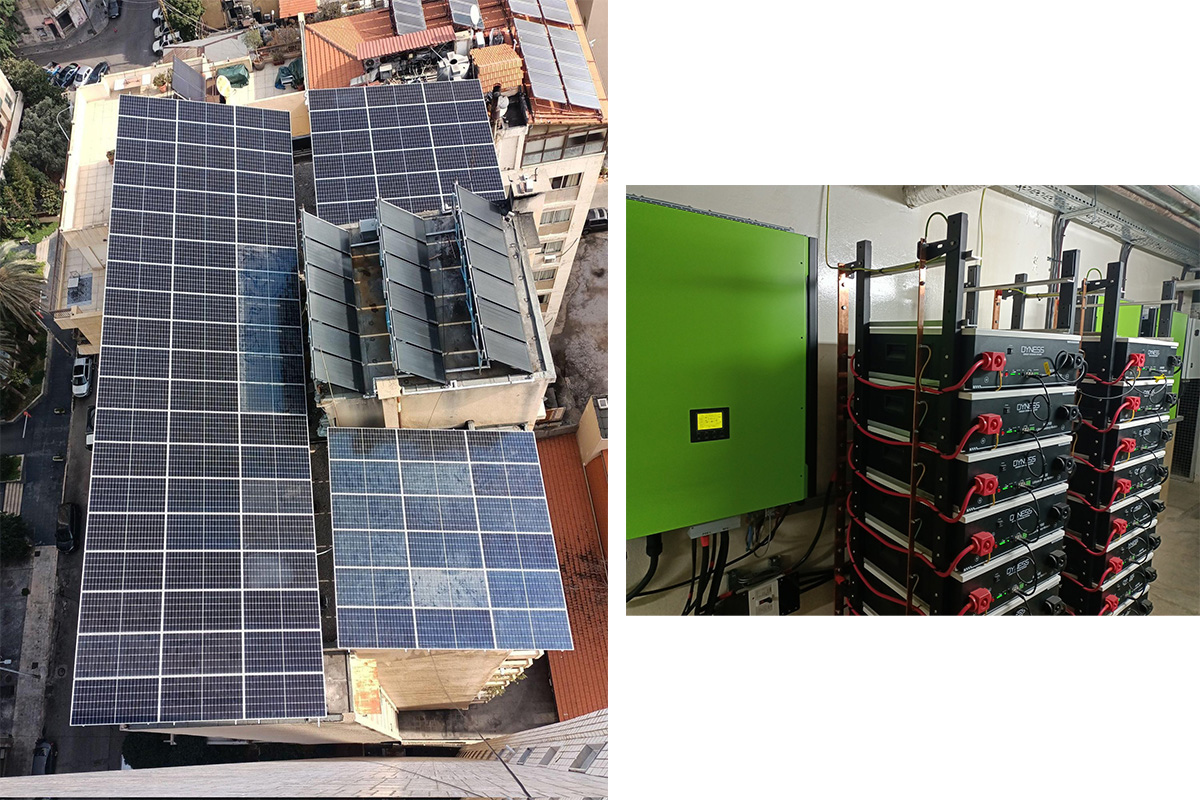
The system, installed at the end of 2022, has a capacity of 56 kilowatts on the roof of the building, 45-kilowatt hybrid inverters, and a battery with a capacity of 100 kilowatt-hours, capable of providing some off-grid power after sunset. The diesel generators continue to be used occasionally at night, for thirty minutes to an hour, to recharge the batteries when they fall below a certain charge level. The system benefits from a dual-flow meter with net-metering: the connection with EDL allows the batteries to be recharged at night, if necessary (and provided that EDL’s grid is on), instead of using generators, or to feed in surplus electricity not consumed from the solar panels during the day. Although the EDL grid’s current dysfunction means that only very limited amounts of solar-generated electricity are actually fed back into the grid, this system could become much more viable with a more stable grid. Heating in winter is provided by heat pumps, and cooling in summer by air conditioning. Although this heating and cooling can sometimes push beyond the solar system’s limits and require the use of a diesel-powered backup generator, this does not happen often.14
A key factor in the proper functioning of the system is that each dwelling has been equipped with an individual meter, allowing the amount of energy consumed by each household to be monitored. Individual metering encourages families to optimize their consumption: any excess consumption requiring the use of the generator would then be charged to that family specifically. As Boustany explained on his X account: “After deduction of common area consumption, solar energy is equally divided among tenants free of charge. The diesel cost is charged on the extra consumption for all tenants who consumed more than what was provided by the sun.”15 To reduce their consumption, he said that he encouraged his neighbors to replace energy-intensive household appliances, especially older air conditioners and refrigerators.16
In total, the generator now only runs for 800 hours per year, compared to 12,000 hours per year before the change. The building’s costs, particularly fuel, have fallen from $45,000 per year to $10,000 per year, representing a total annual saving of $35,000. Spread across eleven households, this represents an average saving of $3,180 per year per household. Since each household paid $7,200 to install the system, the investment will be paid off in less than three years. If this sum had instead been invested individually by each household in an uncoordinated way—as the residents of Rola’s building did for their solar—each household would have been able to buy a system of less than 4 kilowatts, which would have been insufficient to supply its needs. The shared investment allows for the pooling of both the roof and the batteries and common equipment. This approach has produced substantial savings, estimated by Boustany to be about 25 percent, not including the costs associated with the elevator and heat pumps. The distribution of power across the entire building is key, as the varying tempos and patterns of each household’s electricity consumption allow most of the solar energy produced to be used and not wasted.17
Too Little, Too Late?
As successful as Boustany’s experiment seems to have been, there are reasons that replicating it elsewhere might not be easy.
Boustany had to work to convince the building’s tenants to adopt the new system. He made significant personal investments, installing a 24-kilowatt solar test system at his own expense in order to assess its feasibility.
Despite the financial and environmental benefits of this system, it took work to convince the building’s tenants to adopt it. Its implementation required significant personal investment on the part of Boustany, who carried out full-scale tests by installing a 24-kilowatt solar test system at his own expense in order to assess its feasibility, given the shadow cast by a neighboring building. It should also be noted that Boustany had previous experience, extensive expertise, and relationships with installers that enabled him to carry out the tests: he devoted both time and money to the project, though he was able to recoup his investment later. His willingness to make this investment and his track record of managing the building’s generator subscriptions had also already earned him the trust of his neighbors. And even with this trust, it took time to win the co-residents’ agreement to the project.18
Trust, expertise, and the ability to invest in the system as well as in the replacement of domestic equipment are essential conditions that may not be found everywhere, especially in an economic and social context marked by crisis and emigration. Additionally, there is a lack of trust in private installers, who are often inexperienced and profit-hungry. Boustany attempted to encourage his neighbors in other buildings to replicate his initiative by inviting them to visit and explaining this collective achievement to them. But even his acquaintances met his pitch with doubt.19
For all these reasons, it might not be possible to easily recreate Boustany’s system everywhere, particularly in buildings with renters or where access to capital and the ability and willingness to invest vary greatly, or where there is a deficit in trust between neighbors on issues relating to the management of elevators, lighting in common areas, cleaning, parking spaces, and other shared issues. In buildings with more apartments and denser occupancy, demand for electricity may also require installing more capacity than the roof allows for. Another issue is that installers do not have the time, the desire, or even the incentive to promote this type of project—which requires a greater investment of time on their part—only to ultimately sell fewer systems. Five years after the height of Lebanon’s crisis, most households that were able to install solar systems have, and the rest remain too poor to do so. Imports of solar panels, batteries, and inverters plateaued in 2023 and 2024.20
Paths Forward
There is, however, an opportunity to adopt aspects of Boustany’s system in buildings where investments have been made but significant repairs and modifications are needed—such as replacing lead batteries with lithium batteries. In such cases, the Lebanese government and development organizations could use subsidies to encourage pooling, changing not only the batteries but also the inverters needed to make net-metering possible.
Promoting these systems would involve identifying experiments similar to the one described here, and commissioning energy audit companies to carry out studies comparing technical options and their costs. The results would then be publicized, along with tutorials or practical guides explaining best practices, while these financial incentive systems are put in place.
The inclusiveness of systems like the one described in this report should not be overstated. Even if their cost is lower than that of the ordinary solar systems in Lebanon, the required investments will remain inaccessible to large segments of society for financial and material reasons, including limited roof space, but also because of status: tenants are structurally excluded from these mechanisms. In some cases, however, it may be possible to facilitate access for tenants. In the medium-term rental segment, particularly for higher-income expatriates, landlords may have an interest in investing in shared systems at the building level, offering access to electricity at a unit price corresponding to the cost of the system’s depreciation. Another mechanism to enable tenants to benefit from such systems would be to encourage tenant–landlord agreements, guaranteeing tenants who invest in a shared system the right to sell it back to their landlord at a guaranteed cost when they move out. One market-based version of this system would be so-called energy performance contracts, under which private companies rent the roof, install a solar system, and sell the electricity to the residents, repaying their investment in a few years. Such contracts exist in the United States, Switzerland, and Germany, and more generally in the EU.21 Public or aid-based international funding could ease access to money for such initiatives, though this approach would risk excluding households unable to afford the cost of electricity under such an arrangement.22
Another option would be to institutionalize the cooperative model23 and apply it to buildings. Energy cooperatives are autonomous associations of persons who voluntarily cooperate to deliver community needs, in this case energy supply. During the past twenty years, Germany, Austria, and the UK experienced a strong development of such initiatives. For instance, in 2009, 23 percent of newly founded cooperatives in Germany were in the energy sector, mostly for wind farms, bioenergy, and photovoltaic farms.24 Cooperatives’ goal is to disentangle access to solar energy from property ownership and make room for equal access for tenants and disadvantaged households. Such schemes, however, usually require upfront investments in the form of bonds that might prove difficult to collect in the current Lebanese context. Funding should be at least partly be provided by international aid organizations or the diaspora.
Limits and Levers
The model of shared solar systems at the building level is often touted for its democratic and ecological virtues. In several countries, these initiatives are called energy cooperatives, emphasizing their democratic and socially inclusive character. In the EU, they are also referred to as energy communities, which can be organized at neighborhood or village level and therefore extend beyond single apartment buildings.25
But the example described in this report should not be understood as a democratic experiment. It is, rather, an instance of a club of privileged people cooperating in their own well-understood interests. In Lebanon, in contrast to the European energy cooperatives, individual buildings are the default because of the dysfunction of the grid. Thus, the case study presented in this report is not socially inclusive, either.
That does not mean that individual buildings organizing have no positive social impacts. There are undeniable environmental benefits—but these benefits are limited by the scale of the project.
Because of the strong entrenchment in Lebanon of individualistic practices of dealing with solar energy, and the high cost of retrofitting, it is too late for large-scale deployment of such systems. There are, however, levers for configuring and integrating existing individual systems in many buildings in Lebanon, in particular by taking advantage of the necessary reinvestments for component changes—notably, batteries—and to lay the groundwork for more widespread net-metering once the national grid recovers. Achieving this will require promoting the benefits of these systems, disseminating best practices, offering financial incentive mechanisms, encouraging inclusive governance of building committees, listening to owners’ expectations, and striving to find solutions for tenants so they can participate in and benefit from these initiatives. The role of the government and its specialized agencies (the Electricity Regulatory Authority and the Lebanese Center for Energy Conservation) is to promote these projects by highlighting their benefits and to create the legal architecture necessary for their implementation. Aid organizations, for their part, should provide the financial leverage needed to encourage new investment or the reconfiguration of existing systems.
This report is part of “Networks of Power,” a project led by Century International fellow Zachary Cuyler, which aims to map Lebanon’s evolving energy sector and assess the prospects for energy justice.
Header Image: A neighborhood in Beirut as seen from the headquarters building of Electricité du Liban (EDL) on April 28, 2022. Source: Marwan Tahtah/Getty images)
Notes
- “Rola” is a friend of the author, who has chosen not to use her real name because the conversation from which this information was drawn was not originally part of research for the report.
- See Eric Tohme and Nisreen Salti, “Loss of Photovoltaic Infrastructure from Israel’s War on Lebanon from 2023 Onward,” The Policy Initiative, 2026, https://api.thepolicyinitiative.org/content/uploads/files//Eng_Report_Nisreen_Feb2026.pdf.
- See Éric Verdeil, “Beirut, Metropolis of Darkness and the Politics of Urban Electricity Grids,” In Geographies of the Electric City, edited by Andrés Luque-Ayala et Jonathan Silver (Oxfordshire: Routledge, 2016): 155–75, https://halshs.archives-ouvertes.fr/halshs-00858126.
- See Eric Verdeil, Note on the spatial distribution of PV systems in Lebanon and inequalities in access (2018–2023), unpublished analysis, 2026; platform can be accessed here: https://www.facebook.com/CNRSLebanon/posts/pfbid0QJdeUTmGv4hsV9KdG6tMDJFQmH6iibABmPbfCYMVqRKDEJJQxkQrDFfXbzpzpSogl.
- “2020 Solar PV Status Report,” 2022, Lebanese Center for Energy Conservation, https://mail.lcec.org.lb/sites/default/files/2022-08/2020%20Solar%20PV%20Status%20Report%20-%20Final.pdf.
- Julia Choucair Vizoso and Yara El Murr, “Privatizing the Sun: The Dark Side of Lebanon’s ‘Solar Revolution,’ The Public Source, October 11, 2022, https://thepublicsource.org/lebanon-solar-privatization.
- “Provision of Services for the Assessment of E-Waste and Batteries in Lebanon,” Ministry of Environment/United Nations Development Programme, 2024, https://www.undp.org/sites/g/files/zskgke326/files/2024-07/tadwir_e-waste_report_10.07.2024_1.pdf.
- Alix Chaplain and Eric Verdeil, “Regulating a Pluralistic and Decarbonized Electricity Supply through Public Service Principles of Equity and Solidarity,” Arab Reform Initiative, October 2025, https://www.arab-reform.net/publication/regulating-a-pluralistic-and-decarbonized-electricity-supply-through-public-service-principles-of-equity-and-solidarity/.
- Nizar Hariri et al., “Étude transversale des précarités au Liban (1922–23),” IFPO, 2024, unpublished.
- See Zachary Cuyler and Marc Ayoub, “The Future of Lebanon’s Unlikely Solar Revolution,” The Century Foundation, https://tcf.org/content/commentary/the-future-of-lebanons-unlikely-solar-revolution/.
- Christina Abi Haidar, “Laws Governing Electricity Production, Transmission, and Distribution, and the Importance of the Distributed Renewable Energy Law,” Arab Reform Initiative, November 20, 2024, https://www.arab-reform.net/publication/laws-governing-electricity-production-transmission-and-distribution-and-the-importance-of-the-distributed-renewable-energy-law/?tztc=1.
- Camillo Stubenberg, “Solar Killed Dirty Energy in Rural Lebanon. Here’s What Other Countries Can Learn.,” The Century Foundation, March 9, 2026, https://tcf.org/content/report/solar-killed-dirty-energy-in-rural-lebanon-heres-what-other-countries-can-learn/.
- Joseph El Assad, “Elements of Micro-Grids in Lebanon. Success Stories, Benefits, Opportunities and Challenges,” presentation at Lebanon Grand Energy Event (Beirut), September 2025, available at https://www.dropbox.com/scl/fo/vyoca9vpgfjvf97s7b1e3/AL4gfLrTGB7WIUW7rgUFY-8/Session%201A?rlkey=bovguyaqzbfza0pycagu6mb7b&subfolder_nav_tracking=1&st=2d0ewcns&dl=0.
- Interview with Ziad Boustany, Beirut, March 22, 2024.
- Ziad Emile Boustany (@ziadb64), post on Twitter (now X), January 28, 2023, https://x.com/ziadb64/status/1619382514631725057.
- Interview with Ziad Boustany, Beirut, March 22, 2024.
- Interview with Ziad Boustany, Beirut, March 22, 2024.
- Interview with Ziad Boustany, Beirut, March 22, 2024.
- Interview with Ziad Boustany, Beirut, March 22, 2024.
- See Eric Tohme and Nisreen Salti, Loss of Photovoltaic Infrastructure from Israel’s War on Lebanon from 2023 Onward, The Policy Initiative, 2026, https://api.thepolicyinitiative.org/content/uploads/files//Eng_Report_Nisreen_Feb2026.pdf.
- See “Energy Savings Performance Contracts,” U.S. Department of Energy, https://www.energy.gov/cmei/buildings/energy-savings-performance-contracts; and Sergi Moles-Grueso,, Paolo Bertoldi, and Benigna Boza-Kiss, “Energy Performance Contracting in the EU 2020–2021,” Publications Office of the European Union, 2023, https://data.europa.eu/doi/10.2760/751957.
- See a similar proposal in Yasmina El Amine, “Pathways for Energy Justice in Lebanon’s Post-War Reconstruction,” Arab Reform Initiative, October 17, 2025, https://www.arab-reform.net/publication/pathways-for-energy-justice-in-lebanons-post-war-reconstruction/.
-
Rani Al Achkar, “The Business Model for Solar Cooperatives: From Single Beneficiary to Public Benefits,” presentation at The Lebanon Grand Energy Event, September 26, 2025,
https://www.dropbox.com/scl/fo/vyoca9vpgfjvf97s7b1e3/APuVo88YKDLcByos9vJ5IJ4/Session%2011A/3-Solar%20Cooperatives%20-%20Rani%20Ashkar.pdf?rlkey=bovguyaqzbfza0pycagu6mb7b&e=2&dl=0.
- Benjamin Schmid et al., “Energy Cooperatives and Municipalities in Local Energy Governance Arrangements in Switzerland and Germany,” Journal of Environment & Development 29, no. 1 (2020): 123–46. https://doi.org/10.1177/1070496519886013.
- “Energy Communities,” European Commission, https://energy.ec.europa.eu/topics/markets-and-consumers/energy-consumers-and-prosumers/energy-communities_en.