Download the Beyond the Axis PDF.
You can explore the report’s findings and data using this interactive storymap.
Overview: Hubs, Spokes, and Worldwide Webs
In February 2026, the United States and Israel launched a war on Iran that they hoped would once and for all break the back of the Islamic Republic and its so-called Axis of Resistance. Operation Epic Fury took long-standing policy assumptions to an extreme: that by hitting the right leaders, weapons facilities, and supply lines, an outside actor could induce catastrophic failure across the Iranian regime and its web of Middle Eastern allies.
But the two powers were using tactics from the age of the telephone exchange against an adversary built for the internet era. Over the past quarter century, two parallel transformations—one in how Iran and its allies build military capability, the other in how the global economy moves goods, money, and information—have rewired both the Axis and international commerce from hub-and-spoke networks with identifiable choke points into complex, adaptive ecosystems with no clear points of failure.
This report uses a unique research strategy, combining historical survey, deep field research, open-source investigations, and data analysis, to describe and explain these twin transformations in unprecedented detail. Its findings help explain why Iran and the Axis have proven so resilient in the face of U.S. and Israeli attempts to crush them: the Axis represents a new kind of dispersed, self-reproducing power—which this report calls an ecosystem—that is a distinct feature of a highly globalized, interconnected world in the midst of a messy power transition to multipolarity. The Axis of Resistance is likely not a one-off but rather a new type of challenge that will shape conflict and politics in the second quarter of the twenty-first century.
The through line is drones, or unmanned aerial vehicles (UAVs). One of the 2026 war’s defining images was of Iran’s screeching Shahed-136 drones plowing into luxury Gulf real estate, critical infrastructure, and American military bases, with billion-dollar U.S. missile defense systems struggling to keep up with an onslaught of these UAVs, which cost a few tens of thousands of dollars to make. The Shahed-136 and earlier Iranian-made one-way attack drones like it tell an important story of how the two transformations have changed the face of modern warfare and blunted the military tactics and policy tools of the late twentieth and early twenty-first centuries. Since the early 2000s, Iran’s Islamic Revolutionary Guards Corps (IRGC) and Hezbollah have developed a model for cultivating and building the capabilities of nonstate allies. Groups are courted, trained, armed, and eventually taught to build their own weapons from commercially available components—most notably, one-way attack drones. Each rung of this “capability ladder” that a group climbs both builds them up and binds them to Iran and one another through shared training, battlefield experience, and knowledge.
At a certain stage—what this report calls a capability tipping point—a small number of these groups cross a threshold. Internal knowledge, networks, and supply-chain access fuse into systems that produce capabilities far beyond those of their insurgent antecedents and make the groups in question much harder to uproot. As more groups have crossed this threshold, the Axis itself has been transformed, from a centrally managed network running through a hub in Tehran, into something more like a self-perpetuating ecosystem.
Power within the ecosystem is unevenly distributed and is constantly shifting. Iran is still its most powerful and consequential node, but the relationship between Tehran and the Axis is one of mutual interdependence. Capabilities, data, and strategic needs flow in multiple directions. As the wars of 2023–26 have shown, the ecosystem can sustain damage to individual nodes and supply routes without collapsing. Even as the Axis came under unprecedented stress, its supply chains rerouted to account for the collapse of the regime of Bashar al-Assad in Syria, and Yemen’s Houthis even expanded into Africa through outreach to a portfolio of different regional actors, enticing potential partners with training on how to use and build UAVs.
The Axis’s transformation would not have been possible without tectonic shifts in the inner workings of the global economy. In the past, state and nonstate groups relied on either powerful state patrons or arms dealers to source Western technology in limited volumes. Now, they can buy almost unlimited amounts of engines for the Shahed-136, for example, directly from Chinese manufacturers. “Smuggling” no longer adequately captures the process by which these goods are transported to their end-users. Illicit and dual-use items intermingle with licit global trade and move through commercial channels too dense and fast-moving to meaningfully police. When one route is disrupted, the supply chain reroutes to another, more or less automatically.
At the same time, new technologies and surging global trade volumes have made it easier to evade Western scrutiny and sanctions. Most of the goods Iran and the Axis need can now be sourced in Asia rather than the United States or Europe and can be transported to their end-users while avoiding Western regulatory reach. Iran and its allies have become proficient at masking the contents and locations of ships and containers, and at setting up, shutting down, and re-forming shell companies faster than Western law enforcement agencies can identify them. The outgrowth of transshipment hubs whose economic models prioritize ease of doing business over sanctions enforcement has helped, too.
The report unpacks these transformations in four parts. It begins with a short introduction to the Axis and Iran’s drone program, then details the capability ladder that Axis groups climb, the global supply-chain shifts that make the model durable, and the expansion of the ecosystem beyond the Axis’s assumed ideological and geographic bounds.
The report argues that policy responses to the proliferation of UAV technology, and to the densely interconnected groups of actors like the Axis who are among its most avid adopters, must be rewired for an age of ecosystems. This means moving away from the critical-node domino theory that defined Operation Epic Fury and toward an approach that maps ecosystems rather than their constituent parts, matches responses to group capabilities, and uses multilateral action to make it harder for armed actors everywhere to build weapons from off-the-shelf components.
Such adaptations will necessitate an honest debate about the limits of what policy can do and the price that states are willing to pay to achieve their objectives. It may be possible to prevent some groups from moving too far up the capability ladder and to constrain some Axis groups. But doing so may involve providing political space for politically unsavory groups; building armed counter-networks that are likely to take on lives of their own; or finding ways to pressure repressive states to improve political and economic conditions in marginalized areas.
The report is the capstone for “Beyond the Axis,” a Century International project supported by the Cross-Border Conflict Evidence, Policy and Trends (XCEPT) research program, funded by UK International Development. Its claims are substantiated by two years of fieldwork, open-source investigations, and data analysis by a multidisciplinary research team. It draws on more than 250 key-informant interviews with officials, Axis group members, businesspeople, and analysts across the Middle East and the Horn of Africa. The report also makes use of purpose-built databases of arms interdictions, drone proliferation, sanctions, and training events; vessel-tracking using automatic identification system (AIS) data and satellite imagery; and hundreds of documentary sources in English, Arabic, Farsi, and Hebrew. This approach allows the researchers to overcome the limits to access that are an inherent challenge to the study of closed regimes and clandestine groups, and to triangulate evidence for key claims. Unless explicitly stated, all data and visualizations in the report were produced for this project.
Iran, the Axis of Resistance, and Its UAVs
In November 2004, a Mirsad-1 unmanned aerial vehicle (UAV) crossed the Lebanon–Israel border on a short surveillance mission.1 By piloting the UAV into Israeli airspace, Lebanon’s Hezbollah became the first nonstate group known to have used a drone for military purposes. A few months later, in April 2005, Israeli forces spotted a second Hezbollah drone, setting off alarm bells in Tel Aviv and Washington.
At a meeting with American embassy staff in Beirut two weeks later, a Lebanese businessman, Qassim Daoud, provided U.S. officials with some of the first details of Hezbollah’s fledgling drone program.2 The Lebanese group, he said, had been given three Iranian-made Ababil-T drones by Iran’s Islamic Revolutionary Guards Corps (IRGC), which they had renamed Mirsad-1. The first crashed after its inaugural flight into Israeli airspace. A second suffered mechanical problems, and needed to be repaired by an Iranian technician, as Hezbollah lacked the know-how to fix it. Only the unit spotted by the Israelis two weeks earlier remained usable.3
The Mirsad-1 flight was a small but important sign that the groups now known as the Axis of Resistance were undergoing a radical change.
The Mirsad-1 flight was a small but important sign that the groups now known as the Axis of Resistance were undergoing a radical shift. At the end of the 1990s, they had been a handful of relatively small, geographically and politically isolated insurgencies that employed the rudimentary twentieth-century technology and tactics of their armed group peers. They were almost entirely reliant on Iran for material and military support. Hezbollah, the most advanced of the Axis groups in 2004, could strike targets tens of kilometers away, at most. But all of that was about to change.
At the time of the Mirsad-1’s maiden journey, for example, Yemen’s Houthis were a small insurgent group battling the Yemeni government with AK-47s and rocket-propelled grenades.4 By 2024, they had emerged as a key player in the Axis, launching more than a thousand drones and missiles at military and commercial shipping in the Red Sea and at targets in Israel up to 2,600 kilometers from Yemen’s borders.5 And the Houthis knew how to fix their own drones—they didn’t have to wait for Iranian tech support.
A substantial body of literature considers why Iran built up the Axis, first to export its revolution and later as part of a strategy of “forward defense.”6 But how did certain Axis groups achieve the military capabilities they did when others did not? State support is only part of the answer. Many nonstate actors receive outside help but do not develop in the way Hamas, Hezbollah, the Houthis, and some Iraqi groups have. This report attempts to answer these questions by following one specific type of transfer: the ability to build and deploy longer-range drones, starting with the Mirsad-1. To ground the report’s analysis, this section provides essential background on the Axis of Resistance, and on Iran’s drone proliferation program.
The Axis of Resistance
Iranian support for nonstate actors has passed through several distinct phases. In the Islamic Republic’s early years, there was no Axis, and Iranian support concentrated around Hezbollah, formed by the IRGC from peripheral Shia Lebanese groups after the 1982 Israeli invasion of southern Lebanon.7 Later, Iran fostered armed groups from Iraqi Shia factions driven into Iranian exile by Saddam Hussein, and supported two Sunni Palestinian armed groups, Hamas and Palestinian Islamic Jihad.8
During the second phase, from the 2003 U.S. invasion of Iraq to roughly 2015, Tehran established the Axis brand name and adopted a doctrine of “forward defense,” building regional allies as a deterrent to U.S. invasion of Iran. (The name is a jab at George W. Bush’s coinage of the term “Axis of Evil” in 2002.) The IRGC’s external Quds Force was mobilized to recruit new members and upskill its existing networks.9
These early years marked a significant turnaround in the fortunes of the Axis. With IRGC and Hezbollah support, Iranian-backed factions embedded themselves in the post-Saddam Hussein politics of Iraq, battling U.S. occupation forces and other Iraqi rivals.10 Hezbollah matured into one of the world’s most capable nonstate military forces, fighting Israel to a standstill in their 2006 war.11 In 2007, Hamas and Palestinian Islamic Jihad won a civil war in Gaza, becoming the enclave’s de facto government and attracting deeper support from Tehran.12 And then, between 2011 and 2014, Yemen’s Houthi movement seized control first of its home governorate of Saada and then the capital, Sana’a.13
The third phase, starting with the civil wars that consumed the Middle East from the early 2010s onward, saw group capabilities improve and connectivity between groups deepen amid wars in Iraq, against the Islamic State; in Yemen, against Saudi- and Emirati-backed forces; and in Syria, where multiple Axis groups gathered to try to salvage the Assad regime.14
The fourth and most recent phase, beginning with Hamas’s October 7, 2023, assault on Israel, has been a period of significant retrenchment. An Israeli onslaught decimated Hamas and leveled Gaza, killed much of Hezbollah’s senior leadership, and shattered Iranian air defenses. Then, in December 2024, former Sunni jihadists in Syria (of the non-Axis variety) toppled the Assad regime, severing a critical logistical corridor. And finally, in February 2026, the United States and Israel launched a major new war on Iran, killing the Islamic Republic’s supreme leader, Ali Khamenei, and plunging the Middle East into region-wide conflict.15
UAVs, Iran, and the Axis
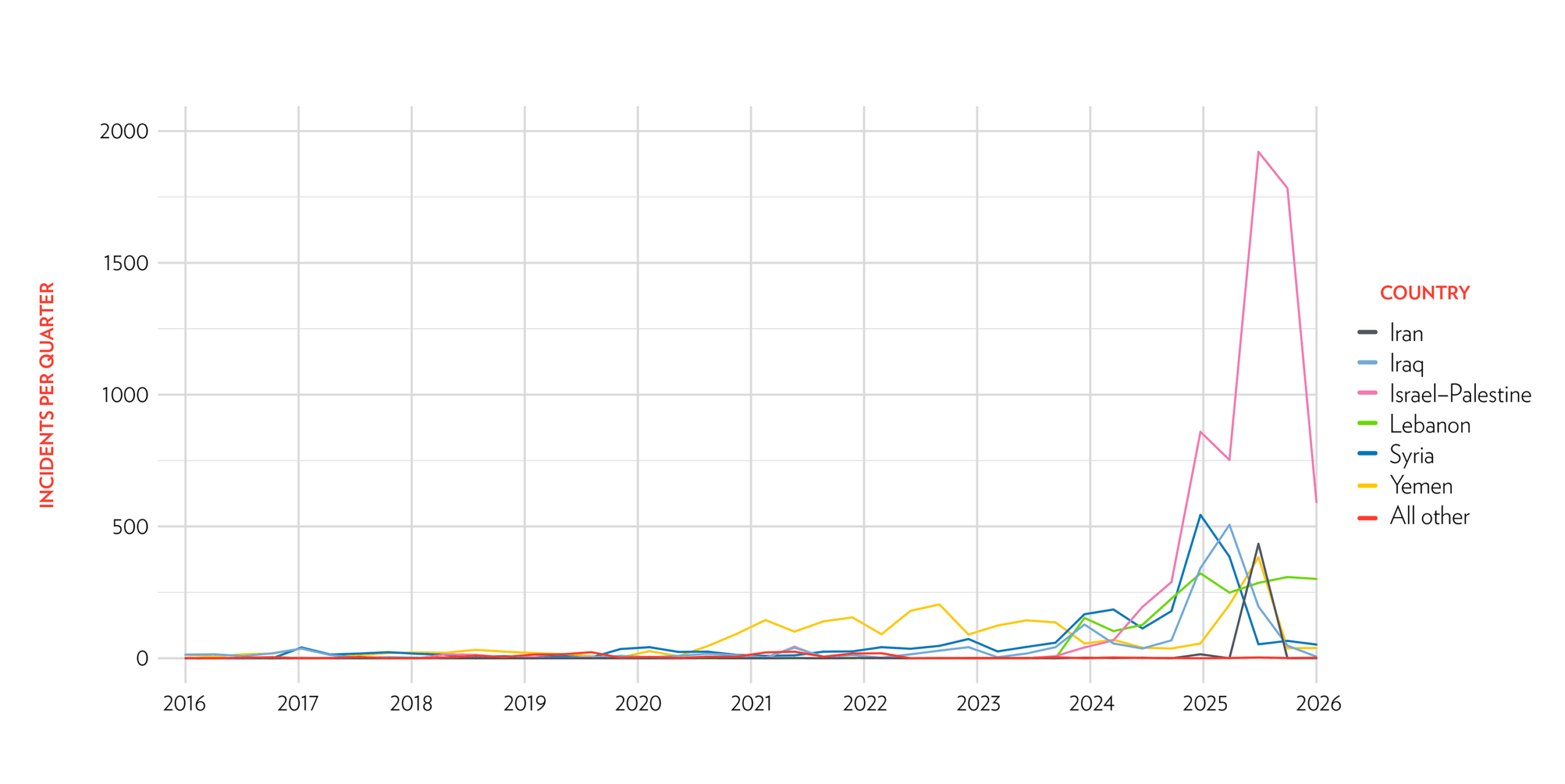
In a vanishingly short period of time, low-cost drones have leveled the playing field in conflicts between rich state actors and either poorer, less-developed ones or nonstate armed groups. They have provided a sudden, decisive edge in some conflicts and pushed others into grinding, attritional stalemates. And they have done so at an astonishing speed. Drone-related conflict incidents rose from 140 in 2016 to more than 58,000 in 2025, a 41,000 percent increase, according to the Armed Conflict Location and Event Data project (ACLED; see Figure 1).16
FIGURE 1
UAVs perform three functions that were once the preserve of powerful states, at radically lower costs than in the past. Surveillance drones that can cost as little as a few hundred dollars provide a bird’s-eye view of the battlefield that previously could only be obtained from reconnaissance aircraft or satellites. One-way attack UAVs deliver precision strikes tens, hundreds, and even thousands of kilometers away that cost tens of thousands of dollars rather than the hundreds of thousands or millions that advanced missiles cost. Medium-altitude, long-endurance systems carry missiles and continuously track targets, performing functions that previously required attack helicopters or fighter aircraft, each of which costs tens or even hundreds of millions of dollars to manufacture.
Low-cost drones have leveled the playing field in conflicts between rich states, poor states, and nonstate armed groups.
Iran was an early adopter of drones, and its UAVs have played an important role in changing the face of modern conflict. The Islamic Republic’s drone program, which started in the mid-1980s, is the product of adaptation to circumstance. Over the course of the 1980–88 war with Iraq, the Iranian Air Force and Navy were decimated. After the war, Iran developed a new defense doctrine that focused on lower-cost, asymmetric capabilities. Missiles and UAVs became a focus.17
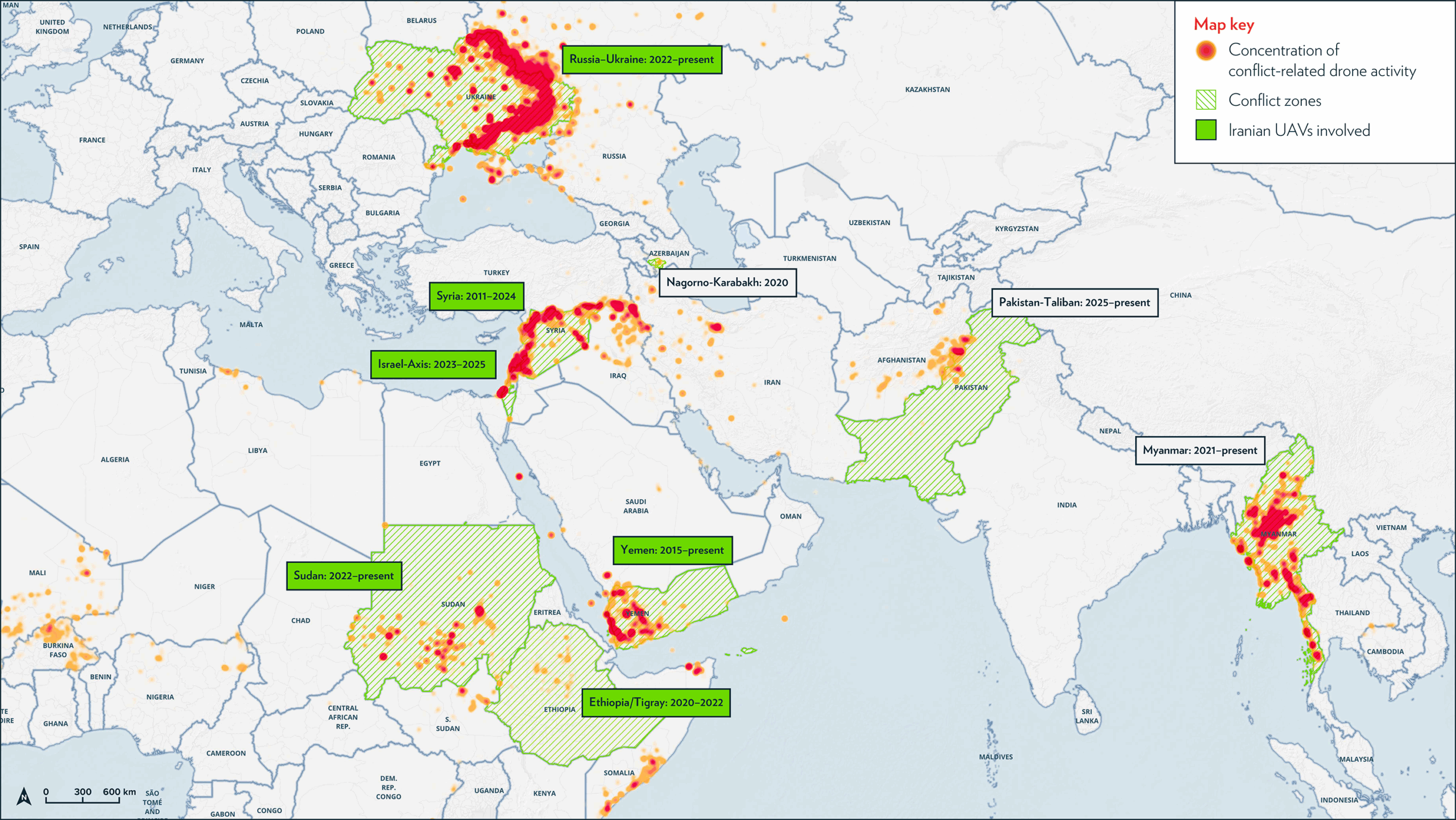
Since the turn of the millennium, Tehran has been notable not only for developing UAVs for its own use but also for pursuing two tracks of UAV proliferation. Iran has sold finished systems and manufacturing blueprints to allied states like Russia, Sudan, and Venezuela. And it has transferred both complete systems and the knowledge needed to build them to nonstate partners like Hezbollah, Hamas, and the Houthis.18 As a result, Iranian drones have played an important role in many recent UAV-heavy wars (see Figure 2).
FIGURE 2
The history of the Iranian UAV development program is long and complicated, with an ever-expanding list of names, designs, and component types. But Iranian drone proliferation is simpler and helps tell a story about how and why Iran has made some of the choices it has. Iran mainly proliferates seven advanced drone systems to state and nonstate actors: three medium-altitude, long-endurance (MALE) systems; and four one-way-attack systems of varying range and complexity, designed to act as a cheap alternative to precision-guided missiles.19
Of these systems, the one-way attack drones are the most important. MALE systems are hard to make and complicated to use in ways that one-way attack drones are not. State and nonstate actors increasingly use off-the-shelf quadcopters as first-person-view drones for battlefield surveillance and precision attacks over shorter ranges.20 One-way attack drones, by contrast, fly over much longer distances and can be used to saturate sophisticated air defenses, imposing significant costs on adversaries who are forced to use missile interceptors worth millions to ward off drones costing thousands or tens of thousands of dollars. And enough one-way attack drones slip through the cracks of air defenses to inflict serious military and economic damage, as evidenced by the destruction waged by Russia on Ukraine and by Iran on its Gulf neighbors.
Iran’s proliferation effort has converged around four one-way attack UAV systems, three of which are widely transferred to Axis groups (see Figure 3). The Ababil series—the basis of Hezbollah’s original Mirsad-1, the latest version of which is known in Iran as the Ababil-T—was the Axis’s workhorse for years. Simple enough to produce locally from commercial components but able to strike targets up to 200 kilometers away, it provided proof of concept for one-way attack at a time when Iran was still experimenting with multiple different UAV types. The longer-range Sammad series extended the range of attacks and has been used prolifically by the Houthis to strike Saudi Arabia and Israel up to 2,600 kilometers from Yemen, and reportedly by Iraqi groups against U.S. bases.
FIGURE 3
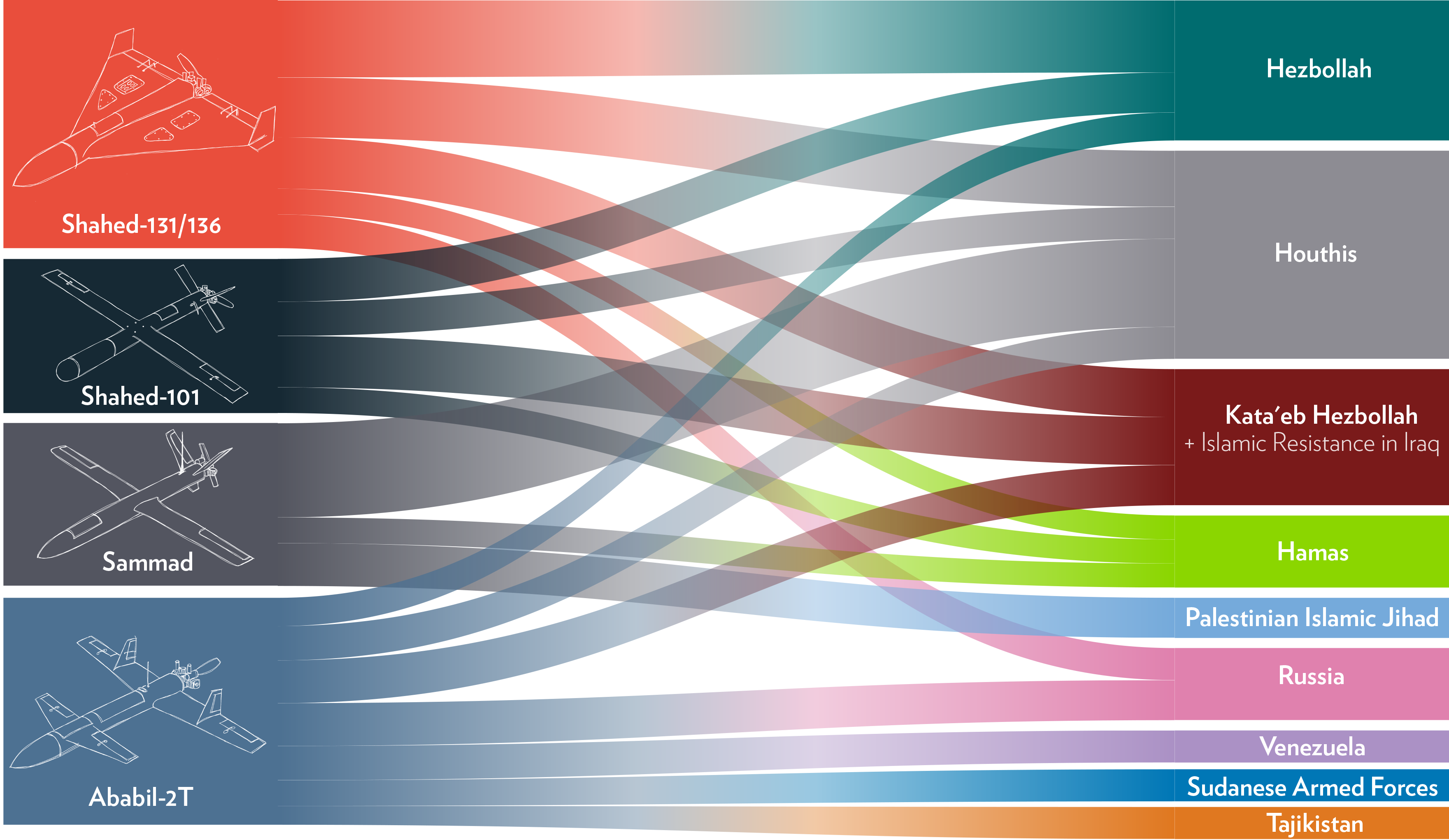
More recently, the Shahed-101—similar in size to the Ababil-T but with a longer range—was first used by Iran and Iraqi Islamic Resistance groups (who designate it the Murad-5) to strike Gulf and Israeli targets during the regional conflicts of 2023–26. It is also reportedly in the hands of the Houthis and Hezbollah and has been used by Russia in Ukraine.21
Then there is the Shahed-136, and its smaller sibling the Shahed-131. The Shahed-136 is mainly used by Iran and Russia, although the Houthis claim to have used it before any other group.22 (The Shahed-136 was first documented in Houthi hands in January 2021, though there is no conclusive evidence the group has in fact used it.)23 Iran initially denied knowledge of the Shahed-136, a fiction that more or less held until Russia started buying the drones from Tehran in 2022.24 Hezbollah, the Houthis, and Iraqi groups working under the banner of the Islamic Resistance in Iraq are all reported but have not been definitively proven to have used either the Shahed-131 or the Shahed-136, which are more complicated to assemble or build than the other drones that they do use.25
“The AK-47 of the Skies”
Iran’s one-way attack drones are by no means the most sophisticated of weapons. But they are fit-for-purpose, in the same way that an AK-47 is the better choice for an armed group like Hezbollah or the Houthis than more sophisticated but pricier models.26 Axis groups could use more accurate, pricier rifles, but the AK-47 is cheap, robust, and accurate enough for most of the tasks an insurgent group needs a rifle for. They can also be produced or assembled at scale, to arm tens or even hundreds of thousands of fighters, from imported parts. (The Houthis appear to be trying to do this with the AK-103, which is even easier to assemble.) From a cost-benefit perspective, the AK-47 is a better weapon than more sophisticated options. Similarly, the Ababil-T and Shahed-136 look rudimentary—even quaint—compared with top-of-the-line American drones. But swarms of these UAVs are almost guaranteed to damage their targets, at a fraction of the cost of a Reaper.
Iran has strong incentives to continue proliferating its one-way attack UAVs—sometimes described as the “AK-47 of the skies”—to state and nonstate actors.27 The drones have low-cost, long-range strike capabilities that impose an incredible cost asymmetry, allowing Iran and its allies to push their regional and international rivals—the United States and Israel, in particular—into grinding and unpopular wars of attrition. Proliferation has also helped Iran hone its drone doctrine. Every conflict in which an Axis group or state actor like Iran has deployed Iranian-designed UAVs has generated performance data against the defense systems Iran itself now faces, from Hezbollah attacks skirting Israeli air defenses to Russia’s Shahed-136 campaigns against Western-made systems in Ukraine.
There is no greater proof of the program’s success than the fact that the United States is now fielding its own expendable one-way attack drones.
There is no greater proof of the program’s success than the fact that the United States is now fielding its own expendable one-way attack drones, the Low-Cost Uncrewed Combat Attack System (LUCAS), modeled on captured Shahed-136s.28 The world’s most powerful military—America’s—is copying Iranian technology field-tested by Russia in Ukraine.29
Drones also serve as a kind of “isotope tracer” for mapping the evolution of the Axis of Resistance. In medicine, the earth sciences, and industrial engineering, radioactive isotopes that can be detected using sensors are introduced into a body, geological system, or complex pipe networks. Following the isotope reveals the structures and flows of the systems it passes through. Drones similarly act as tracers that tell researchers who has designed, built, and supplied weapons to a particular group. For example, a group found to be in possession of stocks of the Ababil-T can be determined with some certainty to have, at the minimum, some kind of contact with Axis networks, if not full interdependency. Tracking drone proliferation across the Axis and over time reveals constantly shifting inner workings: the channels through which people, materiel, and knowledge move, and the emerging channels that might otherwise go unnoticed.
From Cultivation to Expansion: The Path to Capability Breakout
In 2006, around the time that Hezbollah started using weaponized versions of the Mirsad-1 to attack Israel, a veteran Hezbollah operative, Ali Musa Daqduq, traveled to Iraq to train Iran-backed militias in the basics of insurgent tactics: how to build bombs, evade capture, and organize simple military and cell structures.30 This was the incipient Axis, steeped in the guerilla tactics of the late twentieth century.
When Daqduq arrived in Iraq, Axis groups were almost entirely unsuited to the task of building advanced weapons systems and procuring the parts needed to build them. But by 2023, Palestine’s Hamas, Lebanon’s Hezbollah, Yemen’s Houthis and, to a degree, Iran-aligned Iraqi groups each acted like and held the armaments of conventional armed and security forces, and directly and indirectly governed territory where tens of millions of people lived.
This twenty-year arc, from insurgent tactics to advanced drones, is the story of the Axis of Resistance writ large. A close read of this period, starting in the early years of the U.S. occupation of Iraq, shows two patterns. First, Axis groups progress through an observable sequence that this project calls the “capability ladder.” Peripheral actors and second-tier and down-on-their-luck would-be elites are courted, trained, and provided with increasingly advanced weapons, and eventually taught to build their own, using commercially sourced components from supply chains they build themselves. In very few cases, they leverage these capabilities to directly cultivate new allies. And second, the groups that have achieved this kind of capability breakout have fundamentally rewired their own internal structures and the Axis of Resistance into ecosystems that make them more powerful and resilient than their insurgent ancestors.
FIGURE 4
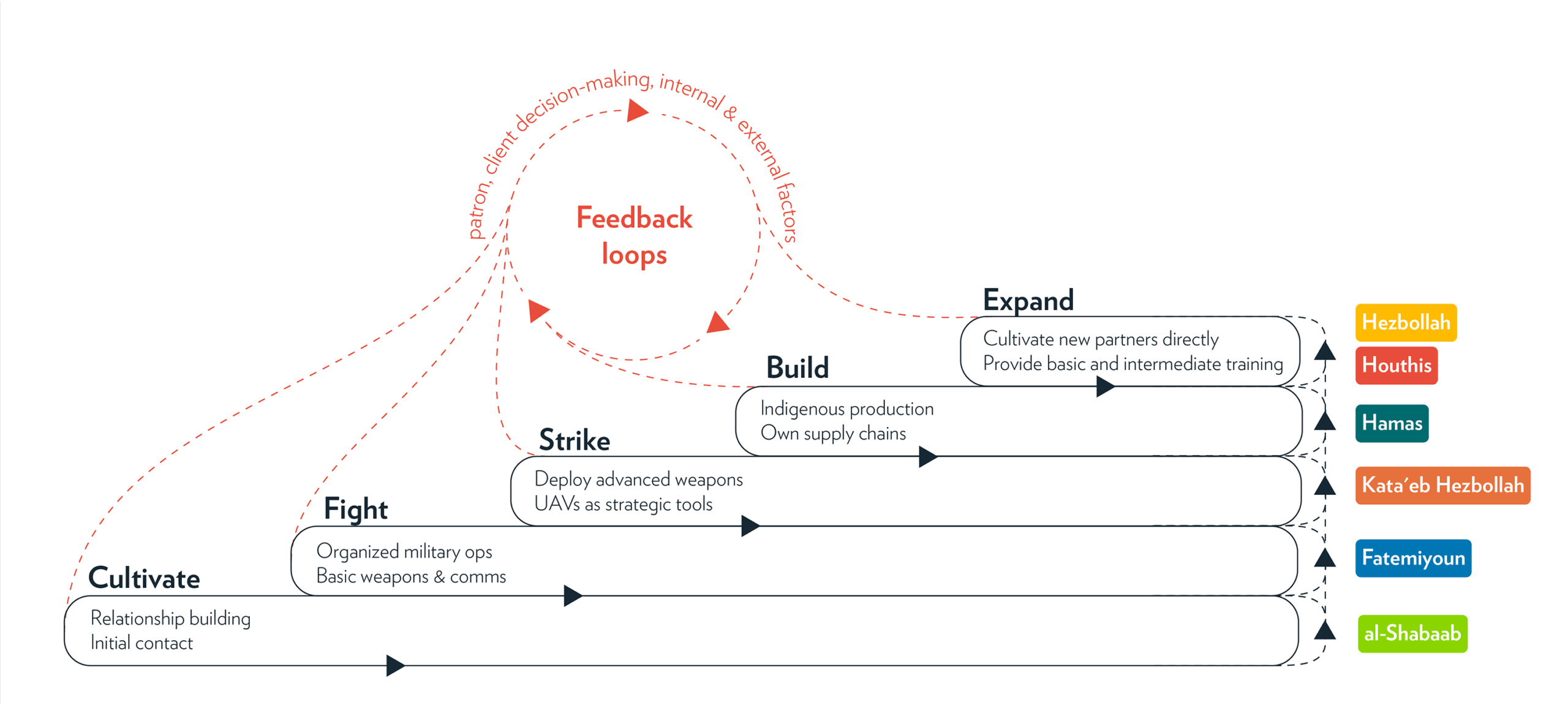
This section traces the evolving capabilities of Hamas, Hezbollah, the Houthis, and Iraqi groups, including Kata’eb Hezbollah; along with the Afghan Fatemiyoun Brigades and other groups that did not achieve full capability breakout. It maps the sequence in which groups acquire different capabilities and the factors that determine whether they advance or stall. It argues that, after a moment of capability breakout when groups can build their own one-way attack UAVs from components sourced from indigenously run supply chains, it becomes infinitely more difficult to degrade and destroy them.
Stage 1: Cultivate
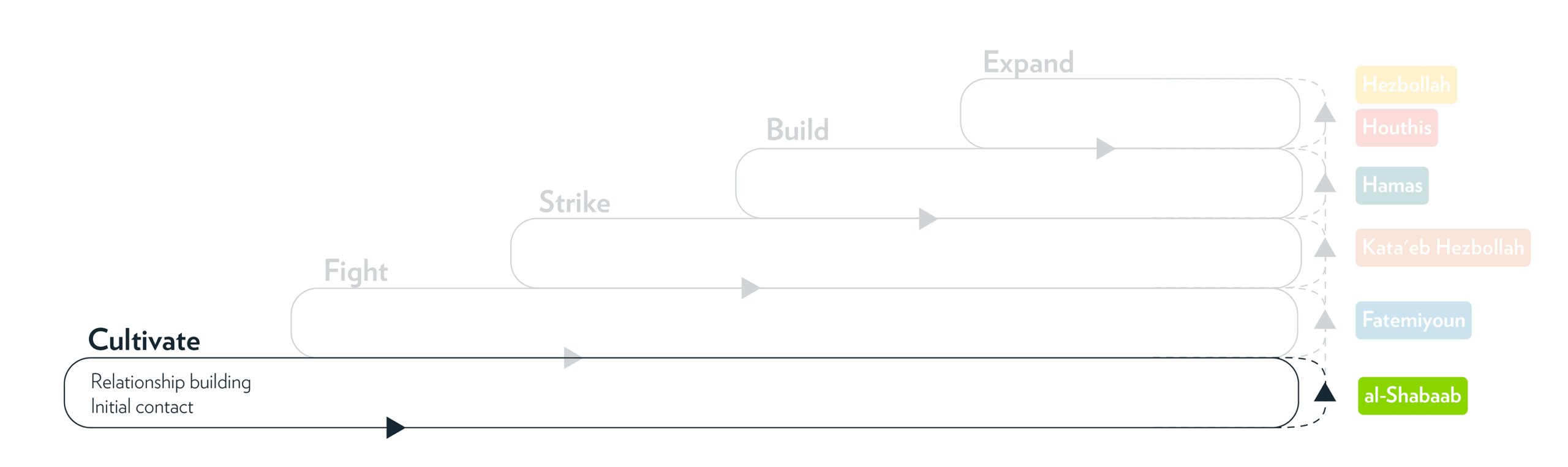
Every Axis relationship begins with a period of cultivation during which the IRGC or an established Axis group builds a broad portfolio of relationships in a target country. The approach resembles that of venture capital: a series of small investments, made on the basis that the few bets that pay off will more than outweigh the cost of those that fail.
Targeted groups and individuals tend to share a common profile. They are not necessarily the weakest or most marginalized actors in their societies, but they perceive themselves to be oppressed and foster lofty ambitions toward revolution and power. They also broadly align with a “resistance” mindset of anti-imperialism, opposition to Zionism, and broad commitment to Islamic governance. Not all of the groups Iran cultivates are Shia, and fewer still subscribe to the wilayat al-faqih (“guardianship of the jurist”) model that governs the Islamic Republic. But virtually all share the broader project of expelling U.S. and Israeli influence from their region and replacing it with an Islamic political order.
From the start, the aim is to foster interdependence. In the early stages of the relationship, Iran or an Axis group provides arms, basic training, money, and political backing. In doing so, it creates a relationship that becomes more difficult to exit the further up the capability ladder a group progresses. The IRGC itself was assembled this way after the 1979 Islamic Revolution. Formed from a constellation of smaller Iranian armed factions, the IRGC rose to power in lockstep with the Islamic Republic’s second supreme leader, Ayatollah Ali Khamenei, who promoted loyalist commanders within the IRGC to build his own power base, and then provided the corps with the financial resources it needed to become a power center in its own right.31
Later, when the IRGC entered Lebanon during the Israeli occupation of 1982–2000, Amal, the main Shia faction, was already a client of neighboring Syria.32 Rather than attempting to peel Amal away from Syria, IRGC operatives focused instead on recruiting Amal splinter factions and other less prominent Shia groups and individuals to form the spine of a new movement, which later became Hezbollah.33 Hezbollah, in turn, applied a similar method to its own internal expansion, targeting a mix of social groups, religious leaders, political actors, and politically homeless young men for recruitment and alliance building. In the Baalbek-Hermel region, for example, Amal had already become an important player by building close ties with existing clan authority structures, an established core of Shia families with standing and property who could mobilize fighters and resources relatively easily. The IRGC and Hezbollah, by contrast, targeted clan branches with less prestige, and young men without property or status, in the same areas.34
As they gained status through Hezbollah patronage, peripheral recruits would come to act as bridges to central clan figures and power centers.
As they gained status through Hezbollah patronage, these peripheral recruits would come to act as bridges to central clan figures and power centers in their own right, allowing the party to gradually embed itself and build influence from within clans and other power structures, and creating growing interdependencies with Hezbollah and Iran. As later sections of this report will show by focusing on the example of the Amhaz of Baalbek, members of hitherto second-rung clans would come to play an important role in Hezbollah in the coming decades; and would become important players in Lebanese politics and society.35
While the cultivation process often appears targeted with the benefit of hindsight, it usually involves a more speculative approach, spreading bets across potential partners before homing in on those with the greatest potential. Iraq and Yemen demonstrate the logic of this portfolio approach. In Yemen, the IRGC cultivated a broad web of relationships with politicians, businessmen, and southern separatists before eventually committing to the Houthis.36 It was only when the Houthis demonstrated their value and potential—after Saudi Arabia backed the Yemeni government against the Houthis in 2009–10 and the group seized control of their home governorate of Saada during the Arab Spring uprisings of 2011—that Tehran began to significantly invest in the Houthis.37 Iranian support surged after the Houthis seized control of Sana’a, the Yemeni capital, in September 2014, with Tehran abandoning its support of many other groups.38
Iran meanwhile hosted thousands of Iraqi Shia exiles after they were forced out of the country from the late 1970s on. Tehran concentrated its cultivation efforts around the ideologically aligned Supreme Council for Islamic Revolution in Iraq and its armed wing, the Badr Brigade. But after the U.S. invasion in 2003, Iran provided training for a wider range of Iraqi Shia armed groups, including those associated with the cleric Muqtada al-Sadr. Iranian influence over this portfolio of actors would wax and wane after 2003. Some of these trainees remained closely aligned with Iran, while others, including Sadr, split or sought greater autonomy. The IRGC itself may have encouraged splintering to prevent one actor from becoming too powerful and resistant to its influence.39
One bet paid off: Jamal Jafaar Mohammed Ali Al Ibrahim—better known by his nom de guerre, Abu Mahdi al-Muhandis—a former Badr commander, formed a new armed group that came to be known as Kata’eb Hezbollah. Abu Mahdi led it until his death, alongside Quds Force commander Qassem Soleimani in a January 2020 U.S. drone strike. Kata’eb Hezbollah is now both a key formation within the Popular Mobilization Units (a state-sanctioned umbrella organization of mostly Shia paramilitary factions formed in 2014 to fight the Islamic State and since absorbed into Iraq’s official security) and a leading player in the Islamic Resistance in Iraq, the grouping of Iran-aligned Iraqi armed groups most closely aligned with Tehran.40
Elsewhere, Iran has been willing to engage with groups whose ideology does not align with its own. Until the Iran–Iraq War, Tehran enjoyed a close relationship with the secular Palestine Liberation Organization (PLO). But the PLO leader Yasser Arafat sided with Iraq during its 1980s war with Iran and signed the Oslo Accords in 1993, recognizing the Israeli state against Iran’s wishes.41 Hamas and Palestinian Islamic Jihad, young Sunni Islamist groups that had rejected Oslo, were searching for a patron. In December 1992, Israeli authorities deported 415 Hamas and Palestinian Islamic Jihad activists to southern Lebanon, placing a Palestinian militant leadership cadre into sustained proximity with Hezbollah for over a year.42 Iran has since maintained Hamas and Palestinian Islamic Jihad as distinct entities with separate commands and funding streams, hedging its bets and demonstrating its willingness to work with strategically useful groups whose ideology overlaps but does not entirely align with its own.
As this report discusses in more detail below, the cultivation process continues to this day. The Houthis have begun to build a new portfolio of relationships in Africa, most importantly with al-Shabaab in Somalia, whom they have begun to provide with basic training.
Stage 2: Fight
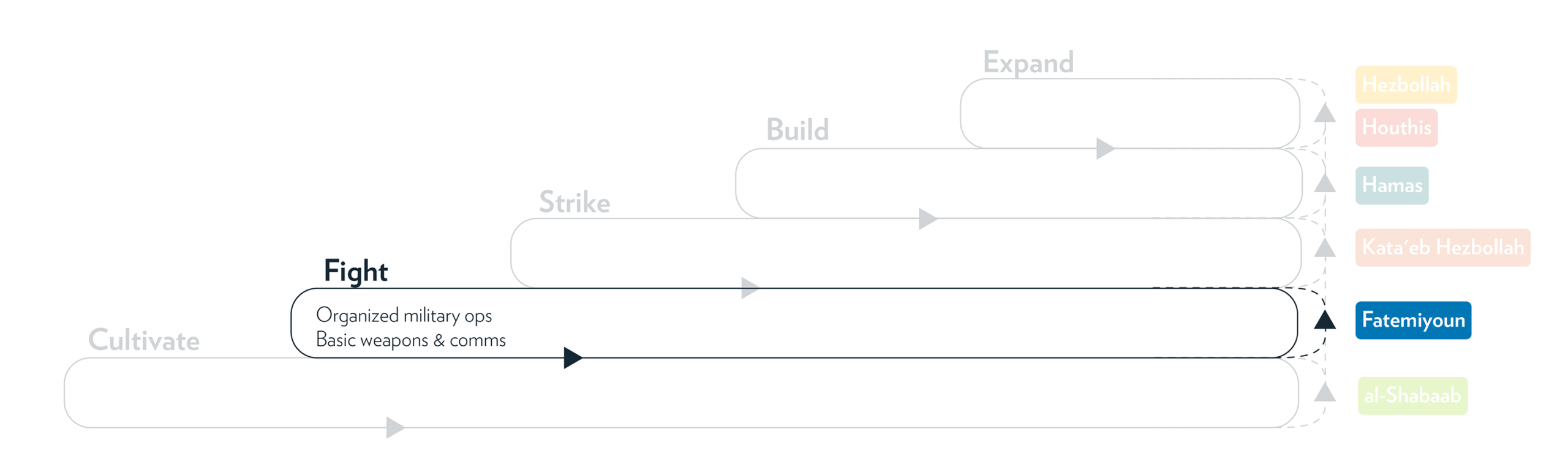
At some point in the cultivation process, the IRGC decides that a particular group is worth providing with military training. This is the “Fight” stage of the capability ladder. In recent years, the IRGC, along with select Axis allies, has expanded the scale of these trainings. Between 2012 and 2015, Hezbollah’s external training entity, Unit 3800, formed to oversee training of the kind Daqduq provided in Iraq, expanded its remit to cover Syria and Yemen, as armed conflicts involving Iran’s allies broke out in those countries.43 By the mid-2010s, training had also evolved into a graduated process designed to produce skilled fighters and technicians rather than just insurgent guerillas.
The IRGC has refined its training courses over time. Basic training now includes the use of first-person-view drones for surveillance, while new specialized courses on a variety of weapons systems and tactics have been added for graduates of this first course.44 At the same time, the IRGC and Hezbollah have built a cadre of advisers who can deploy to the field to work alongside their partners, often closely collaborating with senior leaders of Axis groups over a number of years.45
Training also acts as a sorting mechanism. Hezbollah and the IRGC eventually encourage groups to send promising recruits abroad—primarily to Lebanon and Iran—for higher education, teaching them advanced military doctrine and the technical skills needed, for example, to build drones. Along with the advisers they embed alongside groups in their home countries, this method allows IRGC and Hezbollah trainers to screen for particularly capable candidates who are a good ideological fit for the Axis.
A common and sometimes perplexing feature of training abroad is the requirement to attend ideological courses promoting the Islamic Republic’s broad anti-imperialist ideology, and principle of wilayat al-faqih (a key component of Khomeinism that fuses republican politics and Twelver Shiism and is used to justify the power of the supreme leader) and the Islamic Republic’s broader worldview.46 These courses rarely lead to conversions, because many Axis groups, even those that are Shia, do not subscribe to wilayat al-faqih. The training in Iran’s ideology appears to have less to do with proselytizing broadly than with identifying leaders who can be brought into closer alignment with the IRGC. Yemeni observers of the Houthi movement believe that some Houthi commanders have developed a particularly close relationship with their Hezbollah and IRGC peers and handlers, who in turn have encouraged their additional training and promotion within the movement, creating additional bridgeheads within the Houthi leadership structure.47
Integrating Networks
The training process is also a test of a group’s ability to integrate loose social networks into more effective and capable, systematized structures. Explosively formed penetrators (EFPs), a type of improvised explosive device, are an important early benchmark for this process. EFPs are roadside bombs set off by remote control or motion detector and designed to penetrate armored vehicles. EFPs were first used by Hezbollah against Israeli forces in the early 2000s and later transferred to Iraqi groups. The Houthis started using them in Yemen in the mid-2010s.48
The training in Iran’s ideology appears to have less to do with proselytizing than with identifying leaders who can be brought into closer alignment with the IRGC.
A group’s possession and use of EFPs are important markers of progress up the capability ladder, because they point to a subtle but important shift in the way that the IRGC equips its allies. In 2008, the director of a major U.S. effort to counter improvised explosive devices publicly acknowledged that the majority of EFPs found in Iraq were locally built rather than Iranian-made, as they had been during earlier periods of the U.S. occupation.49 Iraqi groups’ move toward building rather than just importing EFPs marked a significant change in the way those groups organized and recruited from local networks. Manufacturing EFPs is as much a procurement and engineering challenge as a military one.50 It requires engineers and machinists, materials sourced through commercial channels, and the ability to maintain operational security across a mixed military-civilian network.51 A group that can produce EFPs has proven it can physically build not just bombs but also networks beyond its natural recruitment base. It has built the network reach and the supply chain infrastructure that the next stage of investment requires.
Stuck at “Fight”
Not all groups that receive training advance, and many remain stuck at the Fight stage. Iraq’s Kata’eb Hezbollah absorbed IRGC training, built discipline, and advanced rapidly to become a trusted IRGC ally, and was provided with advanced weapons systems (see below). But other Iraqi factions did not develop, or in many cases shifted away from Iran. They were not provided with arms or training beyond insurgent tactics. In Yemen, southern secessionists who worked with Iran between 2011 and 2014 claim they received only limited military support once it became clear that they lacked broad ideological alignment with Iran.52 When, in 2014, the Houthis began their march from northern Yemen toward Sana’a in the south, Iran encouraged its southerner clients to work with the Houthis and let them operate in the south.53 Instead, the southern groups split from the IRGC and fought against the Houthis when they moved south of the Yemeni capital in 2015.54
In some cases, the IRGC deliberately holds groups at this relatively early stage of development. For example, since the early days of the Islamic Republic, the IRGC has recruited fighters from Shia populations in neighboring Afghanistan and Pakistan. In 2013 and 2014, the IRGC formalized these forces into the Afghan Fatemiyoun Division and Pakistani Zainabiyoun Brigade, and sent them to fight in Syria.55 Their fighters received basic combat training and were deployed to dangerous fronts where the Axis needed manpower.56 Fatemiyoun fighters trained at the same Syrian sites as Hezbollah, Iraqi, and Houthi cohorts (discussed in more detail below).57 But neither the Fatemiyoun nor the Zainabiyoun were provided the opportunity to build indigenous management structures, to receive advanced weapons instruction, or to develop the pathway toward indigenous production that characterizes groups Iran views as worth developing. The case of these Pakistani and Afghan groups is a reminder that the capability ladder is a trajectory reserved for the few, and that the sorting mechanism of training is designed to identify which recruits are worthy to ascend. It also illustrates the IRGC’s willingness to exploit its allies to serve its own purposes, particularly when they lack a domestic power base or alternative patron.
Stage 3: Strike
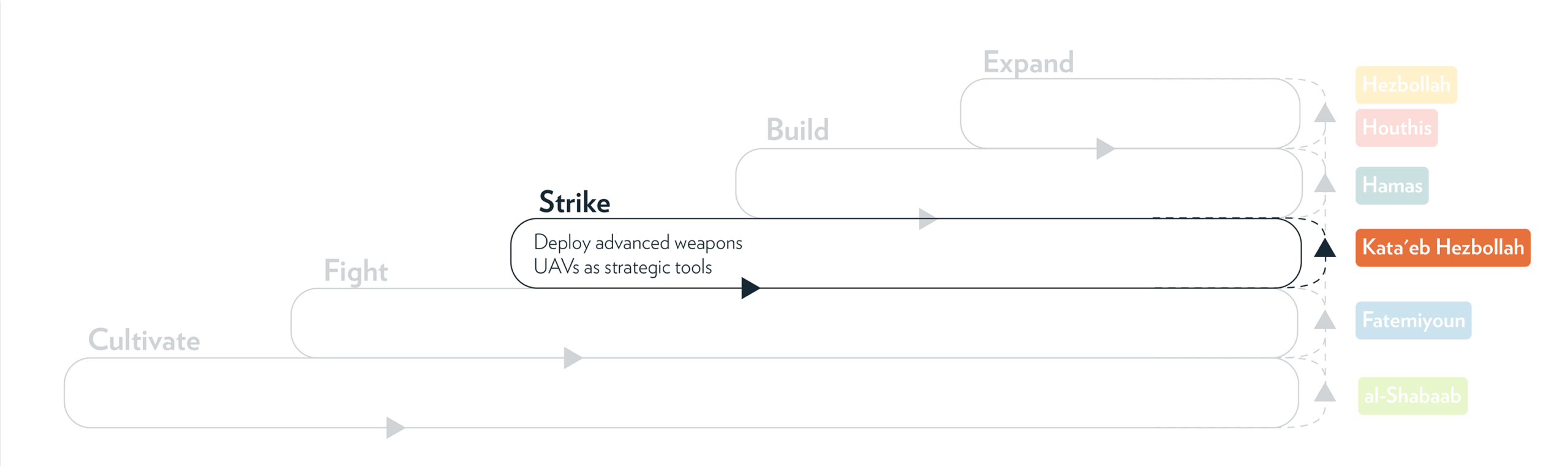
Groups that have demonstrated military effectiveness, technical capacity, sufficient political alignment, and network integration capacity, and that have secured enough territory to receive, store, and operate advanced weapons systems become eligible for access to Iranian-made and -designed strategic weapons.
In this “Strike” phase, Iran and its Axis partners provide their new allies with weapons capable of attacking targets at distance, including one-way attack drones, rockets, anti-ship missiles, and, in some cases, ballistic missiles capable of striking targets hundreds of kilometers away. These transfers matter because an armed group that can threaten military headquarters, energy infrastructure, or neighboring states from a safe distance is no longer an insurgency but a strategic actor that is closing the military gap with more powerful adversaries. Most importantly, this is the point at which groups transition from using off-the-shelf drones for surveillance to being provided with distinctive, Iranian-designed one-way attack drones, which have, in recent years, become the most commonly proliferated “Strike” weapon among Axis groups, likely due to their portability and low cost of production.
These arms transfers also deepen the relationship between Iran, the Axis, and the group receiving them in subtle but important ways. Leaders travel abroad for longer and more specialized training, while IRGC and other Axis advisers embed in-country to oversee operations.
Hezbollah
Hezbollah has historically received the broadest and most sophisticated arsenal of any Axis partner, because it serves the most demanding strategic function as Iran’s primary forward deterrent against Israel. Iran began transferring Katyusha rockets to Hezbollah in the early 1990s. By 2006, the group held an estimated 7,000–8,000 rockets, an arsenal that placed northern Israel under sustained fire for thirty-four days during that year’s war and demonstrated what a nonstate actor with strategic rocket depth could impose on a major military power.58 By the early 2020s, Hezbollah’s arsenal had expanded to an estimated 130,000–200,000 rockets and missiles, including cruise and anti-ship missiles, and a UAV fleet—mainly comprising Ababil-T and Shahed-101 units—that conducted approximately 1,500 drone attacks in the 2023–25 regional war.59
The Houthis
The Houthis graduated to the Strike phase faster than any previous Axis group, largely because of their unique circumstances. In September 2014, the Houthis seized Sana’a and attempted a slow-burning coup, deposing the government in January 2015. In seizing Sana’a and control of the central government, they also acquired a large arsenal of rockets and missiles, and many of the military personnel trained to use them. That March, Saudi Arabia launched a blistering aerial campaign in response.60 Before Saudi Arabia managed to cut off Houthi ports and airports, however, Iran reportedly shipped a large volume of strategic weapons into Yemen by air and sea cargo.61
Over the course of the war, the Houthis deployed a growing arsenal of advanced weapons, starting with existing stocks of aging missiles, before transitioning to Iranian-made ballistic missiles from 2016 onward. From 2017, the Houthis began using their Ababil-derivative Qasef-2K series to target Saudi Arabia’s Patriot missile defense systems around Saudi bases in Yemen. Then, the Houthis transitioned to using the Sammad system to launch longer-range attacks. By 2024, the group was targeting commercial and U.S. naval vessels with anti-ship ballistic missiles, cruise missiles, and drones, and Israel with a range of missiles and drones.62 The Houthis now possess an arsenal comparable to Hezbollah’s, if not wider ranging. While Hezbollah has long been reported to possess anti-ship and cruise missiles, for example, the Houthis have used both systems widely.63
Hamas
Hamas received a more limited arsenal from Iran, due to geographic constraints and a multiyear break in relations with Tehran in the early 2010s. Moving arms into blockaded Gaza is a different logistical challenge from supplying Hezbollah in Lebanon or the Houthis in Yemen. At the same time, Hamas does not need long-range weapons to threaten Israel. Around 2001, the group was building simple Qassam-1 rockets from pipe and fertilizer with a range of four to eight kilometers.64 Iran smuggled variants of its unguided Fajr-series rockets to Hamas in the 2000s before the group started building its own longer-range version around 2012.65 This rocket, which Hamas has designated the M-75, again marked a transition point from receiving complete weapons to manufacturing them from imported components and raw materials that allowed the group to scale.66 Hamas’s Shehab UAV, a shrunken Ababil-series UAV derivative, was similarly adapted for the Gazan context.67 It is smaller and shorter-range, designed to match the constraints of a besieged territory and the proximity of Hamas’s adversary.
Kata’eb Hezbollah and the Islamic Resistance in Iraq
Iran invested in a wide range of Iraqi military groups in the 2000s and played a critical role in the formation of the Popular Mobilization Units.68 But only groups with the closest alignment to Iran, today working under the umbrella of the Islamic Resistance in Iraq, have received advanced medium- and long-range weapons systems.
Iran’s strategy of providing advanced weapons only to the most closely aligned groups became most evident during the regional conflicts of 2023–26, when different Islamic Resistance in Iraq groups and their alleged front groups claimed missile and drone strikes on U.S. bases in Iraq and Syria, and attacks on Israel. The same Iraqi groups have also launched hundreds of drone strikes on Israeli and Gulf infrastructure—primarily using the new Shahed-101 drones—during the war against Iran that Israel and the United States started in February 2026.69
In the same way that the Fatemiyoun are stuck at Fight, the Islamic Resistance in Iraq groups appear to be stuck at the Strike phase, likely because of their unique relationship with and physical proximity to Iran. Kata’eb Hezbollah is sometimes described as an IRGC surrogate in Iraq rather than a standalone Axis member.70 It arguably functions less as an autonomous strategic actor than as an IRGC-monitored auxiliary, closer to a directly controlled wing of the corps than a true Axis partner. Its proximity to Iran also matters, because Iran can easily smuggle arms directly across the border, negating the need for indigenous manufacture.
Stage 4: Build
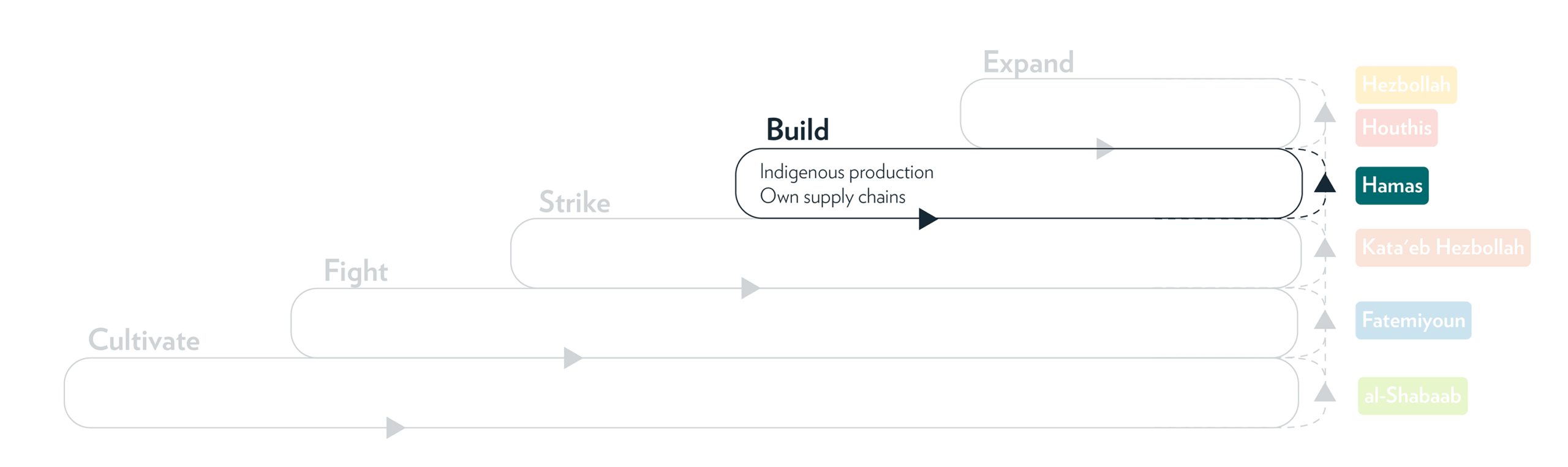
As armed groups scale, become more strategically important, and engage in sustained armed conflict, their needs increase and they become more heavily scrutinized and policed. This is particularly the case for Axis groups that, like Iran, are heavily sanctioned and closely monitored by Western countries. Over time, these constraints have forced the IRGC and the Axis to use military-industrial knowledge to pioneer a new model of arms proliferation, substituting knowledge and network expansion for direct transfers. This is the “Build” stage of the capability ladder.
Around 2007, both Hezbollah and Hamas needed to rearm after their respective conflicts with Israel and other Palestinian factions. At the same time, Iraq was descending into a sectarian civil war, and the United States was more closely patrolling the Iran–Iraq border.71 Hezbollah controlled much of southern Lebanon and Hamas controlled territory in Gaza; both groups acted like states but had powerful enemies and were subject to intensifying efforts to cut their supply lines. Gaza was blockaded by Israel, and the United States and other Western states stepped up efforts to prevent arms supplies reaching Hezbollah from Iran, leading to a series of maritime interdictions of arms destined for the group. The groups needed weapons faster than Iran could deliver them directly, and through channels that could survive sustained interdiction pressure.
Iran’s response to blockades was to transition further toward the model of portable knowledge that began with the experiment with explosively formed penetrators in Lebanon and Iraq.
Iran’s response was to transition further toward the model of portable knowledge that began with the EFP experiment in Lebanon and Iraq. Once it became clear that finished weapons transfers into Gaza were being systematically intercepted, for example, Iran instituted monthslong courses for Hamas engineers with physics and chemistry backgrounds, focused on creating homemade weapon systems.72 Graduates returned to Gaza with blueprints, engineering expertise, and the understanding of how to source components and raw materials through commercial channels.73
Hezbollah’s transition was more institutionalized and more consequential. From its earliest days, Hezbollah had pioneered the use of EFPs and already had embedded engineering and procurement capacity. Then, the post-2006 period produced a dedicated aerial warfare capability. Unit 127, Hezbollah’s aerial operations unit, which flew the Mirsad-1 into Israel, traces its origins to the early 2000s, when the group began building a drone program under IRGC guidance.74 By 2014, the unit had established a dedicated UAV base at Baalbek.75 And by September 2014, it was conducting its own armed drone strikes in Syria, later dropping Chinese-made cluster submunitions on Nusra Front positions.76 By the early 2020s, Hezbollah was estimated to hold more than 2,000 drones, many of them built domestically.77
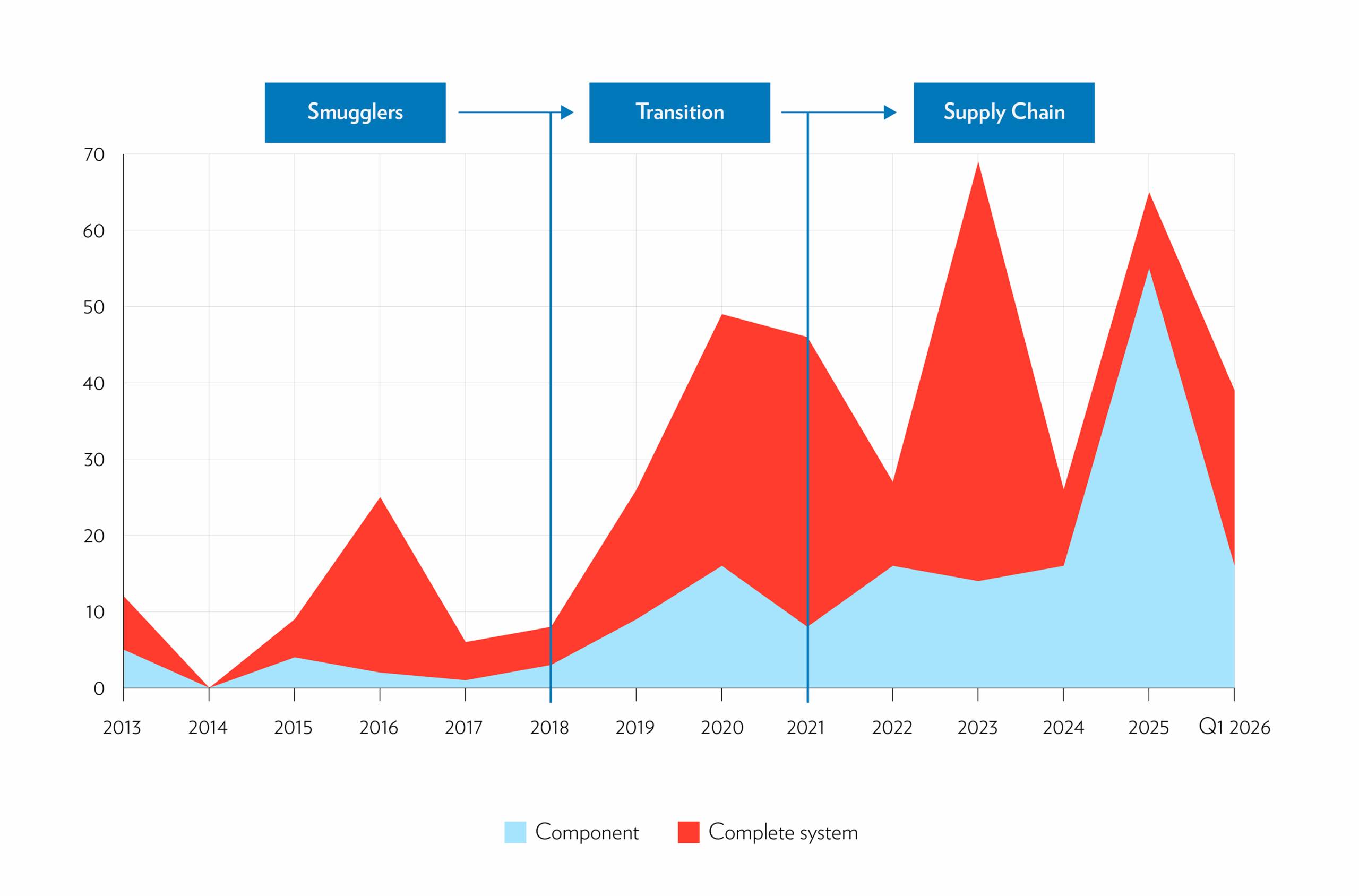
Yemen provides quantitative evidence for the Houthis’ shift to the Build stage. Data from interdictions of cargo bound for the Houthis compiled for an earlier report as part of this project show a measurable change in goods being interdicted en route to the Houthis between 2015 and 2025 (Figure 5, below). In the first year of the Yemen war, Iranian-origin complete weapons systems accounted for 37.5 percent of items intercepted by local, regional, and international forces. By 2024, that figure had fallen to less than 14 percent.78 The bulk of what interdictions stopped that year comprised components like engines, guidance electronics, composite materials, detonators, and raw materials—such as chemicals used to make explosives—being transported to Yemen via a web of licit and commercial logistical channels that were orders of magnitude harder to police than dedicated arms transfers.79
FIGURE 5
The Capability Tipping Point
Groups that have reached the Build stage have undergone an important structural transformation. An ideological core of people can start an organization and learn to fight, but its skillset will be limited to the small social network it emerged from. To grow, groups must expand their network reach, working with people who do not fully share their goals, recruiting first from closely trusted circles (family, people with shared identity, those with common enemies), and then expanding outward to incorporate transactional relationships with smugglers, diaspora traders, engineers, and other technical experts.
By the Build stage, that expansion has produced something new: not a loosely joined-up collection of networks, but a system that has internalized the ability to autonomously build and deploy advanced weapons from components and raw materials sourced through supply chains the group itself runs. Knowledge and capability are now distributed across many nodes rather than concentrated in any one individual. The loss of a procurement agent, a smuggler, an engineer, or a drone operator may throw the system off balance, but it will not collapse it—and the group can draw on continuing training, advice, and technical data from Iran and from its peers across the network. A group that has done this has reached a “capability tipping point.”
This shift is hard to spot because it is often built through an accumulation of organic connections that do not follow the exact form Western observers imagine “systems”—or institutions—should take.80 But the systematization is tangible because it allows the group in question to do something that it could not before: in particular, to harness capabilities previously seen as the preserve of wealthy, powerful states.
To build its drones, for example, Hezbollah needed procurement specialists, logistics operators, and commercial infrastructure that its founding circle of fighters and clerics could not provide. Hezbollah found the needed personnel in the peripheral, second-tier networks it had been cultivating since the 1980s. In 1998, Ali Adham Amhaz, a member of the Amhaz—a relatively unimportant clan that Hezbollah began recruiting from in the 1980s—was caught running a Canadian cell buying GPS systems, night vision equipment, and dual-use electronics for Hezbollah’s emerging drone program.81 Then, in 2014, a mobile phone importer called Stars Group Holding, which was owned by another Amhaz clan member, was sanctioned by the U.S. Department of the Treasury for acquiring engines and navigation equipment for Unit 127.82 Ten years later, in October 2024, yet another clan member, Khalil Mohammad Amhaz, a technical specialist in GPS-guided drone systems, was killed by an Israeli airstrike and named by Tel Aviv as one of Unit 127’s most significant figures.83
Crossing the capability tipping point makes groups much more resilient to attacks on key leaders and supply choke points. Israel, for example, claimed to have destroyed more than two-thirds of Hezbollah’s rocket and drone stockpiles in 2023 and 2024, while the collapse of the Assad regime cut off a critical supply route for the group.84 But Hezbollah rearmed more quickly than anticipated, and as a result fared much better than anticipated in fighting with Israel in 2026.85
Enduring Interdependence
Recruiting from the second tiers and periphery of society creates interdependencies at multiple different scales. For example, Stars Group Holding’s local subsidiary, Stars Communications, had become one of Lebanon’s biggest mobile phone distributors by the time it was sanctioned in 2014. Kamel Amhaz, the owner of the different Stars Group Holding companies, was detained by Lebanese authorities in 2016 for smuggling 1.5 to 2.5 million phones worth $45 million through Beirut airport over fifteen years, bribing airport security to clear suitcases without inspection. His $10,000 bail suggested, as one Lebanese magazine dryly observed, that the state did not take the matter seriously; local media reporting suggests that Stars enjoyed the protection of Hezbollah.86
Today, according to Lebanese political observers, Kamel Amhaz is an important influence broker within the Amhaz, Baalbek-Hermel region, and Lebanese politics.87 This does not mean that the Amhaz themselves have become a “Hezbollah clan.” Many clan members are not loyal to Hezbollah, including those enlisted in the Lebanese army, something clan social media posts trumpet alongside others that praise Hezbollah “martyrs.”88 Rather, the interdependency shows that Hezbollah has embedded itself within parts of the clan, providing clan members with significant benefits while also leveraging that position to build powerful new capabilities for itself.
Groups that have crossed the tipping point have developed autonomous capabilities, and as such might be seen as more independent. Yet, counterintuitively, they are more tightly bound into interdependent relationships with Iran and other Axis groups. Interdependency is strengthened by the “switching cost” of defecting from the Axis, particularly for groups viewed as irreconcilable by their local and international rivals. The case of Hamas illustrates how hard it is to quit. In 2012, Hamas backed the Syrian uprising against the regime of President Bashar al-Assad, a key regional partner for Iran and Hezbollah.89 In response to Hamas’s actions, Assad closed Hamas’s offices in Syria and Iran froze ties with the Palestinian group, which relocated its headquarters to Qatar.90
Groups that have crossed the tipping point might be seen as more independent. Yet, counterintuitively, they are more tightly bound into interdependent relationships with Iran and other Axis groups.
Hamas remained under threat from Israel and politically isolated, and neither Qatar nor Turkey was willing to back the group’s armed wing by providing arms and training. Hamas, for a period, believed that a Muslim Brotherhood-led Cairo could represent an important source of support, and perhaps expected that other Sunni political Islamist groups were on their way to becoming an equally important regional bloc. Several developments in the years after the 2011 Arab uprisings put paid to such hopes, including the 2013 military coup that toppled Egyptian president Mohammed Morsi; the stabilization of the Assad regime; and the collapse of other Brotherhood-linked groups’ political projects. Iran and Hezbollah eventually reconciled with Hamas, resuming support by 2017. The interdependencies that underpinned the relationship—Iran’s need for a Palestinian partner, Hamas’s need for a state patron—ultimately pulled both sides back together.
Stage 5: Expand
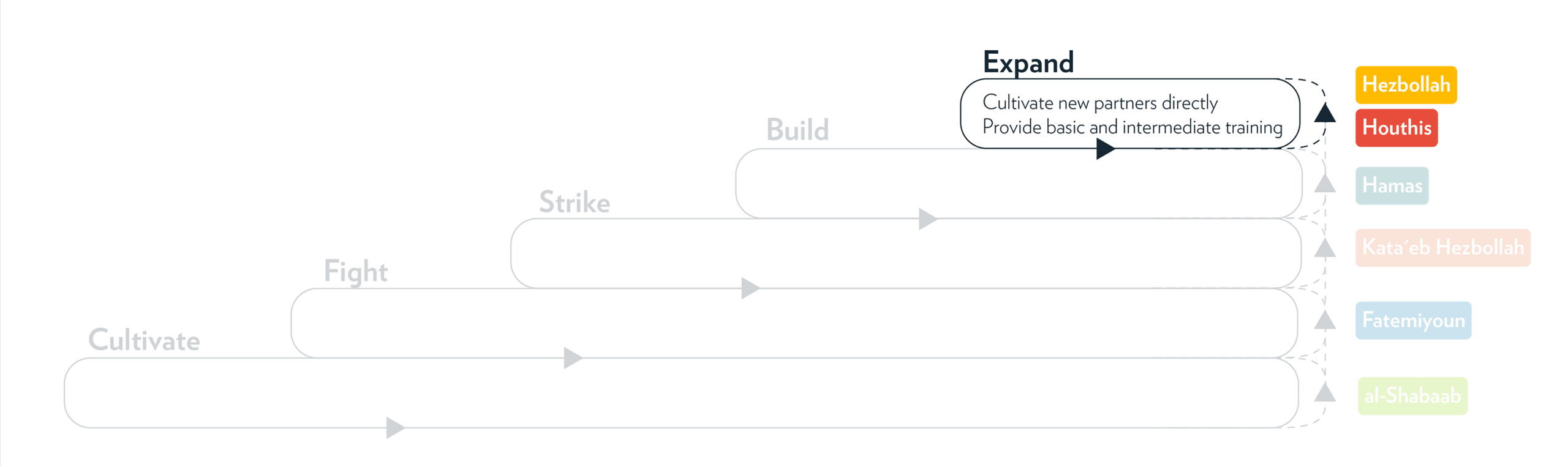
Very few groups move beyond the Build phase. Groups that do, however, can use the allure of their newfound capabilities, power, and network access to directly cultivate their own portfolio of relationships, potentially drawing new groups into the Axis, and widening its reach. A group that has achieved this level of development has reached the final rung of the capability ladder: Expand.
Hezbollah reached this stage earliest. Its role as trainer began informally when Hamas cadres that had been deported to Lebanon in December 1992 spent over a year in proximity to Hezbollah operatives, forging the personal relationships that later crystallized into Unit 1800, its dedicated Palestinian operations unit.91 Later, in the 2000s, it deployed trainers to Syria, Iraq, and Yemen (see above). Hezbollah built, in effect, a military training export capability—absorbing what the IRGC had taught it and transferring that knowledge, which it adapted to local conditions, to the next generation of Axis groups.92
The most striking example of Axis group cultivation of another group is the relationship between Hezbollah and the Houthis. Different parts of the Iranian system had long had direct and indirect ties with the leadership of what became the Houthi movement in the early 2000s. Yet according to a number of well-informed Yemeni sources, decades of religious exchanges and direct contact between, for example, IRGC operatives and the Houthi movement’s founder, Hussein al-Houthi, did not lead to a committed decision to train the Houthis until a first major round of armed conflict between the Houthis and the Yemeni government in 2004.93 As the conflict gathered momentum, it was Hezbollah’s secretary-general, Hassan Nasrallah, and one of his most trusted lieutenants, Khalil al-Harb, who decided to invest in the group, providing them with training and arms.94
While IRGC operatives in Yemen during this period facilitated the Houthi project, and Houthi leaders were trained in both Lebanon and Iran, the Iranians also continued to cultivate local Yemeni political and business leaders who opposed the Houthis, and to support components of the southern secessionist movement that was gathering momentum in south Yemen at the time. The Houthis, said one Yemeni researcher, were “Nasrallah’s baby.”95 It was only after the Houthis’ 2011 takeover of Saada and then their 2014 takeover of Sana’a that the IRGC began focusing its support much more specifically on the Houthis.96
Hezbollah’s successful cultivation of the Houthis also demonstrates the value that capable Axis groups bring to the training process. Hezbollah brought a cultural fluency to interactions with the Houthis and other groups that the IRGC did not. A Yemeni tribal and political figure whose family members include important Houthi leaders describes Hezbollah’s in-country team as “flexible enough for the Houthis and rigid enough for the Iranians,” acting as interpretive bridges between a more formal Iranian military that some locals found heavy-handed, and the more laissez-faire, highly social culture of Yemen.97 Syrian sources report a similar dynamic at training camps in their country from the late 2010s and early 2020s.98
The Houthis have experienced the fastest progression of any Axis group, and are now cultivating new allies, both directly and in collaboration with Iran, on the African sides of the Gulf of Aden and the Red Sea—crossing the Axis’s assumed ideological and geographical boundaries; the Zaydi Shia Houthis are now building working relationships with Sunni groups, including al-Shabaab.
Feedback Loops Between the Rungs
Progression between stages of the capability ladder is not linear. It is shaped by a series of contextual and group-level factors that act as feedback loops, informing a group’s capability, its relationship with its patron, and decision-making by both patron and client about where to apply resources and whether to deepen the relationship.
Five factors interact with one another constantly, determining whether groups advance or remain stuck at a specific rung of the ladder. First is organizational capacity, a group’s internal discipline, leadership quality, and ability to build civilian infrastructure from within existing social networks that make it self-sustaining as both a military and governance actor.
Second is network reach. As groups grow, they must recruit engineers, businessmen, smugglers, and diaspora traders outside of a trusted core. A group’s ability to identify and integrate useful people from expanding networks determines how fast it can absorb new capability. The most capable individuals a group needs are rarely available within its original social base.
Third are material constraints. What a group can receive, store, operate, and manufacture depends on the territory it controls, the supply routes available to it, and the physical infrastructure it can access. Hamas in blockaded Gaza faces categorically different constraints from the Houthis in Yemen, who control major cargo ports.
Ideological and relational fit matters a great deal, too. Iran’s investment reflects not just a group’s utility but the depth of trust between the group and its patrons. Ideological seminars act as a sorting mechanism, testing willingness to work within the Axis framework, even if groups do not align with the Islamic Republic’s religious worldview. Groups that fail this assessment can continue as partners—useful occasionally, trusted rarely, never fully integrated.
Last but just as important is context. External events—a war, an invasion, a sanctions regime—create the preconditions for investment. The Houthis’ rapid progression reflects the group’s organizational capacity. But their takeover of much of northeastern Yemen in 2014–15, and the strategic opportunity created by the Saudi intervention during a period of broader regional competition, gave Iran both an opening and an incentive to provide them with greater levels of support than in the past. Crisis is often the condition that precipitates the most consequential transfers. Hezbollah, by contrast, built its capabilities over a much longer timeline, due to lower initial capacity and shifting requirements, responding to a changing regional political context as it transitioned from a secret cell-based organization into a state-like actor. It also climbed the ladder before the commercial supply chains that helped accelerate the Houthis’ rise came into existence.
The Axis Ecosystem
Over the past twenty years, multiple Axis groups have crossed the capability tipping point, building dense webs of cross-border ties with each other and with smugglers, businesspeople, traders, engineers, other armed groups, and even other state actors. As group capabilities have increased and the Axis has become more intertwined and externally connected, the Axis itself has crossed a threshold and evolved into something new.
An analysis of approximately forty reported UAV training events between 2010 and 2024, drawing on public and private reporting and field interviews, provides empirical evidence for this point, by tracking three shifts in drone training happening at the same time over the course of a decade and a half: where training takes place, who leads it, and what is being taught.99
FIGURE 6
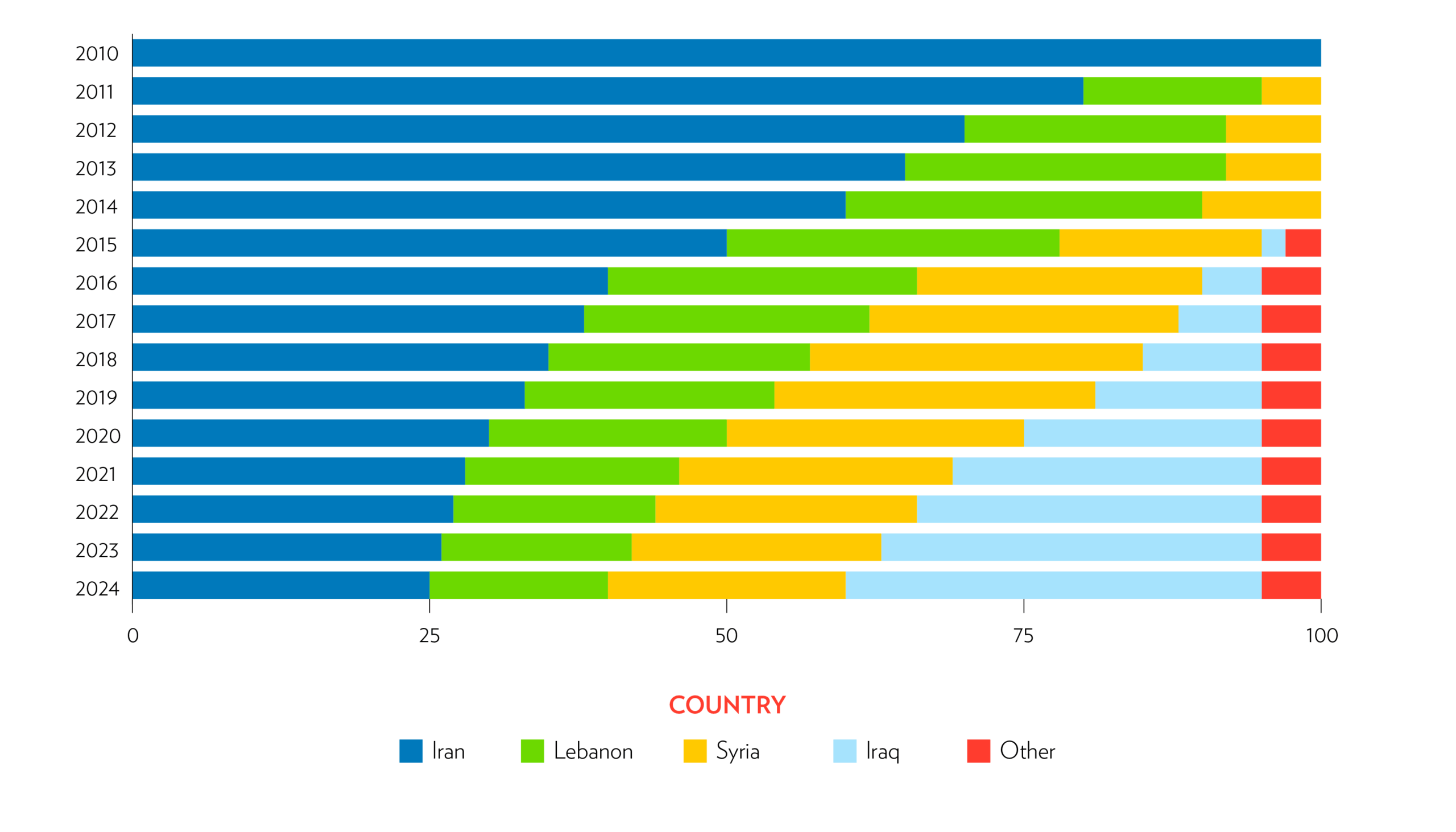
In 2010, all documented drone training for Axis groups took place in Iran and was led by Iranian trainers. By 2011, training had begun in Lebanon, where Hezbollah had built its own operational drone base, and in Syria. From 2015 onward, as the Popular Mobilization Units were formed in Iraq to fight the Islamic State, half of all documented training events took place outside Iran, with Hezbollah operatives either co-leading or independently running courses for counterparts from other Axis groups. By the early 2020s, training was increasingly led by non-Iranian Axis personnel, albeit usually with IRGC oversight. By 2024, Hezbollah was training Russian soldiers on Iranian one-way attack systems in Syria while the Houthis were reportedly training al-Shabaab and Sudanese armed factions on drone use and manufacture.100
FIGURE 7
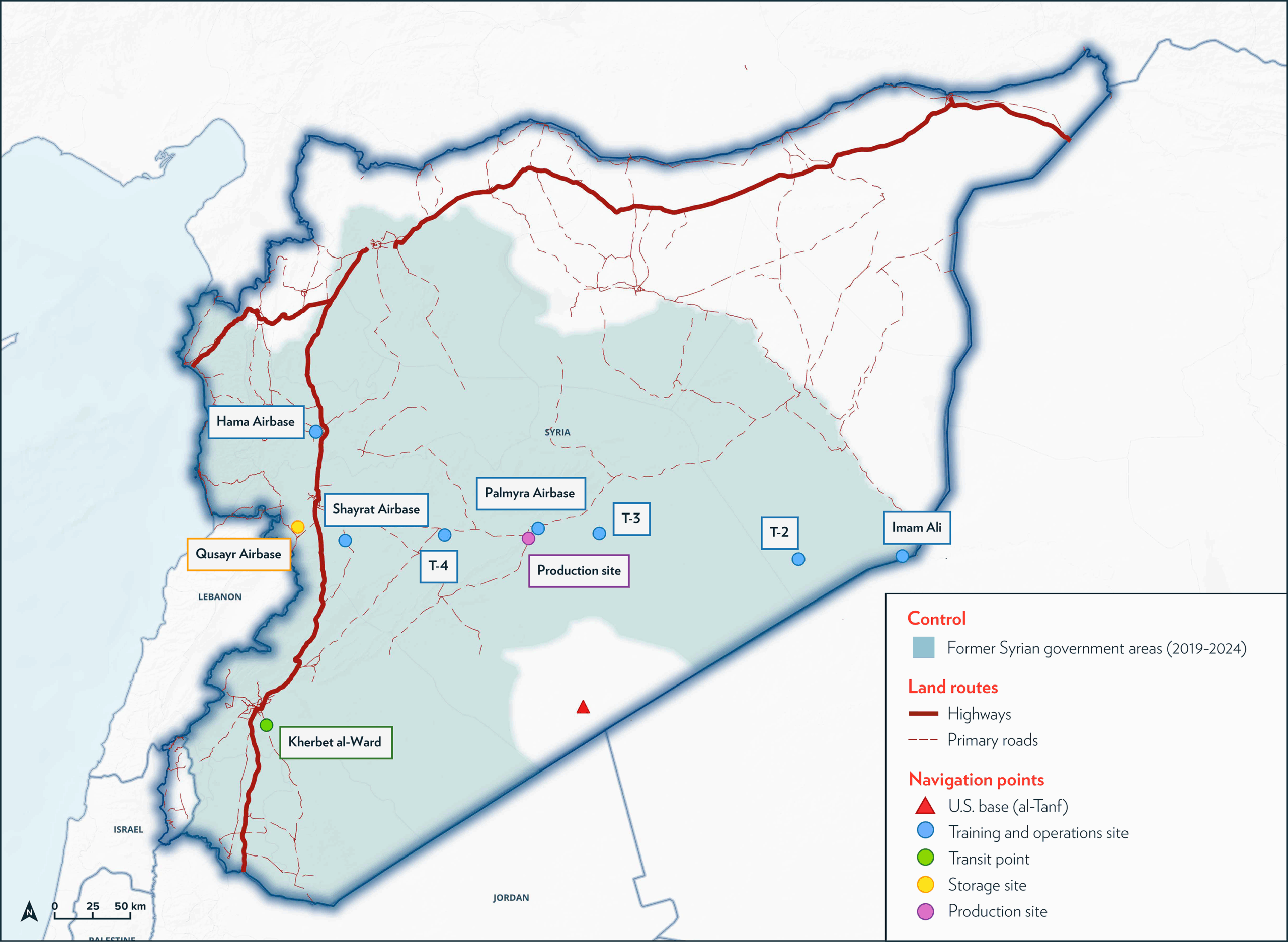
The Axis’s evolution into an ecosystem was accelerated by the collapse of the Islamic State and deepening Iranian and Hezbollah entrenchment in Syria. From 2017 until 2024, Iran and its allies controlled a corridor linking Iraq, Syria, and Lebanon, and exerted control over key air bases across Syria. Quds Force experts trained individuals from the Syrian Air Force, Hamas, Palestinian Islamic Jihad, the Houthis, the Popular Mobilization Units, Fatemiyoun, and Hezbollah’s Unit 127 at overlapping facilities (Figure 7, above).101 These sites produced three things: field-testing for a range of Iranian UAV systems; a more capable Axis; and a cohort of people from different groups and different countries who had trained together, tested systems together, and built the personal relationships that formed horizontal ties between Axis groups.
Again, this does not mean that Iran is no longer the most important and influential node in the ecosystem. Its strategy of cultivating peripheral and second-tier actors has created powerful incentives for Axis groups to remain in the fold. Axis groups continue to rely on Iran for resources, finance, technology, and training. But the fact that these groups have developed their own capabilities does give a new context to the role of Iran and the IRGC in their survival and growth. If Iran were to be significantly diminished, or if the regime were to fall, it is not a foregone conclusion that the ecosystem itself would collapse.
Consider the fall of the Assad regime in December 2024, which severed Iran’s corridor of allies. The regime’s fall closed the training facilities and cut off an important UAV transfer route for Hezbollah. Despite these setbacks, the cohort that formed in the region persisted—in fact, it had already dispersed, to Yemen, to Iraq, and to Lebanon. Syrian drone and arms manufacturing experts are rumored to have fled to Iraq, Iran, and Yemen.102
Even after the decimation of Hamas and the killing of Hezbollah’s leadership in the 2023–25 wars with Israel, the Axis remains intertwined, with the Houthis—the survivors and breakout stars of the 2023–25 conflict—emerging as an important new power center. And, as the next section of the report shows, in the past three years, the Axis ecosystem has been able to quickly adapt its supply chains, rerouting around the broken connection in Syria, thanks in no small part to fundamental shifts in the inner workings of the global economy.
The Axis, in other words, has become a complex, adaptive ecosystem that organically adapts to stress, with power and influence redistributing when one part of the ecosystem is damaged or a specific connection is severed. Iran is less the central telephone exchange without which all communication would stop than the biggest and most connected node in a broader, internet-like mesh network. Figure 8, based on research for this project, shows a stylized network map of the Axis, as a simple hub-and-spoke, in the mid-2000s; and in its current, ecosystemic form in 2026.
FIGURE 8
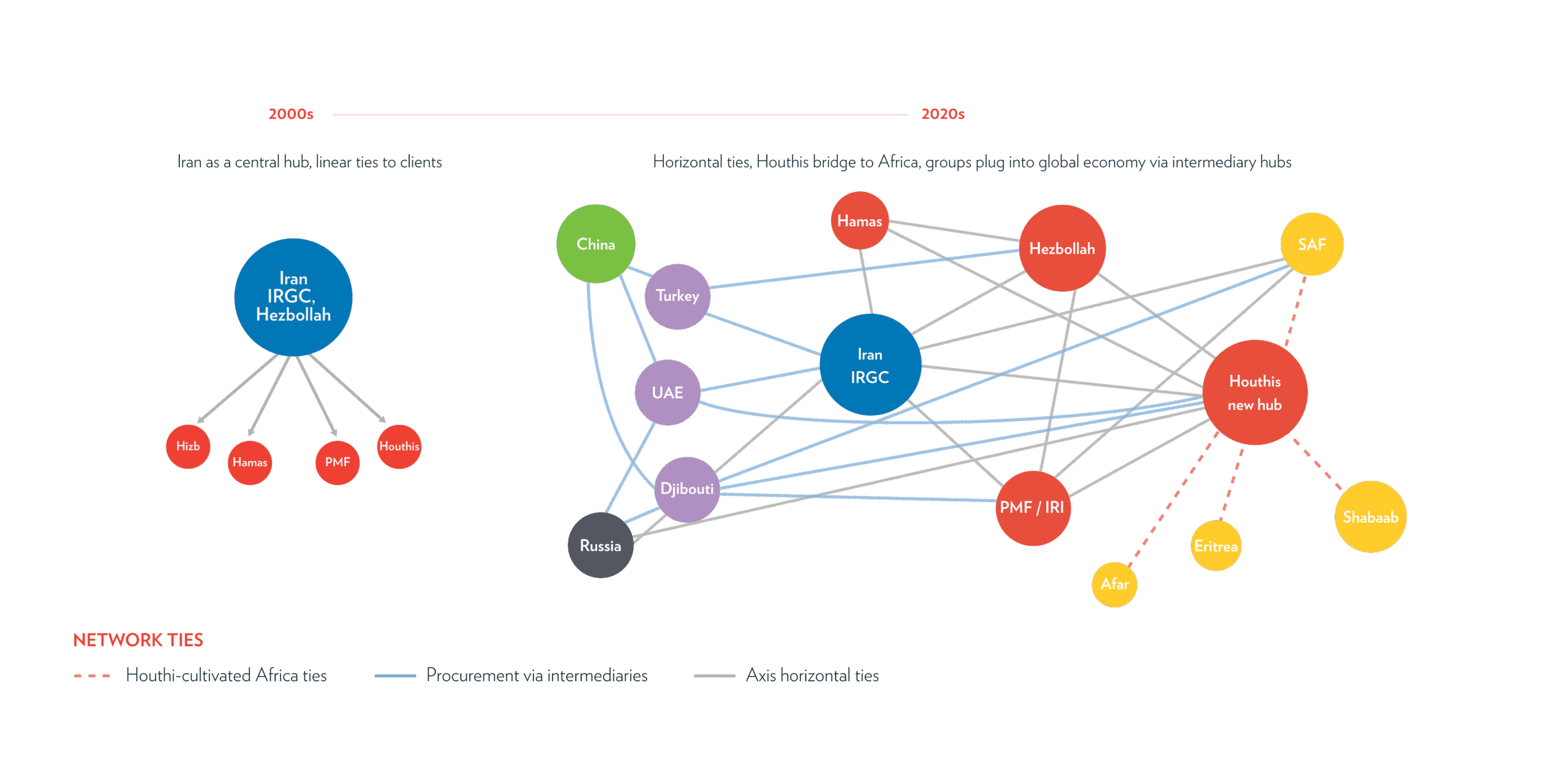
Global Shifts, Shifting Axis
In 2009, German authorities uncovered a plot to source engines for the Iranian Ababil-3 MALE surveillance drone from a German manufacturer.103 A group of Iranian businessmen had bought around sixty of the engines and labeled them as jet ski components to circumvent German regulations that banned the sale of potential “dual-use” items that could have a military function to Iran.
By 2026, a Chinese-made copy of the same engine, itself based on an Iranian duplicate, was powering Russia’s war in Ukraine and Iranian attacks on its Gulf neighbors. The United States has sanctioned the Iranian and Chinese firms responsible for supplying the engines for use in Russia’s Geran-2 and Iran’s Shahed-136 (the drone the Geran-2 is based on). But American sanctions, once a powerful tool in Washington’s counter-proliferation efforts, have done little to change things.
The “choke points” of the early twenty-first century have either been moved or erased by seismic shifts in the inner workings of the global economy.
The cause of sanctions’ new inefficacy is the fact that the “choke points” of the early twenty-first century have either been moved or erased by seismic shifts in the inner workings of the global economy. Twenty years ago, Western companies held an oligopoly over the intermediate goods needed to build advanced weapons, and Western states dominated the financial and trade infrastructure used to sell them. Even as more countries industrialized and built their own trade and finance systems in the 1990s and 2000s, the global networks that underpinned trade, finance, and information were concentrated around the United States and a small number of allied states.104 Sanctions, export controls, and financial pressure were possible because the major choke points of global trade—dollar transfers, intermediate components, banking, even the internet—were under the control of Western states and their close allies.
Today, China rather than Europe dominates intermediate goods manufacturing, including the manufacturing of the drone engines Iran tried to buy from Germany in the early 2000s. Global trade has more than doubled in value and volume since 2000, with much of it moving via container ships that drop off cargo at major hubs for transshipment to smaller ports.105 Trade in raw materials, components, and finished goods moves directly between countries in the Global South in Asia, Africa, and Latin America, without having to pass through Western jurisdictions for processing or assembly—and increasingly does so using financial networks that do not touch Western systems.
FIGURE 9
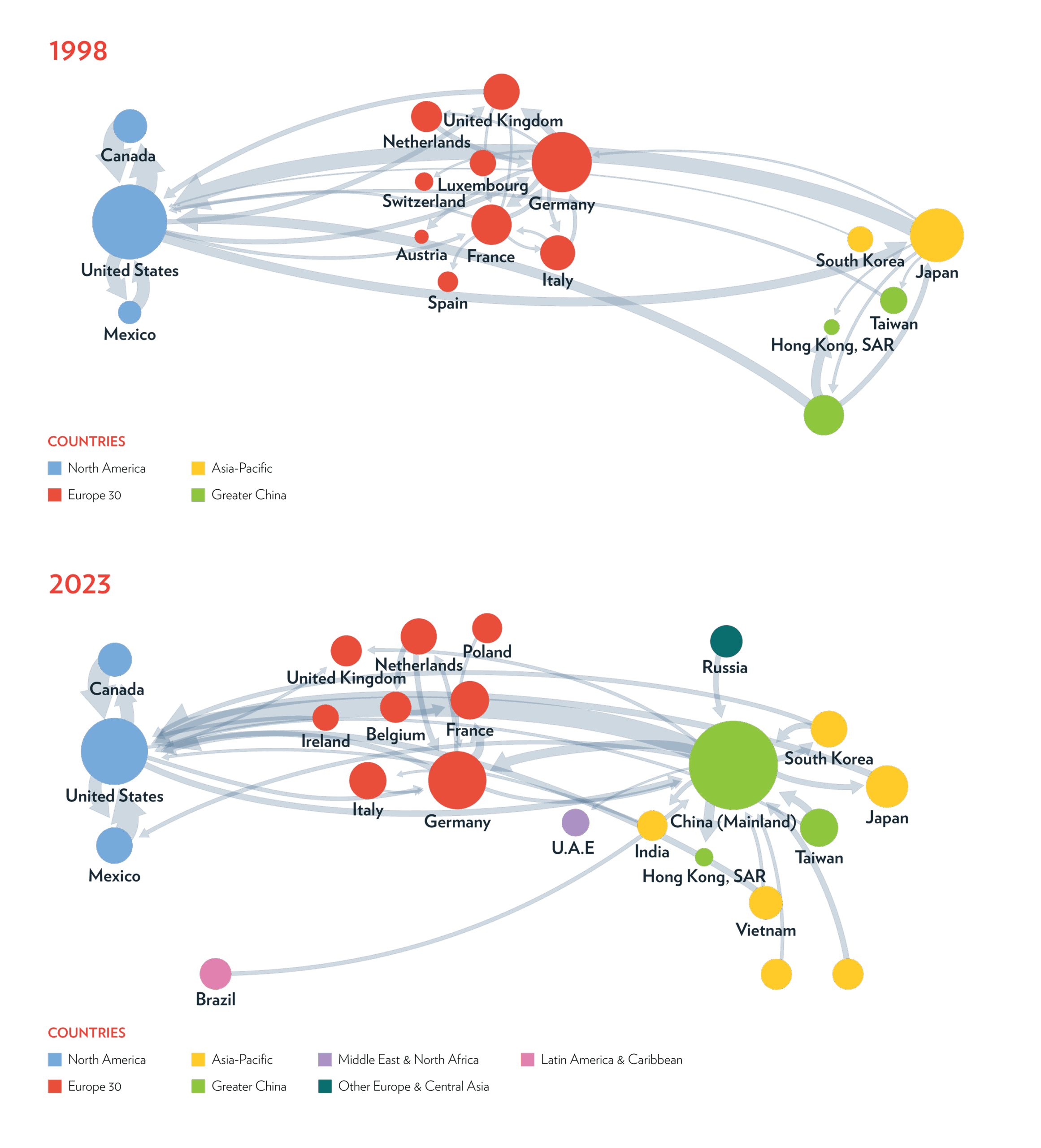
These shifts have changed the topology of global trade. UN trade data analyzed by the McKinsey Global Institute show that, in 1998, the bulk of all manufactured goods worldwide originated from either North America or Western Europe. Japan dominated Asian trade while China was a relatively small source of manufactured goods. By 2025, China was the world’s largest exporter of manufactured goods, selling almost double the amount the U.S. did.106 Countries like the United Arab Emirates have become major container transshipment and trade hubs. Figure 9 shows this change using the McKinsey data.107
The sheer volume of global trade—Rotterdam and Antwerp process tens of thousands of container movements per day—makes it impossible for even well-resourced states to inspect every single container. U.S. Customs and Border Protection inspects approximately 3.7 percent of all container shipments entering American ports; the European Commission estimates EU inspection rates at about 1.5 percent.108
Many of the components used to make drones and other weapons systems are dual-use—they can be used to make civilian goods as well as military ones—and may not be designated as such by their manufacturing countries or the trade hubs they pass through. They become nominally illicit only when moving the last mile into the hands of sanctioned actors. Combined, these shifts have fundamentally changed the scale at which weapons like the Shahed-136 can be built. They have also made interdiction much harder. In 2025, Russia made more than 2,700 Shahed-136 drones a month for its Ukraine war.109 Iran likely launched thousands more in February–April 2026 during its confrontation with the United States and Israel.
The remainder of this section uses a series of investigations to show that, in the same way that the Axis ecosystem is a web of interconnected nodes, it is now nested within much larger, global ecosystems, along with smaller ones, like local smuggling networks. Axis supply chains are increasingly part of a larger, internet-like system whose scale and speed make it impossible for any single state to police, and that is, if anything, even more adaptive and resilient to disruption than the Axis itself.
The Qasef-2K: Made in China, Assembled in Yemen
FIGURE 10
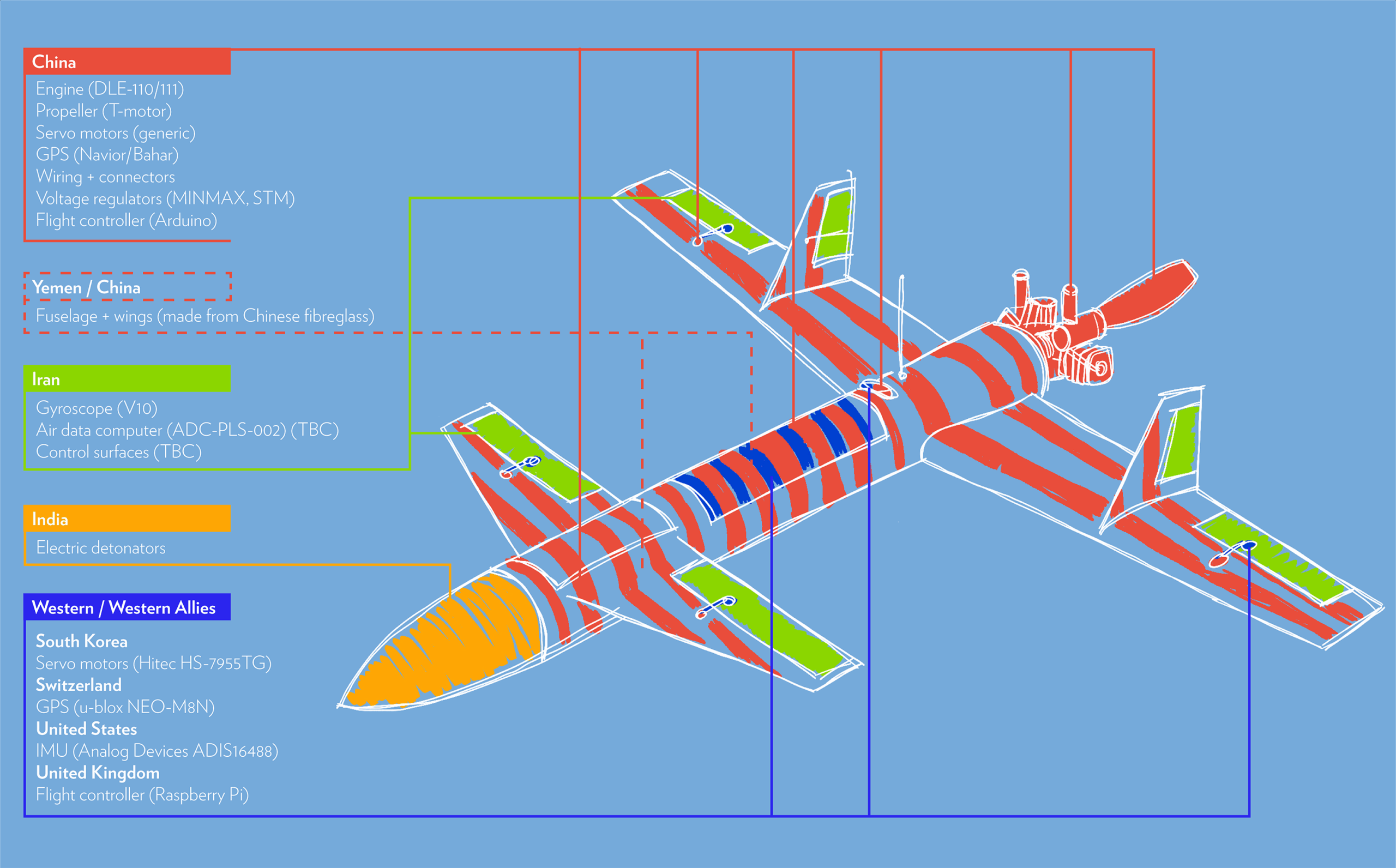
The Houthis’ Qasef-2K, the Yemeni group’s version of the Ababil-T, illustrates the challenge of stopping Axis groups and state actors from building Iranian-designed one-way attack UAVs in this new era. Data from public and private interdiction records show that 60 percent of the components and materials used to build the Qasef-2K come from China, around 15 percent from Iran, while a smaller proportion comes from countries like India, South Korea, Switzerland, and the UK (Figure 10). Western-made components are often purchased by front companies or legitimate businesses in Asia, often in Hong Kong, before being sold on to anonymous buyers.110 Western and Iranian-made components, like the drones’ gyroscopes (a small mechanism that helps measure the direction the drone is flying in and the angle it is flying at), can also, increasingly, be sourced from Asian manufacturers.
Regardless of their starting point, these components wind their way to Yemen through a supply chain of growing complexity that involves transshipment through Djibouti and Somalia, overland trucking via front companies in Oman and the Emirates, container shipping by Yemeni businessmen based in China, and direct maritime transfers from Iran.111 Western- and Chinese-made components alike flow west from Asia, rarely passing through jurisdictions that are sensitive to Western sanctions.112 Because they come from a number of sources and travel many different routes, disrupting one supply channel simply prompts a rerouting of supplies. Sanctioned front companies in China, the Emirates, or Turkey quickly reincorporate under new names.113
Engine of Change
One component in particular helps tell the story of how Iran and the Axis have been able to overcome earlier Western-dominated choke points. A drone’s engine determines its range, payload, and reliability. But perhaps most importantly, it is the single largest component of a UAV that Axis groups need to import to build drones, and access to a steady supply determines whether the drone in question can be manufactured locally by a partner group at a relatively large scale. And unlike in the late 2000s, drone engines today increasingly come from China.
As Iran became more interested in drones in the 1990s and 2000s, it began to look for models it could buy on the open market. One that caught its attention was the South African Denel Seeker, which is widely believed to have been the inspiration for the Ababil-3, an early Iranian MALE drone.114 After negotiations over purchasing the Seeker broke down, and as sanctions on Iran began to bite in the mid-1990s and early 2000s, IRGC-affiliated businessmen like those discussed above made a series of attempts to buy Limbach L550E engines, which powered the drone.115
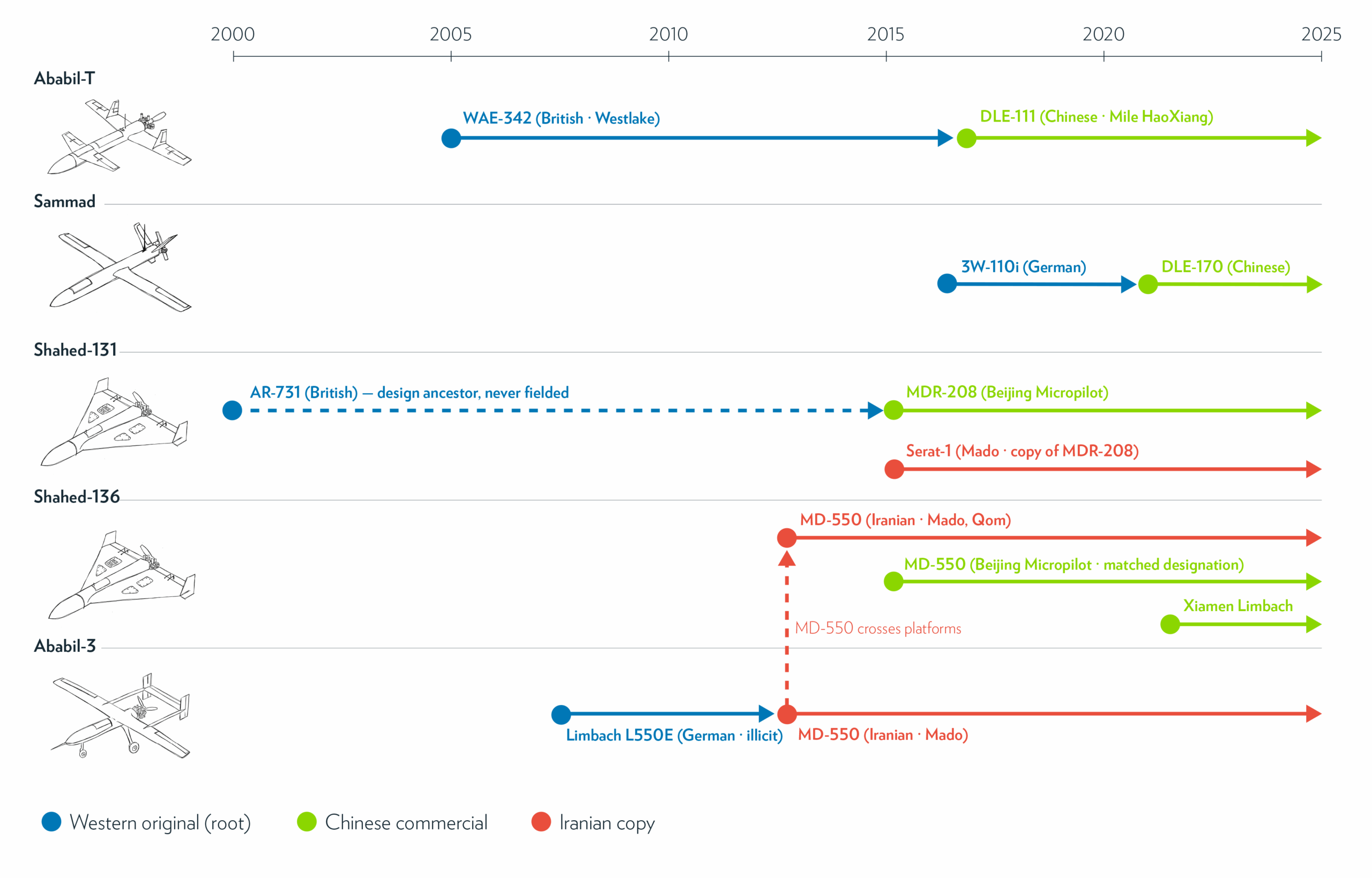
Finally, after years of trying to buy the engines, and being blocked by Western governments like Germany’s, Iran started making its own. Around 2008, the year that the United States imposed its most stringent sanctions yet on Iran, an Iranian motorcycle manufacturer, Oje Parvas Mado Nafar Company (better known as Mado), began making its own drone parts, later supplying the IRGC-affiliated Quds Aviation with a duplicate of the Limbach engine, which it called the MD550.116 Then, in the 2010s, not long after Mado registered businesses in Hong Kong and China, a Chinese company, Beijing Micropilot, began selling its own version of the engine, which it also dubbed the MD550.117 It is unclear if there is any formal relationship between the two companies, but the Chinese firm has subsequently developed a track record of making duplicates of several Mado engines, most of them copies of Western ones.
The MD550 has become one of the most-used drone engines in the world, repurposed for the Shahed-136, which Russia and Iran both now mass-produce. Mado, Beijing Micropilot, and Limbach—bought by a Chinese businessman in 2011 and relocated to China—have all been sanctioned for supplying Iran and Russia.118 But the sanctions have done little to halt the supply flow. Iranian-designed one-way attack drones now almost exclusively use Iranian and Chinese-made, and in some cases Chinese-designed, engines (Figure 11). In almost every case, the drones were originally designed to use European-made engines but later switched to Chinese-made copies, or to Chinese-origin DLE engines, which power not just the Qasef-2K but also the Houthis’ longer-range Sammad series.
FIGURE 11
From State to Shell
The ambiguous relationship between Mado and Beijing Micropilot points to another issue: over the past twenty years, it has become far easier to set up so-called shell companies, entities with no clear ownership structure or business operations. The risk agency Moody’s, which tracks about 600 million companies worldwide, estimated in 2023 that more than 21 million companies raised at least one red flag for tax evasion or more serious illicit activity, and that 900,000 raised three or more such flags.119
In the past, paper trails made procurement networks traceable.120 Hong Kong business records show that, in 2013, Mado’s CEO Yousef Aboutalebi incorporated two companies in Hong Kong using his own name and identity documents.121 Similarly, when Stars Group Holding was sanctioned in 2014 for its role in Hezbollah’s UAV program, investigators traced the network because subsidiaries had been incorporated in China and the Emirates under names closely related to the Lebanese parent.122
Iranian and Axis UAV procurement networks now take greater care to obscure their identities, setting up new anonymous shells when sanctions are imposed. In 2019, the U.S. Department of the Treasury sanctioned Iran’s Pishtazan Kavosh Gostar Boshra (PKGB) for buying tens of millions of dollars of UAV engines and other components to make UAVs in Iran. PKGB quickly set up new, anonymized shell companies in Hong Kong. By the time the Department of the Treasury caught up and sanctioned these companies in February 2024, PKGB had set up three more entities. The department sanctioned these new companies in 2025, but PKGB has almost certainly set up new shells since.123 PKGB, a Western official said, is a major player in the Iranian UAV complex, and as such is being closely tracked by U.S. authorities. But, the official said, “the problem is that it’s impossible to track all the smaller companies we don’t know about yet.”124
“The problem is that it’s impossible to track all the smaller companies we don’t know about yet,” a Western official said.
A growing number of such small, hard-to-spot companies have been integrated into Axis procurement networks through the familiar tactic of recruiting second-tier, socially connected actors, this time in the international diaspora. Since 2015, for example, Yemen’s Houthis have built deepening ties with a subsection of Yemen’s large China-based diaspora, many of whom are part of established Sana’a-based trading families.125 Over time, these efforts created what other Yemeni community members identify as “Houthi” businessmen, an increasingly prosperous group of traders who run export and courier firms from China, are given preferential treatment by the Houthis’ de facto authorities, and who are widely believed to transport dual-use and even military-grade items to Yemen in shipping containers with other, more legitimate goods.126
In 2025, the United States sanctioned a China-based Yemeni national, Nasr al-Hammadi, whose family oversees a Chinese-Yemeni logistics firm that arranges the clearance of containerized shipments from China to Yemen.127 These and other sanctions did little to affect the flow of goods to Yemen. Over the course of 2025, Yemeni authorities in Aden seized dozens of containers carrying shipments of dual-use and even advanced manufacturing equipment that they believe were meant for the Houthis’ arms program.128 An investigation by the authors into the registered recipients of these shipments turned up a group of small electronics and mechanical engineering shops in northern Yemen.129 The Yemeni logistics firm that facilitated the shipments later signed a deal to transship containers to Yemen from Djibouti with a major international shipping line (discussed below).130
Increasingly, one well-placed person can orchestrate vast procurement schemes. In 2022, Fadel Zehri, a Lebanese national from a family of Hezbollah loyalists, incorporated a company in Barcelona with another man, a dual Spanish-Lebanese national. Zehri was also able to access data from a Lebanese tourism business that arranged football match tickets and travel packages for wealthy Arab clients from the Gulf.131 According to Spanish authorities, he used the identities of the tourism firm’s Gulf Arab clientele to place a series of small orders for UAV engines and components from European and Asian suppliers, masking the fact that he was engaged in industrial-scale imports.132 The goods were imported from Asia to Germany, consolidated with additional items bought locally, trucked to Spain, and shipped by container to Lebanon.133
The network was identified only when Israeli investigators recovered a UAV engine from the wreckage of a drone that struck a retirement home in Herzliya, Israel in October 2024.134 Israeli and European law enforcement authorities then traced it back through its supply chain. In March 2026, Zehri was sentenced to six and a half years in prison for his role in the plot by German authorities.135 Spanish and German investigators believe Zehri had purchased enough components to build between 1,500 and 2,000 drones—roughly the entirety of Hezbollah’s estimated pre-2023 attack drone fleet. Zehri has almost certainly been replaced by another individual.136
Shadow Fleets: False Flags and Hidden Routes
It is increasingly easy not just to hide who owns a company, but also who owns a ship, where it is going, and what it is carrying. In recent years, Iran and the Axis have transitioned from using established shipping firms to working with the so-called shadow fleet, a vast and growing cohort of vessels whose owners use shell companies, flags of convenience, and deceptive shipping practices to mask their ownership and even their location.
The shadow fleet phenomenon can be traced back to the Islamic Republic of Iran Shipping Lines (IRISL), an Iranian state shipping firm. By the 2000s, IRISL had begun to operate a global network of subsidiaries, branch offices, and partnerships. It was also, according to U.S. officials, transporting raw materials and components for Iran’s burgeoning ballistic missile program. In 2008, the U.S. government added IRISL to its Specially Designated Nationals and Blocked Persons List, alleging that the company and eighteen related entities were proliferating weapons of mass destruction.137
The following year, three IRISL-owned and -chartered vessels were boarded by European and Israeli maritime forces, carrying small arms and munitions allegedly for Hamas in Gaza and Hezbollah in Lebanon.138 IRISL responded by renaming its ships, registering them in different countries and setting up a bewildering array of shell companies to obscure their ownership. IRISL and the companies it formed have been sanctioned at least two hundred times.139 The fleet also started to change its patterns of movement, mainly running routes to Asia before returning to Europe during the easing of restrictions on Iran in 2015–18, when the Joint Comprehensive Plan of Action (the Iran nuclear deal) was in effect. During this period, the network likely started transporting materials for transshipment to Yemen via ship-to-ship transfer in the Red Sea.140
As scrutiny of IRISL and other state-owned shipping companies’ operations has grown, the shadow fleet has moved further into the darkness. Since IRISL was first sanctioned, as the United States’ use of sanctions as a political tool has intensified, new private fleets have emerged to service sanctioned state and nonstate actors in Iran, Russia, Syria, Venezuela, Yemen, and beyond. The modern shadow fleet uses a mix of shell companies and deceptive shipping practices, including cutting off automatic identification systems (AIS), making “dark runs” to ports, and “spoofing”—using software to show a falsified location.141
While the best-known version of the shadow fleet is used to move oil from sanctioned states to international markets, project research shows that it is also almost certainly used to move people, materials, and arms to end-users, including the Axis groups. Around 2022, a network of cargo vessels began operating between the Arabian Gulf and the Red Sea.142 These vessels regularly cut their AIS transmitters before entering the Strait of Hormuz into the Persian Gulf, only turning them back on when they departed the waterway on their way back on the clockwise route to the Red Sea. Satellite imagery shows that a number of these vessels entered Iranian ports, particularly Rajei Port, west of Bandar Abbas, and stopped at berths also frequented by IRISL vessels.143 Rajei was the port struck by a major explosion in April 2025 that was later reported to have been caused by mishandled sodium perchlorate, a precursor for solid missile propellant, thought to have been transported to the port by IRISL ships.144
Figure 12 shows one such vessel, the Vikan, switching its AIS off before entering Hormuz in early February 2026, and reappearing off the coast of the Emirates on February 28, just as the United States and Israel were launching Operation Epic Fury. Satellite imagery from a vessel matching the Vikan’s dimensions and appearance berthed at Rajei with its AIS disengaged during the ship’s “dark” period.
FIGURE 12
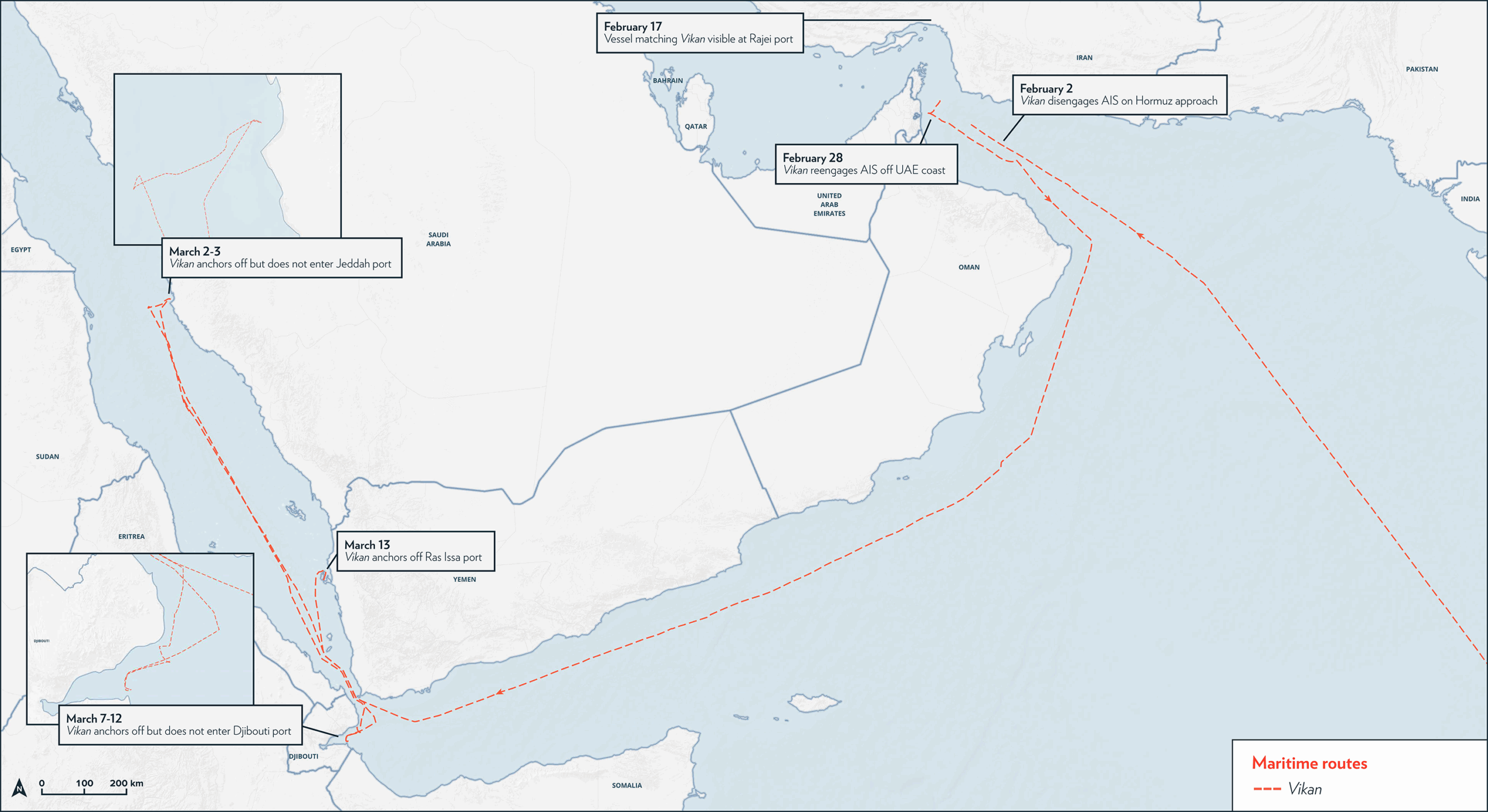
Many of the ships identified, including the Vikan, belong to Turkish shell companies that are, in turn, linked to a sanctioned, Syrian-run oil transportation network with ties to the prolific Yemeni oil and fuel smuggler Said al-Jamal, and are crewed by Syrian sailors with ties to earlier iterations of the Syrian network.145 The authors have dubbed the wider network the Majesty fleet, because of the central role played by two companies, Majesty Navigation and Majesty Navigation Enterprises, in managing the vessels (see Figure 13).
FIGURE 13
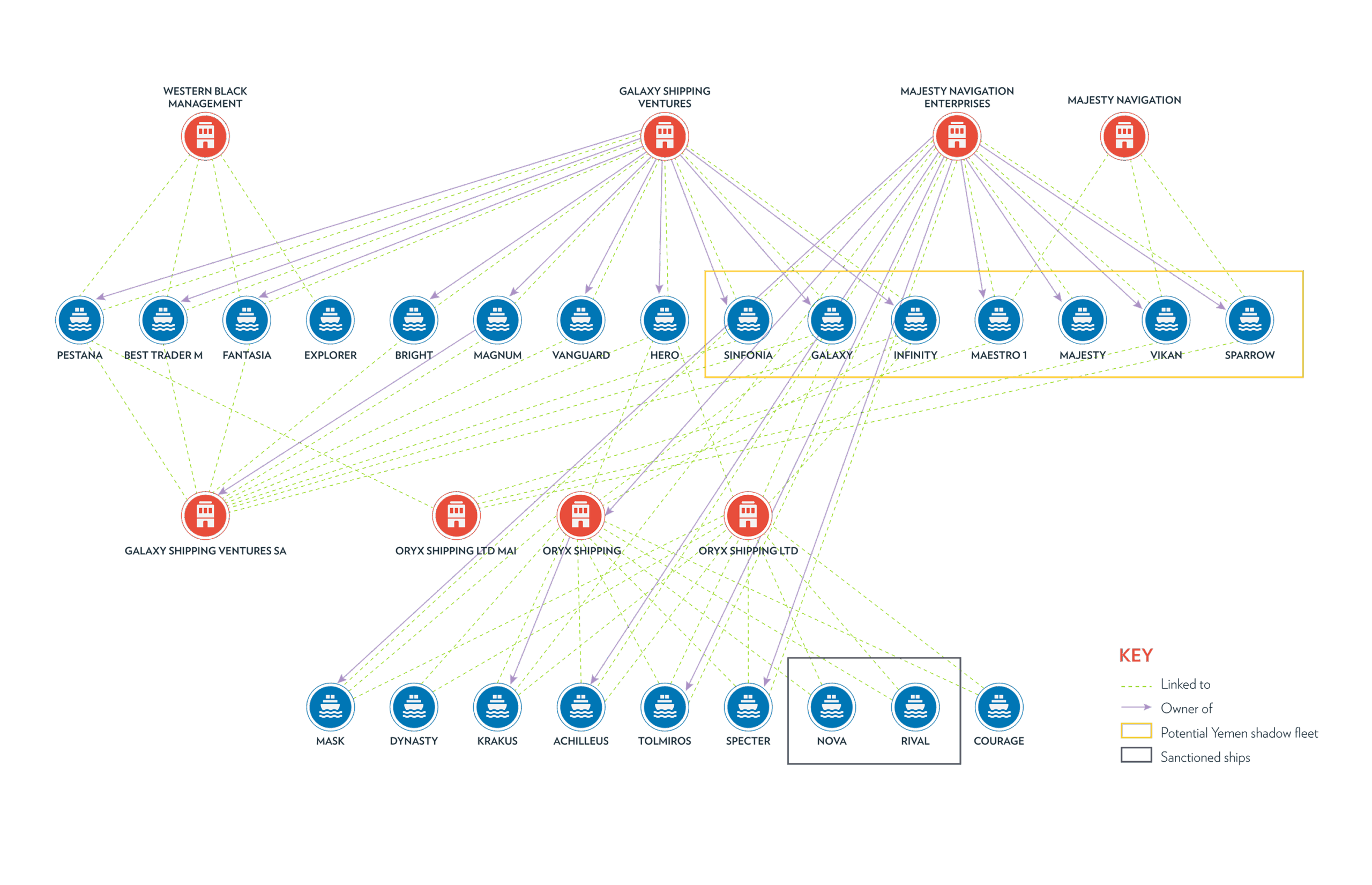
Unlike big firms like IRISL, Stars Group Holding, or PKGB, shadow fleets like the Majesty network are built through accumulations of small units—vessels, shell companies—designed to evade interest and detection. And where these vessels are spotted, the options for intervention are limited. Western officials and open-source investigators consulted by the authors agree that the Majesty network has all the hallmarks of a shadow fleet, but that proving the claim that its ships are definitively engaged in smuggling illicit material would be extremely challenging. “These vessels show lots of suspicious patterns, but so do a lot of ships, and the question is, how do you assign value to them and stop them? This isn’t a few dhows doing smuggling, this is something new,” a former U.S. official said.146
Bridging the Gap: Transshipment Hubs
Shadow fleet vessels are careful to move between ports where Western sanctions are either not recognized or loosely enforced. Turkey and the Emirates, for example, have emerged as major trade, finance, and re-export hubs over the past two decades, handling a substantial share of all goods flowing between Asia, Europe, and the Middle East.147 The two countries’ economic models prioritize ease-of-doing business, and take a lighter touch approach to container screening, and to vetting shell companies, than their European and U.S. counterparts.148 Perhaps unsurprisingly, Turkey and the Emirates appear in the majority of Axis procurement networks documented in U.S. Department of Treasury sanctions against UAV procurement networks since 2015 (see Figure 14, below).149 Djibouti, meanwhile, has emerged in recent years as an important hub for Houthi smuggling.150
These hubs matter because they provide the vital link between sanctioned actors and the outside world. Ship-tracking data show that ports in Houthi-held Yemen, Syria, Lebanon, Libya, and Sudan are largely isolated from global trade, receiving vessels almost exclusively from regional hubs in Turkey, Egypt, the Emirates, and Djibouti (Figure 15a). Those hubs, in turn, are globally connected, receiving vessels from China, India, Southeast Asia, and Europe (Figure 15b). They allow Western and Chinese components transported through apparently legitimate channels to transit the “last mile” into sanctioned jurisdictions or to sanctioned actors.
FIGURE 14
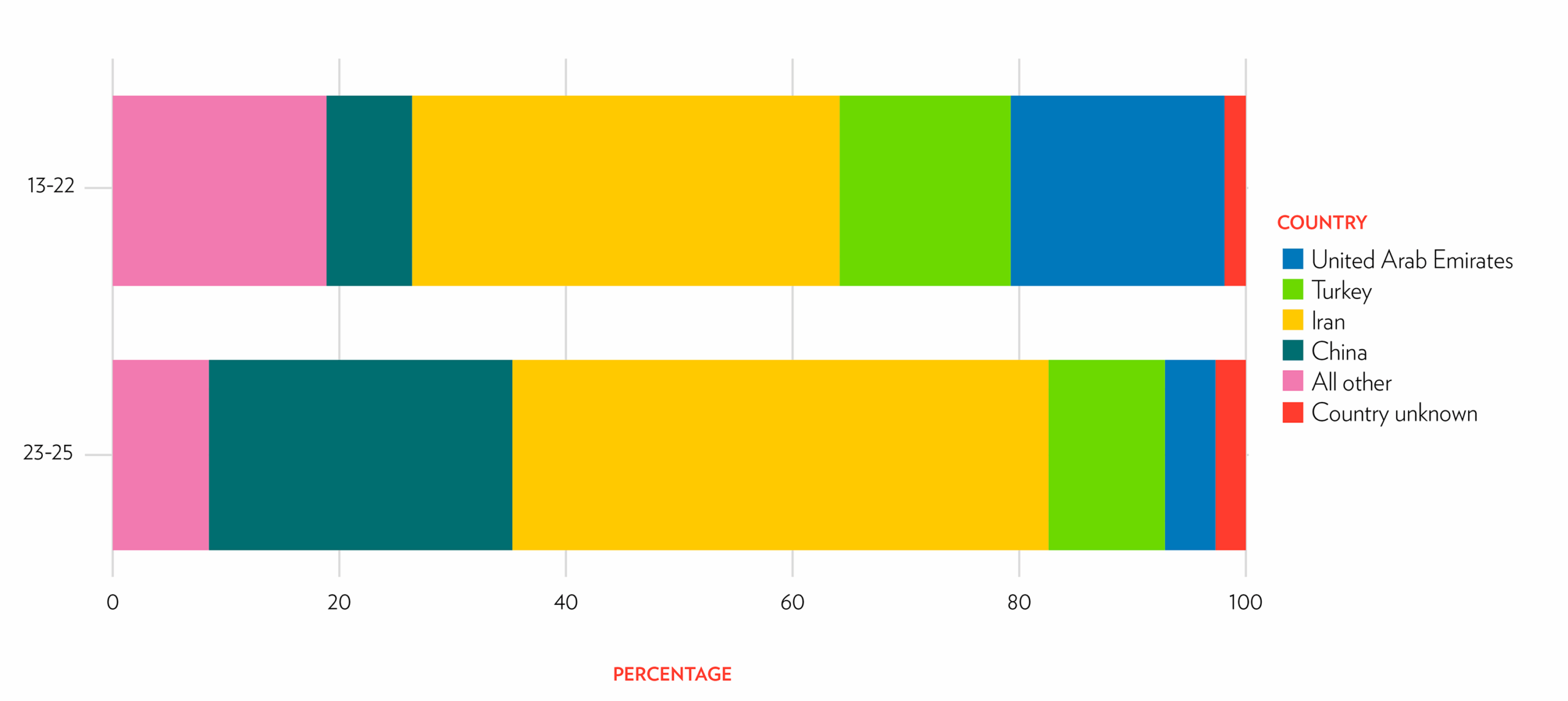
They act, along with traditional trade networks like the dhows that crisscross the Indian Ocean and are used to move Iranian arms to Yemen, and newer “feeder” lines like the Majesty network, as bridges between sanctioned actors and the outside world.151 Unlike major container shipping lines, which send ships around the world, Majesty ships rarely berth at European ports and never travel to U.S. ones. More recently, a Yemeni shipping management firm, al-Halal, announced an agreement with CMA CGM, a major container shipping line, to act as the latter’s feeder to Yemen, via Djibouti. Al-Halal was the main logistics provider for the containers seized in Aden in 2025 described above. Businesses in Sana’a now reportedly advertise container shipping from Djibouti via dhow as a commercial logistics option.152
FIGURES 15A AND 15B
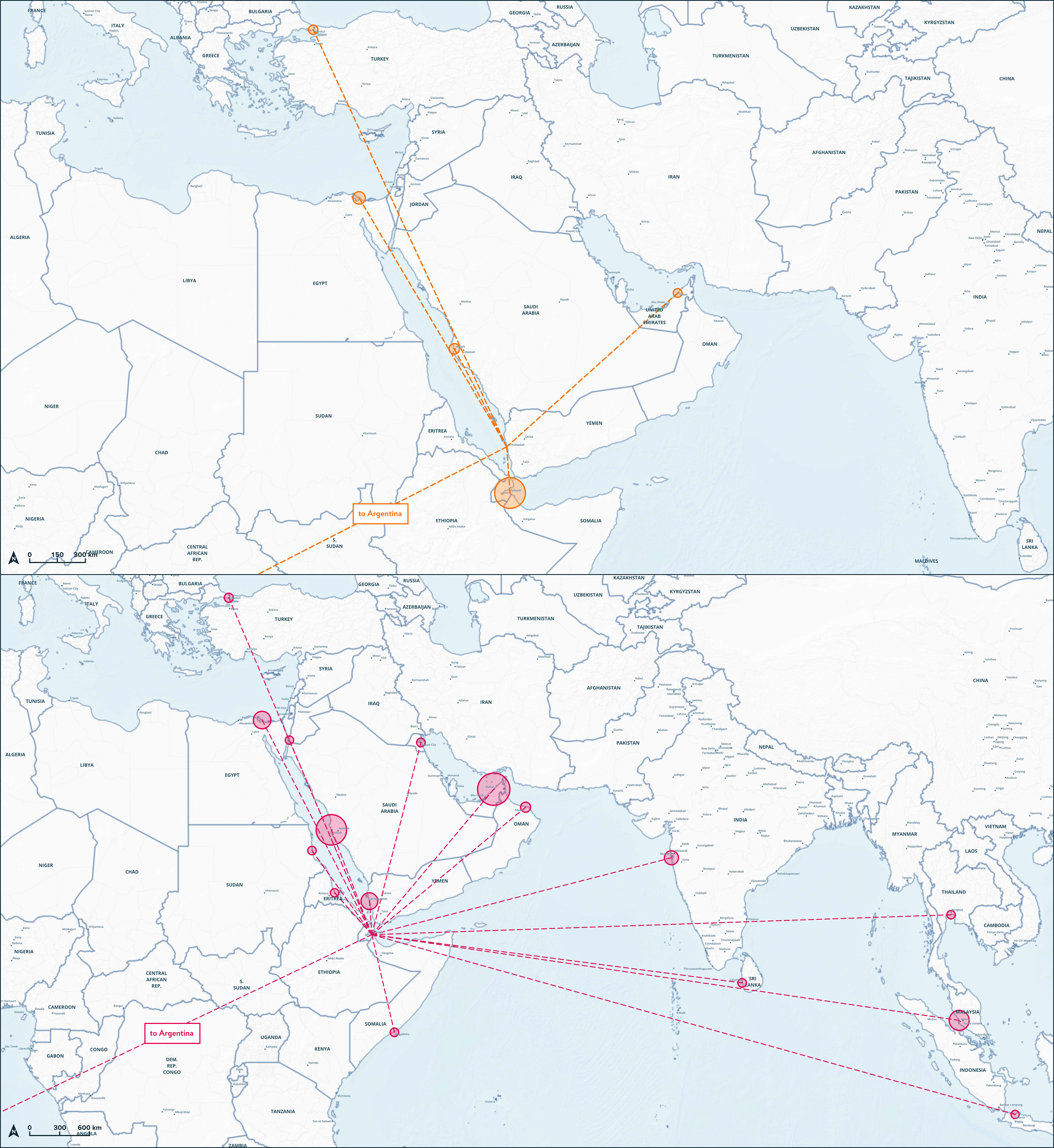
The Adaptive Axis
The Axis supply chain is now globally plugged in, made up of countless moving parts, and increasingly embedded within larger ecosystems of trade. This complexity has made it adaptive in ways that were unimaginable when it largely consisted of direct transfers from Iran and friendly arms dealers.
Its recalibration since the events of October 2023 illustrates the point. The fall of the Assad regime in December 2024 was seen as a near-fatal blow to Hezbollah. But Syrian officials report that the IRGC and Hezbollah were still shipping arms across Syria and even into Syrian ports through February 2026, using pre-2024 smuggling and trade networks to help rebuild Hezbollah’s stockpile, albeit at a much slower pace than the Syrian corridor allowed for when Assad was in power.153 Elsewhere, the Zehri network was being unwound—and likely rebuilt—in Europe.
Older, state-led networks are also adapting. IRISL vessels pulled back from the Mediterranean during the 2023–25 regional conflict and have not berthed at Syrian ports since the fall of the Assad regime. But they have since returned to the Mediterranean, avoiding European ports, concentrating their activities instead in Libyan ports.154 Libyan observers believe that the country’s rival authorities, who control port infrastructure, have been offering berthing and storage access to illicit actors for profit.155 Israeli researchers believe that goods are being brought to Libya for transshipment to Hezbollah via Lebanese waters, and to Iran-allied groups in Sudan through Libya’s southern border, although project researchers have not independently confirmed these claims.156
The system’s distributed architecture, made up of a mass of individual procurement agencies, shippers, smugglers, and truckers, makes adaptation almost automatic.
This pattern plays out everywhere. When one route is disrupted, goods reroute through alternative pathways. The system’s distributed architecture, made up of a mass of individual procurement agencies, shippers, smugglers, and truckers, makes adaptation almost automatic. Figure 16 (below) shows a simplified mapping of the Axis supply chain’s evolution between 2010 and 2025. It follows a now familiar evolution from hub-and-spoke to ecosystem. It starts life as a simple, centralized structure with goods moving across a small number of channels controlled by Iran. By 2020, it includes both global supply chains and the Syria land corridor. By 2025, after the collapse of the Assad regime, it has quickly adapted to constraint and opportunity, routing its cargo via new hubs and along new routes, including Libya, while expanding its reach farther into Africa.
The supply chain is plugged into a much larger trade ecosystem that is less a shadow economy—illicit and hidden—than a tangle of commercial, criminal, and “gray” networks so intermingled that the line between licit and illicit has all but disappeared. This ecosystem moves more goods than the entire global economy did at the turn of the millennium, through jurisdictions beyond or increasingly insulated from Western influence, and is so dense and fast-moving that no single state can govern it.
FIGURE 16
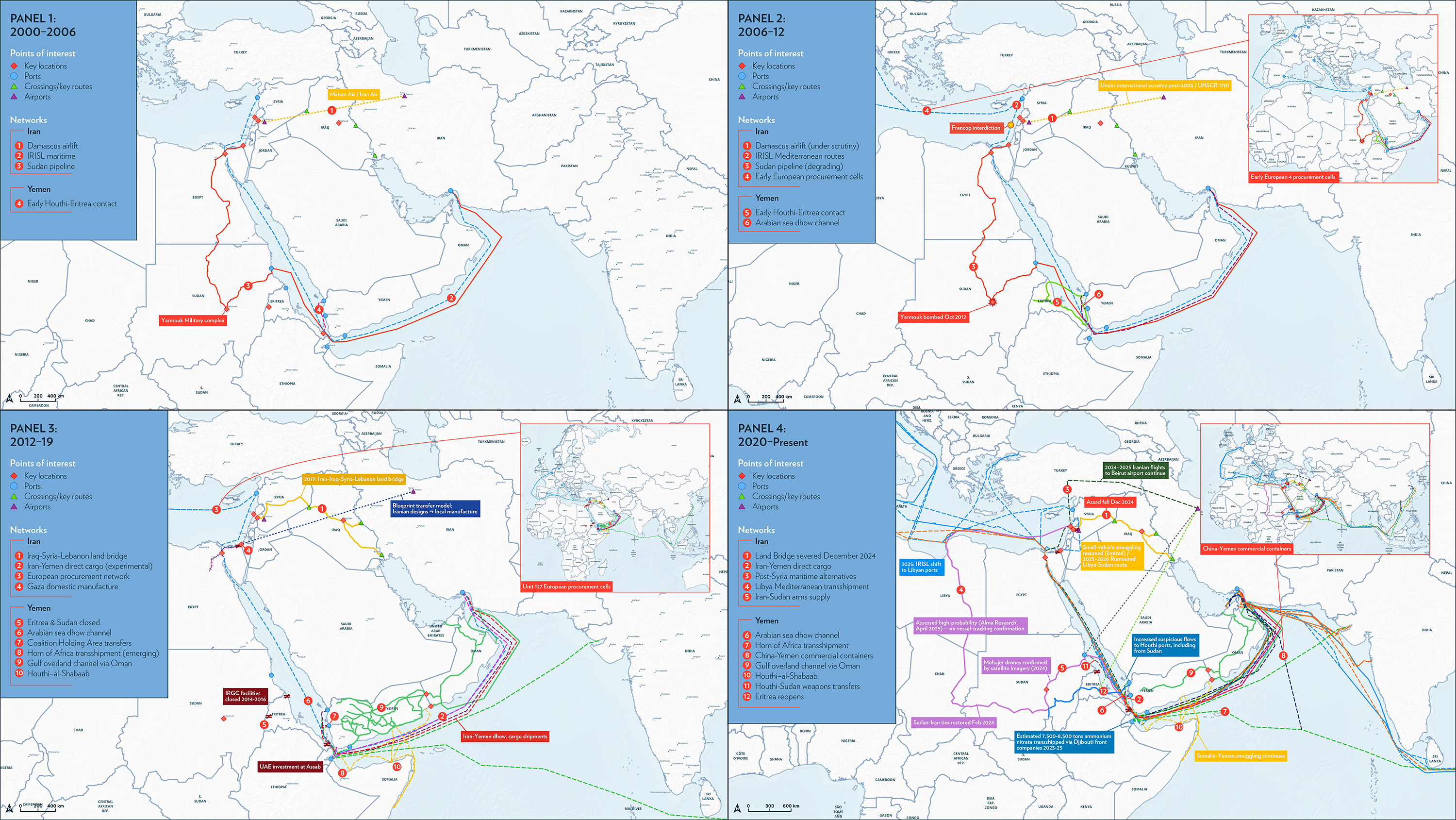
Beyond the Axis
The evolving and expanding nature of the Axis supply chain points to a final, important shift in the way that the Axis works. The ecosystem does not stop at assumed ideological or geographic borders mapped out in offices in Washington and London. This is not just true of the Axis’s supply chains. Power and alliances, too, are taking on a much more networked character. In fact, the Axis continued to cultivate new potential members and reconfigure itself—even as its demise was being widely predicted.
In 2024 and 2025, a series of blows to Iran and the Axis led many observers, including Israeli political leaders, Western think tanks, and even some Iranian officials, to argue that the Axis of Resistance was in fatal decline.157 On September 17, 2024, Israel detonated explosives it had secretly installed in pagers that Hezbollah used for its internal communications, killing 12 people, injuring at least 4,000, and demonstrating how deeply its intelligence services had penetrated the group. Later that month, Israeli airstrikes killed Nasrallah and several other senior Hezbollah figures. Then, in October 2024, Israeli forces killed the Hamas leader Yahya Sinwar, in Gaza. That December, the Damascus regime of Bashar al-Assad collapsed. Things only appeared to get worse for Iran and the Axis the following year, when the United States and Israel entered into a short, direct war with Iran that officials in Tel Aviv and Washington claimed decimated Iran’s air defenses, nuclear, and ballistic missile programs. A new Lebanese president, Joseph Aoun, ordered the disarmament of a purportedly helpless Hezbollah while the new government in Damascus cracked down on cross-border smuggling.
Yet by March 2026, it became clear that predictions of the Axis’s decline had been premature. Hezbollah proved much more able to reconstitute and rearm itself than many observers had believed. Iran, too, proved a much more robust adversary to Israel and the United States, in part because of its ability and willingness to fire thousands of missiles and Shahed-136s at its Gulf neighbors. Less visibly, the Houthis, while playing a much quieter role in the regional conflict, continued their network-building efforts in Africa.
A clue that the Axis was more robust than it appeared had come in September 2024, the month of the pager attacks, when security services in Mukalla, a port city in southern Yemen, detained a Somali national named Ahmed Elmi Samatar. Samatar soon confessed to being a member of al-Shabaab, the militant Sunni Somali armed group, which is affiliated with al-Qaeda.158 Samatar’s testimony breathed life into a rumor circulating among Yemeni, Somali, and regional intelligence networks: that al-Shabaab and the Zaydi Shia Houthis were building a working relationship. Samatar had been facilitating Shabaab fighters’ travel to Yemen for several months and had overseen Houthi operatives’ travel to Somalia to scope out potential missile and drone launch sites. In Yemen, Somali fighters were receiving the latest iteration of the training program that the Hezbollah operative Ali Musa Daqduq had provided for groups in the Popular Mobilization Units in Iraq eighteen years earlier, on basic military tactics, improvised explosive devices, and drone use.159
FIGURE 17
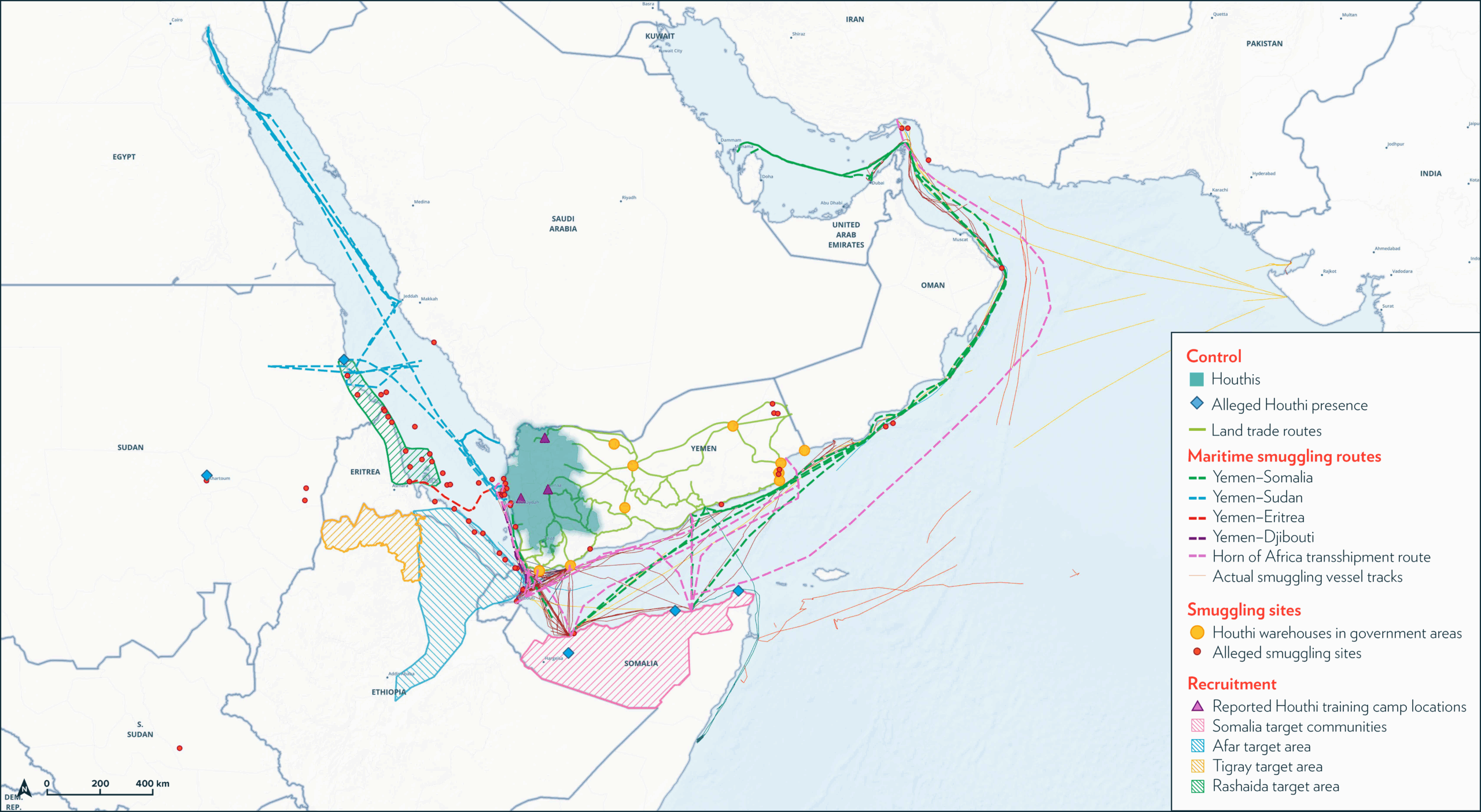
It turned out that Samatar’s involvement was just the tip of the iceberg of Houthi activity in Africa: Since at least 2022, a small group of senior Houthi intelligence and smuggling officials in Sana’a have built a web of relationships across the African coasts of the Red Sea and Gulf of Aden. Houthi smuggling networks are now present in Somalia, Djibouti, Eritrea, and Sudan. The group is recruiting smugglers, intelligence agents, and fighters from marginalized cross-border communities around the region. In one case, the Houthis trained, between 2016 and 2024, around 150 men from the Afar community that straddles the borders of Eritrea, Ethiopia, and Djibouti, eventually deploying some of them to the front lines of the Yemen war. (The relationship imploded when the Houthis killed the Afari leader they had been working with, after he organized a strike over the number of his men being sent to fight on the Houthis’ behalf.)160 Along with training al-Shabaab fighters, the Houthis are also reportedly transporting arms to and training Islamist factions within the Sudanese Armed Forces (SAF) on Iran’s behalf.161
A great deal of analysis of the Axis is still rooted in the assumption that it is formed primarily of several fixed units—Hamas, Hezbollah, the Houthis, and the Islamic Resistance in Iraq—whose continued survival is contingent on Iranian support and supply lines crossing through Syria. In reality, as individual Axis groups have grown more capable, they have experienced the “rich-get-richer” effect. As the Houthis’ expansion into Africa now shows, they accumulate more and more connections as their desirability as a partner increases; this was also Hezbollah’s trajectory, as well.
Al-Shabaab and Sudanese Islamist factions are not drawn to the Houthis and Iran because of ideological affinity, but because the Houthis have capabilities that these groups need and that no other available patron can provide—and, likely, because of shared adversaries, including the United States and Israel. Al-Shabaab’s leaders, for example, had long noted with interest the Houthis’ prowess with UAVs and with Iranian-made antiaircraft missiles they used to shoot down the U.S. Predator drones that have long bedeviled the Somali group.162 The more of these horizontal ties groups like the Houthis build, the greater the number of opportunities there are for cultivation, training, and even capability breakout.
Breakout in Africa?
Axis-led capability breakout may come to Africa surprisingly soon. Throughout 2025 and into 2026, regional and Western officials began to worry about a growing Houthi presence in Port Sudan (the current base of the SAF) and elsewhere in Sudan, including, allegedly, Houthi operatives sent to Sudan to train Islamist SAF factions in drone manufacturing and use alongside IRGC operatives.163 At first, the idea that the Houthis were becoming involved in Sudan in this way made little sense. The only Iranian drone in use in Sudan was the MALE Mohajer-6, which the Houthis have no history of building or using. But then, in July 2025, Sudan’s Military Industrial Corporation unveiled a new UAV that it called the Safaroog at a defense fair in Istanbul. Before the war started, the firm had been Sudan’s state arms manufacturer, and during the war, its leadership had already been sanctioned for importing Iranian drones. Arms experts were quick to note the resemblance of the Safaroog to the Ababil-T. Side-by-side comparison of the Safaroog with the Ababil-T shows a nearly identical profile (Figure 18, below).164 And if there is one drone the Houthis know how to make, it is the Ababil-T, which they call the Qasef-2K. A growing body of evidence now points to a deepening relationship between the Houthis and specific SAF factions (see below).
Figure 18
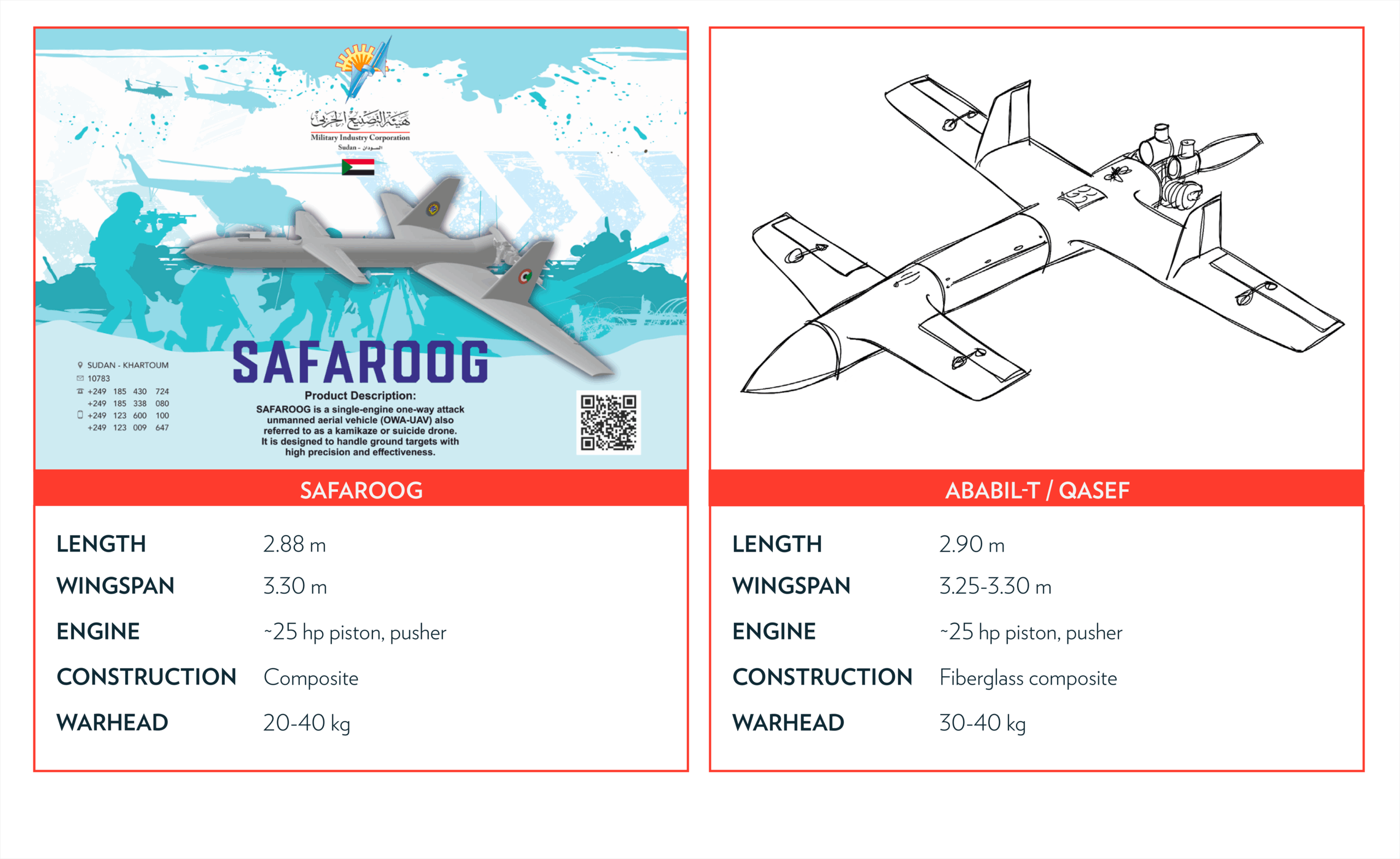
Outlasting the Axis
Networks outlast the political moments that birth them. The IRGC and the Axis are evidence of this continuity, in and of themselves. A conventional narrative of the Axis is that it is the product of a top-down Iranian, Khomeinist project that began in 1979.
But the origins of the Axis progenitors are not nearly so simple or hierarchical. The ties—and ideas—that underpin the Axis began with Shia political mobilization not in Iran but in Najaf, in Iraq, in the 1950s and 1960s; in the wars between Israel, the PLO and Lebanese factions in Lebanon in the 1970s and 1980s; and in the broader melting pot of revolutionary ideas that swept across the Middle East and the Global South in the mid-twentieth century.165 Many of the IRGC’s future founding cadres, for example, were trained in Fatah camps in Lebanon in the 1970s during that country’s civil war, absorbing the PLO’s guerilla warfare tactics before applying them during the Iran–Iraq War.166 Among the Lebanese trainees in the same camps was Imad Mughniyeh, the mastermind of Hezbollah’s evolution into a state-like military force and its external operations.167
The Islamic Revolution’s leaders and implementers were themselves shaped by, and drawn from, a diverse cast of revolutionary and anti-imperialist networks with overlapping but not identical interests. Dawa, the Iraqi Shia party founded in Najaf in 1957, provided a template for Shia political organization across the region, including the Movement of the Disinherited that became Amal in Lebanon, and the Iranian clerical networks that coalesced around Ayatollah Khomeini during his own thirteen-year exile in Najaf in the 1960s and 1970s.168 These groups drew on a range of sources for intellectual inspiration, including the Sunni political Islamist Sayyid Qutb, Ali Shariati, and Frantz Fanon.169 The Khomeinist project after 1979 focused on organizing these strains into a kind of common effort that, even as it was (on close examination), somewhat ideologically disjointed, was also greater than the sum of its parts when it came to military might and efficiency.
What often endures after networks transform or dissolve are capabilities.
Sometimes, networks reconstitute themselves in surprising ways. Elements of the military core of the secular, Ba’athist Iraqi regime of Saddam Hussein later helped the Islamic State build its short-lived caliphate in Iraq and Syria.170 One of the reasons the Houthis proved such a potent threat after their takeover of Sana’a in 2014, meanwhile, was the fact that they were able to take control of the Yemeni military, which already had an air force and missile program.
What often endures after networks transform or dissolve are capabilities. As newer networks have arisen out of old ones, new tactics and technologies have made those networks radically more potent. The PLO camps of the 1970s seeded guerilla tactics that were little changed by the time Daqduq arrived in Iraq in 2006. But the Axis has embedded much more consequential capabilities. The difference between the current cohort of Axis groups and their predecessors is not just one of capability or resources. It is also a difference of embeddedness.
Red Sea Nexus
The Houthi–SAF relationship similarly illustrates the way that historical relationships can reconstitute themselves to account for new circumstances. It also gives an idea of some of the ways that the Axis might evolve in future. The Houthis appear to be working not with the SAF’s main military command, but with a network of former and current military leaders tied to a specific Islamist faction that dominated Sudanese politics in the 1990s and early 2000s.
This group had a strong working relationship with Iran, apparently exchanging territorial access for arms: IRGC-Hezbollah smuggling cells ran arms to Hamas through Sudanese territory, and until the mid-2010s Khartoum had an agreement with Iran to build its own version of the Ababil-3, which its state-run Military Industrial Corporation called the Zagil-III.171 Sudanese military intelligence also allegedly hosted Houthi operatives in Sudan on Iran’s behalf.172 In 2016, Omar al-Bashir, then the president of Sudan, publicly broke with Iran after protestors stormed the Saudi consulate, under growing pressure from Riyadh.173 But in 2019, a popular uprising swept Bashir and many of his Islamist allies out of power.174 Two years later, SAF leaders launched a coup against the country’s new civilian leadership. And two years after that, civil war broke out between the SAF and the Rapid Support Forces, a western militia that supported the 2021 coup.
The civil war in Sudan has provided the Islamist network—and Iran—with a comeback opportunity. But they need help. With the SAF starved of arms, members of the network rekindled their relationship with Tehran around 2024, and Iranian air freighters airlifted Mohajer-6 drones to the Sudanese.175 The IRGC also, allegedly, had the Houthis send shipments of small arms to Port Sudan.176 These shipments likely played an important role in preventing the collapse of the SAF and in supporting its recapture of Khartoum in 2025.
There are several reasons why the Houthi–SAF relationship could endure even without Iranian brokerage. Many of the militias the Islamist faction backs lack military and technical training that the Houthis could provide. And if SAF factions begin producing Safaroog drones, Houthi procurement expertise could help them source components. The SAF’s status as a de facto state actor would make it easier for it to import dual-use materials than it is for the Houthis, impeded as they are by heavy sanctions and interdiction pressure. Components entering Sudan could in turn be redirected onward to Yemen, a supply route that would be harder to disrupt than the Houthis’ current ones, and one that would flow in the opposite direction from the arms flows this report has documented. A new, different form of interdependence could emerge even if the Islamic Republic collapses or emerges from the current regional war much diminished.
Regional context matters, too, and could equally lead to an unforeseen recalibration of the Axis ecosystem. The Houthis’ African expansion comes at a moment of regional turmoil that goes beyond the U.S.–Israeli–Iranian war. In late 2025, Saudi Arabia and the Emirates entered into direct competition over their respective spheres of influence in Yemen, the Red Sea, and the Horn of Africa. By the beginning of 2026, Saudi Arabia had pushed Emirates-backed forces out of eastern Yemen and was working with the SAF and the Federal Government of Somalia to roll back the Emirati presence in Sudan and Somalia.177 Ethiopia, an ally of the Emirates, is reportedly hosting Rapid Support Forces fighters in its north and allowing them to launch drone strikes on SAF positions, while Eritrea, a longtime foe of Addis Ababa, is both rebuilding its relationship with Iran (and, allegedly, the Houthis) and warming to overtures from Riyadh.178 Israel, working in close alignment with the Emirates, is also entering the regional fray. It has announced its recognition of the independence of Somaliland—a breakaway region of Somalia that has also received backing from the Emirates—and plans to set up a military base there, in part to counter the Houthis.179
Even if Iran collapses, in other words, the Axis ecosystem will persist. Although it may not be known as the Axis of Resistance in the future, the ecosystem, and many of the capabilities embedded in it, will outlast both the Islamic Republic and the Axis, morphing, adapting, and expanding into new areas as circumstances change.
Rewired Response: Conclusions and Recommendations
During the Iraq and Afghanistan wars, when more U.S. and allied troops were being killed by roadside bombs than any other threat, the U.S. Army established a new initiative, the Joint Improvised Explosive Device Defeat Organization (JIEDDO), to coordinate the response to the use of IEDs and explosively formed penetrators (EFPs). Washington invested billions of dollars in electronic countermeasures, in live digital monitoring capabilities, and in military operations to disrupt the manufacturing and supply networks behind the IED and EFP systems.180
The measures were effective in reducing American casualties. But they were a Band-Aid. “JIEDDO was a pretty efficient system for telling you what had killed your troops two days earlier, but it cost us hundreds of millions and billions of dollars. The way we ended the IED and EFP threat to U.S. forces was by withdrawing from Afghanistan and Iraq,” said a former U.S. Army explosive ordnance disposal specialist who served in the two countries in the mid-to-late 2000s.181 “Ultimately, there was no military or technical solution to the problem.”
Two decades after the invasion of Iraq, the regional wars of 2023–26 showed the long tail of the lessons the IRGC learned from the EFP program, and the changes the IRGC had wrought across the Axis by implementing them. Training groups to build their own weapons produced a much more resilient asymmetric threat than directly supplying them. And by teaching groups to turn networks into systems, the IRGC inadvertently rewired them into a globally connected ecosystem.
Iran’s adversaries have not learned the same lessons. The United States and Israel, having spent two decades targeting supply choke points using sanctions and other tools of economic coercion, moved on to attack physical choke points in the form of key leaders and arms production and storage sites. In 2025, Washington and Tel Aviv repeatedly declared victory over Hamas, Hezbollah, the Houthis, and Iran. But by May 2026, prominent commentators were declaring a relative Iranian victory over the United States and Israel while noting, with surprise, the speed with which Hezbollah had reconstituted itself over the previous year.182
Thinking in Ecosystems
The Axis of Resistance is an ecosystem. It is a dense mesh of interdependent actors that is still expanding and is far more adaptive and resilient than many outsiders recognize. And it has been a source, over the past two decades, of increasingly indiscriminate violence conducted at a growing remove. Charting a new policy course that addresses the Axis’s destabilizing role in the region, and its access to strategic weapons, will be challenging. Most states, and most of the policy bodies that serve them, were built during a period in which states could be treated as the primary unit of policy analysis, with regional or thematic connections overlaid on top and armed groups seen as subunits. Somalia, for example, could be understood as a single unit of analysis that was part of the Horn of Africa, and al-Shabaab as a Somalia counterterrorism problem.
These units of analysis and policymaking were always an oversimplification, providing decision-makers at home with an artificial sense of clarity that allowed for streamlined decision-making processes. Of course, as this report has shown, such oversimplifications obscure much more than they clarify. Hamas, Hezbollah, and the Houthis are not just subunits of Palestinian, Lebanese, or Yemeni political systems; nor can they be reduced to a counterterrorism or “Iran threat network” problem for which there is a simple, codifiable set of relatively low-cost solutions. They are formidably capable and networked actors embedded within their own societies and the global economy.
Policymakers recognize this point in the abstract, but struggle at times to know where to start in building a new analytical or policy approach to the problem set. In an earlier XCEPT-supported study, researchers at Chatham House discussed the challenge of conflict resolution in contexts where armed actors are plugged into decentralized, nonhierarchical ecosystems in which institutions, armed groups, and businesses operate across state borders. “If stabilization and peacebuilding in conflict zones are to become more effective,” they wrote, “policymakers must identify key entry points for understanding conflict dynamics . . . [in] a world that increasingly eludes categorization according to nation states or spheres of influence.”183
The temptation, when faced with something as complex as the Axis, can be to start too broad—to try to map the entire ecosystem and to be paralyzed by the scale of the task.
The temptation, when faced with something as complex as the Axis, can be to start too broad—to try to map the entire ecosystem and to be paralyzed by the scale of the task. This report is a template for finding a starting point for a workable understanding of and policy response to ecosystemic actors. Rather than building a complete model of the Axis and its relationship with Iran, the authors have taken a single weapon type—Iranian one-way attack UAVs—and used it as an isotope tracer. Drones, as the report has shown, are worth following because they feature at every point in the ecosystem’s expansion, and act as a critical marker of capability breakout. Groups are enticed with the promise of UAV technology, trained in the use of first-person-view drones, then provided with more advanced one-way attack models, and eventually taught to build their own.
Tracing UAV transfers reveals not just a weapons program, but also the shape of the ecosystem that produces it and is produced by it: the model of cultivation, training, and integration; the markers of a group’s progress toward deeper capability and closer ties to Iran; the outgrowth of ecosystems and their integration into larger ecosystems of trade and finance; and, in the case of the Axis, its ongoing expansion into the Horn of Africa.
By taking this approach, the report has produced two sets of implications: a deeper understanding of the mechanics of UAV proliferation; and the tiered policy challenge of dealing with the Axis ecosystem and its expansion.
Going Global: Proliferation and Multilateral Coordination
This report focuses on Iranian UAV proliferation, but its findings carry broader lessons. Iranian drones sit within a wider pattern of proliferation in which more state and nonstate actors are building ever more capable drones, drawing on a commercial component supply that grows and adapts in response to demand. Recent wars in Ukraine, the Middle East, and Africa have accelerated this dynamic, with Iran, Israel, Russia, Ukraine, Turkey, the United States, and the Axis groups (among others) all scaling up production of drones of varying size, range, and sophistication. In the long run, drone proliferation, including of long-range, more strategic variants, will only become more acute. Tried-and-tested policy tools will do little to turn back the tide.
As this report shows, the Axis groups’ current capabilities would have been unthinkable two decades ago, and reaching them required years of IRGC and Hezbollah investment in training and materiel transfers. Iranian and Axis cultivation and training still produce something important—the amalgamation of dense internal networks of skilled people, procurement structures, and embeddedness that gives Axis groups their durability. But today, anyone with an internet connection and a credit card can buy most of the components needed to make weaponized drones and learn how to assemble them through YouTube and other online tutorials.
China’s government has expressly said that it wants to grow its aerospace sector, including providing funding and incentives for the development of long-range UAVs in the same way it did for electric vehicles and solar panels.184 China’s strategies drove down the cost of production and improved the quality of electric vehicles and solar technology, allowing Chinese exporters to develop a dominant position in the global market. A similar trajectory for the aerospace sector would mean that UAVs and the intermediate components used to make them become more advanced and cheaper in the coming years—not because Iranian firms are copying Western components but because Chinese firms are building and exporting better drones. China, in other words, is fast becoming the world’s UAV choke point. Western officials believe Beijing is aware that Chinese intermediate goods are reaching Iran, Russia, and the Houthis, and that it tolerates this trade. Whether this reflects deliberate strategic calculation or the inertia of a giant export-oriented economy, the net effect is the same.
As for the trade channels that move goods from China to their end-users, these increasingly make use of low-friction transshipment hubs that have, thus far, chosen to prioritize their economic models over U.S. sanctions. The extensive deployment of U.S. sanctions and tariffs over the past two decades has arguably accelerated the development of economic networks, financial channels, shipping infrastructure, and component supply chains now precision-engineered to evade U.S. and Western influence.
For these reasons, the only solution to the democratization of drone technology will be a multilateral one that countries like China, Turkey, and the Emirates believe are in their individual interests. Two developments offer cautious optimism that a conversation, at least, may now be possible in ways that it was previously not. The first is that the costs of UAV proliferation are now visible to states that previously benefited from it or looked the other way. Since February 2026, Iran has directly targeted Saudi Arabia, the Emirates, Bahrain, and Kuwait with drone strikes; it is clear that these countries have direct material interests in restricting UAV proliferation that align, at least partially, with Western policy preferences. The second is that China, perceiving a growing threat to its internal security, has itself begun to take domestic UAV regulation more seriously, clamping down on the use of hobbyist drones around major cities.185 The industrial drivers making Chinese drones cheaper and more capable are also making them accessible to actors that China has no interest in arming, including criminal organizations and insurgent groups based in China.
Some tentative steps have already been taken toward multilateral action on one case of drone proliferation via commercial channels. In November 2025, the UK government, in its role as the informal UN lead for resolutions on Yemen, introduced new language on dual-use items and materials, while renewing the Security Council’s sanctions regime there. The UK-drafted resolution tasked the UN Panel of Experts that monitors the sanctions regime with reporting on the “direct or indirect sale, supply or transfer” of “dual-use components and precursor chemicals” to Yemen.186 China and Russia abstained, allowing the resolution to pass. The resolution created space, at a minimum, for multilateral discussion on the role of commercially sourced dual-use components in drone and other forms of modern warfare.
The Axis Ecosystem: A Tiered Approach
Iran and the Axis have proven highly resilient to policies built around the logic of targeting key nodes. They have survived the collapse of the Assad regime, the decimation of Hamas, and significant military damage to Hezbollah and Iran itself. The outcome that the United States and Israel sought in February 2026—precipitating catastrophic failure across the Iranian regime and the Axis—proved out of reach. In fact, the 2026 war showed that achieving these aims would impose a colossal price in blood and treasure: invasion and occupation of Iran (by the United States) and swathes, if not all, of Lebanon (by Israel) while precipitating civil war in Iraq and bombing Yemen into a new humanitarian catastrophe. And even then, if the Iranian regime were to collapse, and Hezbollah were to be defeated militarily, the ecosystem would live on in some form. Most importantly, the capabilities embedded in it would endure, particularly the ability to build and operate long-range drones made from imported parts.
Considering this resilience, what outcomes can policymakers realistically work toward? If eliminating the Axis is not among them, a narrower set of options presents itself from this report’s research: preventing the ecosystem’s further expansion via new groups and constraining the behavior of the groups already within it. Two broad types of policy follow from those two goals: the first targeting pre-breakout groups not yet fully embedded in the ecosystem, and the second dealing with post-breakout groups that have become far more resilient to external measures. These are not the outcomes the authors would ideally want, but they are the ones the report’s evidence suggests are achievable in the near term.
This is where the capability ladder is useful as a tool for policymakers. The ladder does not, in and of itself, tell policymakers what to do. What it does is locate a group on the spectrum of capability development and interdependence. It allows policy actors to identify which groups are pre- and post-breakout, and which warrant the most attention. In Africa, al-Shabaab and the Islamist SAF factions warrant the closest attention because they are demonstrably pre-breakout. al-Shabaab would warrant even more attention if it begins using Iranian-designed EFPs or shooting down Predator drones; so too for the SAF if it begins deploying the Safaroog, their Ababil-T variant, in the field. Afar groups and individuals with previous ties to the Houthis could also be monitored for any resumption or deepening of those ties (see Figure 19).
Figure 19
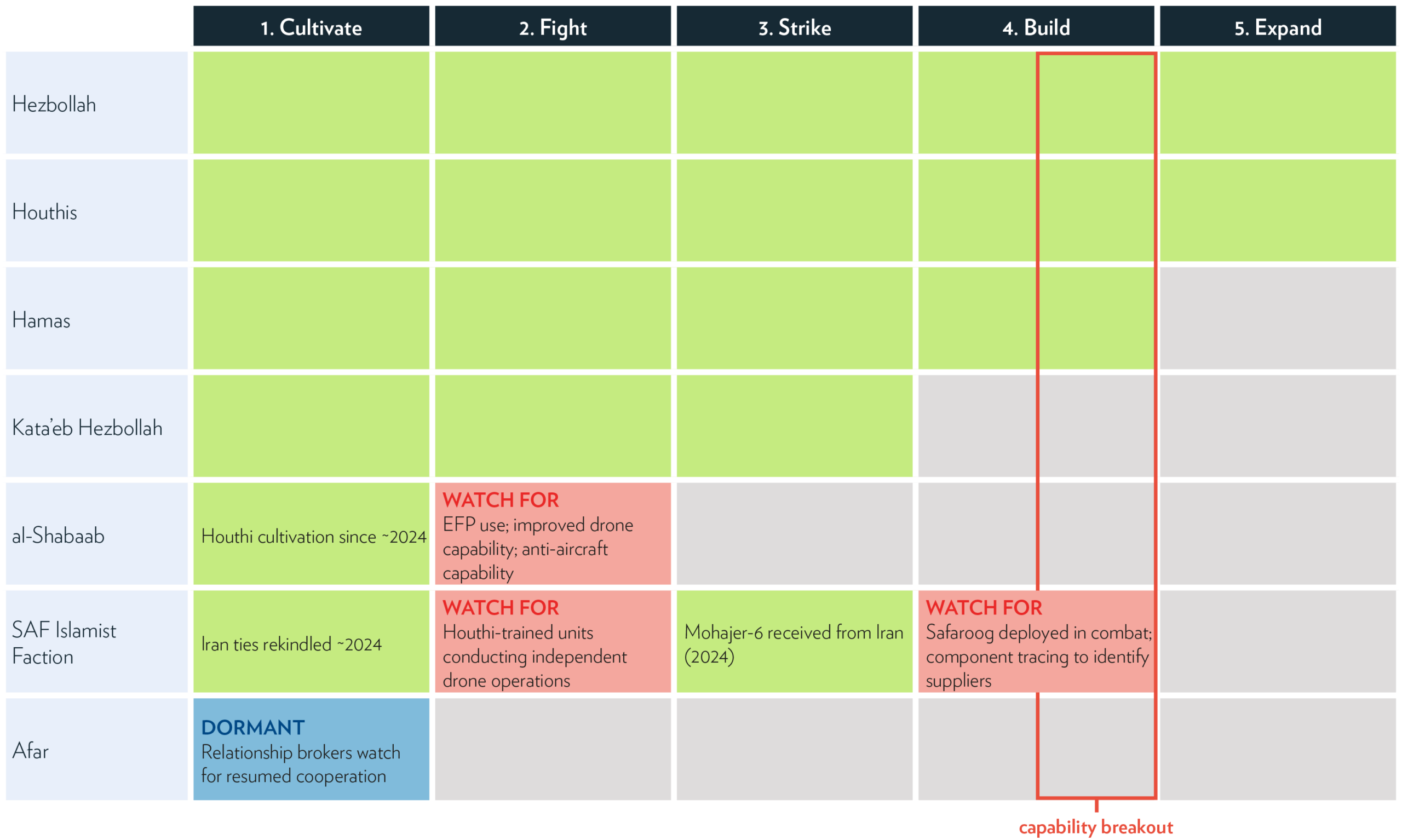
Each group and stage requires its own calibrated response. The rest of this section outlines the tools that policymakers might apply once this determination has been made. All of these policy responses require long-term investment, underscoring another important tension: Western policymakers’ time horizons are often constrained by electoral and budget cycles, and by a constant search for short-term policy “wins” that demonstrate efficacy to voters and political leaders. Such policies, by their nature, are ill-suited to tackling ecosystemic challenges that build slowly before bursting into view.
Before Breakout
For groups that are still being cultivated and trained by Iran or the Axis, there is some potential for intervention. Coercion alone has rarely worked with these groups. What has worked is the possibility of an alternative pathway. In Iraq, groups that Iran had hosted and armed for decades did not, in the end, remain instruments of a purely Iranian agenda. Over time, many developed national political stakes of their own that Tehran could influence, but not direct. But groups that did not build their own constituencies or local agendas—among them, Kata’eb Hezbollah—became more deeply enmeshed in a lopsided, dependent relationship with the IRGC.
The groups the Houthis are now cultivating in Africa can be sorted into two categories. The first, al-Shabaab and the Sudanese Islamist faction within the SAF, are ambitious would-be powers who see Houthi and Iranian support as a pathway to power. The second, the cross-border communities, like the Afar, that the Houthis have targeted, are responsive because they are desperate. The Houthis have been able to map these truly marginal communities because a large number of migrants originate from them and pass through Yemen, fleeing the economic, social and political hardships they face at home in search of a better life in the Gulf states. Afaris and individuals from other marginalized ethnic groups who have responded to Houthi overtures have done so, in turn, because they lack an alternative patron or pathway to improving conditions at home.
The different categories of groups require different policy responses. For ambitious would-be powers like al-Shabaab and the SAF Islamists, the question is one of carrots and sticks: whether pressure can be applied and credible off-ramps offered in a way that pulls them away from Iranian and Houthi support, increased capability and deeper interdependency, without legitimizing their methods or their bids for power at home. This, in turn, requires deep thought about what pressure will work against these groups (both are already subject to U.S. and other sanctions, and al-Shabaab has been targeted by a plethora of military campaigns), who might engage them, and what way out they and their members might be offered when the moment is right. For the marginal cross-border communities the Houthis target, the problem is different and more familiar: governance deficits and economic and political exclusion that make those communities pliable in the first place.
Over the Threshold
Once groups cross the capability tipping point, the costs and risks of attempting to even restrain them increase exponentially. The devastating Israeli offensives on Gaza and Lebanon in 2023–25 are sometimes cited as a demonstration of the potential for outright military defeat. Yet Hezbollah’s partial but unexpected resurgence, and Hamas’s persistence in Gaza, suggest the limits of even maximally violent and legally contested campaigns. Mitigation through sanctions, interdiction, and occasional strikes is a medium-term strategy that this report’s evidence suggests is not, on its own, a solution: it fosters adaptation that makes these policies less effective over time and is likely to produce further rounds of intensive conflict rather than a positive-sum end state.
A more honest reckoning would include options policymakers have so far been reluctant to consider, which carry real moral costs. From the evidence assembled in this report, two stand out—not as the most palatable, but as the most available.
The first is political engagement with at least some post-breakout groups, particularly as they take on governance in the territory they hold. A group administering a population acquires interests in stability, service delivery, and in not being bombed that an insurgent actor does not. This, in turn, provides a degree of leverage under the right circumstances. States have dealt extensively with the Taliban since 2021, and with the new authorities in Damascus since late 2024, accrediting envoys, lifting sanctions, and delisting leaders, often while sidestepping the question of formal recognition.187 These engagement strategies have produced mixed results: they appear to have moderated the impulses of the Damascus government, but not those of the Taliban in Kabul. Yemen’s Houthis point to the limits of the approach, meanwhile. The group, which is the de facto authority in northwestern Yemen, is engaged in direct talks with Saudi Arabia and with the UN over ending the war in Yemen but has repeatedly sought to use negotiations to engineer a settlement that leaves it in a dominant position in government, something Yemen’s internationally recognized government rejects.
The second option is fostering counterbalancing networks of armed actors, political coalitions, and even businesses, as a hedge against the power of post-breakout groups. But as this report has shown, counter-networks often outlive the moments they were created in. Sponsoring proxies to check other proxies has, in general, a poor track record. It means partnering with morally and legally compromised actors and risks exacerbating the conflicts and cross-border competition that produced the Axis in the first place. Some regional officials and observers believe, for example, that the Emirates has made support for nonstate armed groups in Libya, Sudan, Somalia, and Yemen a pillar of its foreign policy. Emirati officials deny some of these relationships and say that when they do engage with such groups, they do so to protect their national security interests. These observers allege that Emirati backing has only inflamed and prolonged the conflicts in those countries.188
Both approaches—engaging with capable actors and building counterbalancing networks—risk accelerating the very drift that Western policymakers say they want to avoid: the slide from a rules-based order.
Western states appear to be in little mood to start building their own networks of allies in the region. Regional officials and observers complain that the United States offers only limited support to state allies like the Lebanese Armed Forces that could counterbalance Axis groups. Washington continues to pressure the Lebanese army to disarm Hezbollah but has offered it little in the way of sustained backing or thought on how to convince the local Shia population that the Lebanese state can and will protect their interests, and Lebanon’s sovereignty, if Hezbollah were to be disbanded.189
Both approaches—engaging with capable actors and building counterbalancing networks—risk accelerating the very drift that Western policymakers say they want to avoid: the slide from a rules-based order—albeit a lopsided and often badly mismanaged one—into a transactional free-for-all that amplifies the drivers of conflict rather than containing them. That drift would, in turn, accelerate the trend toward an ecosystemic world order: a swirl of adaptations in a world governed by no single state or institution.
That these are the available choices should be cause for a moment of self-reflection on how much ground the rules-based order has already lost; and the extent to which leaning into the zeitgeist of powerful ecosystems will further erode that order. There is an alternative. States could uphold their own and international laws, rules, and regulations, and press others to do the same, including through multilateral venues such as the UN. Such an idea might seem almost laughably old-fashioned. But in years to come, this moment may look like a missed opportunity—to agree to shared rules not only on drones, but also for the new shapes that war is taking and the preservation of human life.
Conclusion: Beyond the Axis
In a May 2026 commentary for the Atlantic, the neoconservative writer Robert Kagan argued that Iran had achieved “checkmate” in its conflict with the United States.190 The diagnosis was appealing but misleading. A decade earlier, the scholar and former Department of State official Anne-Marie Slaughter described a world in which the chessboard—in which two sides with fixed pieces line up against one another in the hope of achieving a decisive final move—was being replaced by the web, a world in which networks were as important as raw power.191 Iran and its Axis of Resistance are just one example of why the old chessboard way of thinking now needs to be set aside.
Two decades of IRGC cultivation, training, and knowledge transfer turned the Axis of Resistance from a hub-and-spoke network of dependent groups into an ecosystem, pushing a small but significant number of Axis groups across a capability tipping point. The ecosystem can still be degraded but cannot, on the evidence of this report, be entirely eliminated. Even if the Iranian regime collapsed, the capabilities embedded across the ecosystem would outlast the Axis itself.
To deal with the Axis, policymakers will have to think beyond the Axis. Find a way in—an isotope tracer—that reveals the ecosystem’s true shape. Sort its members by where they sit on the capability ladder and tier policy responses accordingly. And make it harder, everywhere, for groups to build arms using off-the-shelf components. None of this will eliminate the Axis. It will instead support the more modest work of slowing its expansion, constraining its members, and buying the time in which other things like political settlements, better governance, and multilateral pressure can offer an alternate way forward.
The Axis is not the only ecosystem of its kind. Soon, other ecosystems of armed actors will form, drawing on the same commercial supply chains, the same online knowledge, the same globalized infrastructure. The time to learn its lessons, and adapt, is now.
Acknowledgements
This report is the capstone for “Beyond the Axis,” a Century International project supported by the Cross-Border Conflict Evidence, Policy and Trends (XCEPT) research program, funded by UK International Development. It was produced by a multidisciplinary team of researchers led by Peter Salisbury, who drafted the report with support from the team and editorial director Eamon Kircher-Allen. Kevin Mazur led data analysis and worked with Olea Rusten Rugumayo to produce the report’s visuals. Henry Thompson and Veena Ali-Khan were essential contributors to the report’s framing of arms proliferation and the Axis of Resistance. The project would not have been possible without the support of Thanassis Cambanis, the Director of Century International, and Ruth Citrin and Alexander Fischer at XCEPT.
Contributors
Veena Ali-Khan is a journalist at Bloomberg News. Before joining Bloomberg, she was a fellow at Century International, focusing on the Arabian Peninsula, Gulf energy dynamics, and political economy in the Middle East. Earlier, she was the Yemen researcher at the International Crisis Group.
Aref Alkrez is a Syrian journalist and researcher focused on conflict and post-conflict reporting. His work centers on political violence, missing persons, migration, and war crimes.
Mohammed al-Basha is a researcher and consultant. The founder of the Basha Report, a U.S.-based risk advisory firm, he specializes in the analysis and visualization of complex security, military, and geopolitical environments.
Nadwa al-Dawsari is a researcher and conflict analyst specializing in Yemen and the broader region. Her work examines Yemen’s conflict dynamics and their regional security implications amid the rise of nonstate armed groups and proxy warfare. She is an associate fellow at the Middle East Institute.
Fatima Ayub is a researcher who has worked at the nexus of conflict, security, and human rights issues in the Middle East and South Asia for more than two decades.
Jay Bahadur is the Nairobi-based codirector of Scopus Insights and a former UN Security Council sanctions monitor covering Somalia and Eritrea. His work focuses on Islamist militancy, maritime arms smuggling, piracy, illegal fishing, and natural resource conflict.
Thanassis Cambanis is an author, a journalist, and the director of Century International. His work focuses on U.S. foreign policy, Arab politics, and social movements in the Middle East.
Matthew S. Gerson is an MPA candidate at Columbia University’s School of International and Public Affairs. He previously served as a legislative aide on Capitol Hill, where he advised members on foreign policy and defense issues.
Sima Ghaddar is a sociologist and policy researcher. She holds a PhD in Sociology from the University of California, Los Angeles (UCLA), where her research examines the politics of humanitarian aid, transnational nongovernmental organization governance, and the intersections of patronage, clientelism, and global aid systems in the Global South, with a focus on Lebanon.
Roland Gillah is a conflict analyst and humanitarian access specialist who has worked in Syria, across North Africa and the African Great Lakes. He has consulted for the UN Department of Peace Operations and U.S. Indo-Pacific Command and was an investigator for Microsoft Threat Analysis Team.
Jonas Horner is a researcher and analyst who has worked with the European Council on Foreign Relations, the UN, and the International Crisis Group on Sudan and the Horn of Africa.
Trevor Jones is a researcher and policy analyst focused on international security and emerging military technologies. He is a master’s candidate in International Security Policy at Columbia University’s School of International and Public Affairs.
Eamon Kircher-Allen is editor-in-chief at Century International and was the editorial director for the Beyond the Axis project. He has worked as a journalist in the United States and East Africa, and for more than a decade as a writer, editor, and researcher focusing on economics, the environment, and the Middle East and Africa.
Amanda Long works on violence prevention and national security threat intelligence in the AI space. Previously, she worked as an open-source researcher and policy analyst focused on civilian protection and conflict resolution, including with UNU-CPR, the UN Operations and Crisis Centre, and the U.S. Institute of Peace.
Kevin Mazur is a social scientist and lecturer at the Department of Political Economy at King’s College London. His work blends quantitative and qualitative research methods to examine identities and state-society connections in armed conflict.
Richard Nield is an investigative journalist and analyst specializing in Africa and the Middle East. His work focuses on conflict economies, transnational illicit networks, and corruption, particularly across North and Central Africa and the Horn.
Wolf-Christian Paes is an associate fellow for armed conflict at the International Institute for Strategic Studies. A former arms expert on the UN Panel of Experts and consultant for the UN Office on Drugs and Crime, his work focuses on arms control and sanctions enforcement, as well as on maritime security.
Olea Rusten Rugumayo is a graphic design and communications consultant who specializes in translating complex data, maps, and policy concepts into accessible visuals. She works with clients including the Consultative Group on International Agricultural Research, XCEPT, Chemonics, and the London School of Economics.
Peter Salisbury is the research lead for the Beyond the Axis project. A researcher and writer who studies the political economy of war and peace in the Middle East, he is a fellow at Century International, and an adjunct assistant professor at Columbia University’s School of International and Public Affairs.
Albin Szakola is an investigative journalist and consultant for Tahaleel Limited, specializing in cross-border illicit trade and the political economies of Lebanon and Syria.
Henry Thompson is an arms, energy, and community relations expert. A former member of the UN Panel of Experts for Yemen, he has worked globally to advise major international nongovernmental organizations, energy companies, and peacebuilding initiatives.
About XCEPT
XCEPT brings together world-leading experts and local researchers to examine conflict-affected borderlands, how conflicts connect across borders, and the drivers of violent and peaceful behavior, to inform policies and programs that support peace. For more information, visit https://www.xcept-research.org/ or contact us at [email protected]. This is independent research and the views expressed are those of the authors and do not reflect the UK government’s official policies.
Notes
- Tal Beeri, “Iran’s UAV Army—A Global Threat,” Alma Research and Education Center, 2022, https://israel-alma.org/wp-content/uploads/2023/01/Irans-UAV-Army-%E2%80%93-A-Global-Threat-January-2023-update.pdf.
- “MGLE01: Syrian Intelligence May Have Worked with Hizballah on UAV Launchings,” U.S. Embassy Beirut Cable, April 2005, released via WikiLeaks, https://wikileaks.org/plusd/cables/05BEIRUT1322_a.html.
- “MGLE01: Syrian Intelligence May Have Worked with Hizballah on UAV Launchings,” U.S. Embassy Beirut Cable, April 2005, released via WikiLeaks, https://wikileaks.org/plusd/cables/05BEIRUT1322_a.html.
- Barak Salmoni, Bryce Loidolt, and Madeleine Wells, “Regime and Periphery in Northern Yemen: The Huthi Phenomenon,” RAND Corporation, 2010, https://www.rand.org/pubs/monographs/MG962.html.
- Peter Salisbury, Henry Thompson, and Veena Ali-Khan, “From Smugglers to Supply Chains: How Yemen’s Houthi Movement Became a Global Threat,” Century International, February 9, 2026, https://tcf.org/content/report/from-smugglers-to-supply-chains-how-yemens-houthi-movement-became-a-global-threat/.
- Sanam Vakil, “How Iran’s ‘Forward Defence’ Became a Strategic Boomerang,” Chatham House, March 16, 2026, https://www.chathamhouse.org/publications/the-world-today/2026-03/how-irans-forward-defence-became-strategic-boomerang; Ariane Tabatabai, No Conquest, No Defeat: Iran’s National Security Strategy (Oxford: Oxford University Press, 2020).
- Renad Mansour and Hayder al-Shakeri, “The Shape-Shifting ‘Axis of Resistance,’” Chatham House, March 6, 2025, https://www.chathamhouse.org/2025/03/shape-shifting-axis-resistance.
- Michael Knights, “The Evolution of Iran’s Special Groups in Iraq,” CTC Sentinel 3, no. 11–12(2010): 12-16, https://ctc.westpoint.edu/the-evolution-of-irans-special-groups-in-iraq/.
- To simplify, this report assigns all IRGC and Quds Force-related activities to the IRGC.
- Renad Mansour and Hayder al-Shakeri, “The Shape-Shifting ‘Axis of Resistance,’” Chatham House, March 6, 2025, https://www.chathamhouse.org/2025/03/shape-shifting-axis-resistance.
- August Richard Norton, Hezbollah: A Short History (Princeton, NJ: Princeton University Press, 2007).
- Jonathan Schanzer, Hamas vs. Fatah: The Struggle for Palestine (New York: Palgrave Macmillan: 2008): 110–30.
- Peter Salisbury, “Yemen: Stemming the Rise of a Chaos State,” Chatham House, May 2016, https://www.chathamhouse.org/sites/default/files/publications/research/2016-05-25-yemen-stemming-rise-of-chaos-state-salisbury.pdf.
- Local and knowledgeable Syrian sources, interviews with the researchers, 2025.
- Thanassis Cambanis et al., “Roundtable: War on Iran Was Easy to Start. It Won’t Be Easy to End.,” Century International, March 9, 2026, https://tcf.org/content/commentary/roundtable-war-on-iran-was-easy-to-start-it-wont-be-easy-to-end/.
- Author analysis of ACLED data on file with Century International.
- Ariane Tabatabai, “Decades in the Making: The Iranian Drone Program,” Bulletin of the Atomic Scientists, October 12, 2017, https://thebulletin.org/2017/10/decades-in-the-making-the-iranian-drone-program/.
- On Venezuelan drone cooperation with Iran, see Antonio María Delgado, “From Zero to a Diverse Arsenal: A Look at Venezuela’s Military Drones,” Miami Herald, August 28, 2025, https://www.miamiherald.com/news/nation-world/world/americas/venezuela/article311882605.html. On Sudan, see “Expanding Sphere of Influence: Iranian UAV Export,” Oryx, November 27, 2022, https://www.oryxspioenkop.com/2022/11/expanding-sphere-of-influence-iranian.html. On technology transfer to nonstate partners, see Andrew Hanna, “Iran’s Drone Transfers to Proxies,” United States Institute of Peace, June 30, 2021, https://iranprimer.usip.org/blog/2021/jun/30/iran%E2%80%99s-drone-transfers-proxies; “Iranian Technology Transfers to Yemen,” Conflict Armament Research, March 2017, https://www.conflictarm.com/perspectives/iranian-technology-transfers-to-yemen/.
- Based on media reports, open-source intelligence researchers on X, and author research.
- Tomas Milasauskas and Liudvikas Jaškūnas, “FPV Drones in Ukraine Are Changing Modern Warfare,” Atlantic Council, June 2024. On the broader transformation of close-range combat through FPV drones, see Don Rassler, “On the Horizon: The Ukraine War and the Evolving Threat of Drone Terrorism,” CTC Sentinel 8, no. 3 (March 2025): 1–24, https://ctc.westpoint.edu/on-the-horizon-the-ukraine-war-and-the-evolving-threat-of-drone-terrorism/.
- On the Murad-5 designation as the Iraqi Islamic Resistance variant of the Shahed-101, see Stijn Mitzer and Joost Oliemans, “The Oryx Handbook of Iranian Drones,” Oryx, October 8, 2022, https://www.oryxspioenkop.com/2019/09/the-oryx-handbook-of-iranian-drones.html, listing the “Murad-5” as a Shahed-derivative loitering munition supplied to the Popular Mobilization Units in Iraq. On the Shahed-101’s deployment in Ukraine, see Taras Safranov, “Focused on Logistics: Russia Increased the Number of Attacks With Iranian Shahed-101 Drones,” Militarnyi, November 17, 2025, https://militarnyi.com/en/news/focused-on-logistics-russia-increased-the-number-of-attacks-with-iranian-shahed-101-drones/.
- The Shahed-131 was used in May 2019 and September 2019 attacks on Saudi oil facilities. Both attacks were claimed by the Houthis, but later reporting indicated that at least one originated in Iraq. On the May attack, see “Letter Dated 27 January 2020 from the Panel of Experts on Yemen,” United Nations Security Council, S/2020/326, January 27, 2020, https://reliefweb.int/report/yemen/letter-dated-27-january-2020-panel-experts-yemen-addressed-president-security-council. On the likely Iraqi launch origin, see Michael Knights, “Drones Over Riyadh: Unpacking the Iran Threat Network’s Tactics,” Washington Institute for Near East Policy, January 29, 2021, https://www.washingtoninstitute.org/policy-analysis/drones-over-riyadh-unpacking-iran-threat-networks-tactics.
- Tom O’Connor, “Exclusive: Iran Positions ‘Suicide Drones’ in Yemen As Red Sea Tensions Rise,” Newsweek, January 14, 2021, https://www.newsweek.com/iran-suicide-drones-yemen-red-sea-tensions-1561395. On the Sana’a exhibit, see “Iran: Enabling Houthi Attacks Across the Middle East,” Defense Intelligence Agency, February 2024, https://www.dia.mil/Portals/110/Documents/News/Military_Power_Publications/Iran_Houthi_Final2.pdf.
- “Treasury Sanctions Iranian Persons Involved in Production of Unmanned Aerial Vehicles and Weapon Shipment to Russia,” U.S. Department of the Treasury press release, September 8, 2022, https://home.treasury.gov/news/press-releases/jy0940.
- On Iraqi militia use, a U.S. official confirmed a Shahed drone was used in a January 2024 attack on a U.S. base in Jordan that killed three U.S. soldiers that American military officials said “bore the hallmarks of Kata’eb Hezbollah.” See Fiona Nimoni, “Three Us Soldiers Killed in Jordan Attack Named,” BBC, January 29, 2024, https://www.bbc.com/news/world-middle-east-68133115. More recently, in March 2026 an Iraqi group believed to be a Kata’eb Hezbollah front organization posted a video of itself launching either a Shahed-131 or Shahed-136. See Phillip Smyth (@PhillipSmyth), “Kata’ib Jund al-Karar fi Bilad al-Sham (a front group crafted by the IRGC with some rather close links to KH) has claimed to launch a drone attack at Muwafaq al-Salti Air Base in Jordan.,” X, March 29, 2026, https://x.com/PhillipSmyth/status/2038407867078676655?s=20. On Hezbollah’s alleged possession and use of the Shahed-136, see Neta Bar, “Hezbollah’s Drone Arsenal: How Much of a Threat Is It?,” Israel Hayom, October 14, 2024, https://www.israelhayom.com/2024/10/14/threat-of-hezbollahs-drone-arsenal-explained/.
- Kerry Chávez and Ori Swed, “The Proliferation of Drones to Violent Nonstate Actors,” Defence Studies 21, no. 1 (2021): 1–24.
- Stephen N. R., “The AK-47 of the Skies: How Iran’s Cheap Drones Are Reshaping This War,” Gulf News, March 4, 2026, https://gulfnews.com/world/mena/the-ak-47-of-the-skies-how-iran-s-cheap-drones-are-reshaping-this-war-1.500462530.
- Paul Mozur and Adam Satariano, “‘Designed to Wreak Havoc’: The Cheap Drones Shaping the War with Iran,” New York Times, March 7, 2026, https://www.nytimes.com/2026/03/07/technology/iran-shahed-drones-us-war.html.
- Michael C. Horowitz and Lauren A. Kahn, “Iran’s Drone Advantage,” Foreign Affairs, March 11, 2026, https://www.foreignaffairs.com/iran/irans-drone-advantage.
- United States Office of Military Commissions, United States of America v. Ali Musa Daqduq al Musawi, MC Form 458, “Block II Charges and Specifications,” January 1, 2012, https://embed.documentcloud.org/documents/302052-daqduq-tribunal-chargesheet/.
- David Crist, The Twilight War: The Secret History of America’s Thirty-Year Conflict with Iran (New York: Penguin, 2012); Afshon Ostovar, Vanguard of the Imam: Religion, Politics, and Iran’s Revolutionary Guards (Oxford, UK: Oxford University Press, 2016).
- Hala Jaber, Hezbollah: Born with a Vengeance (New York: Columbia University Press, 1997).
- Clan members and Lebanese businessmen, researcher interviews, 2026.
- Subhi Amhaz, “The Clans of Baalbek-Hermel: From Banners to the Dominion of Hezbollah” (in Arabic), Raseef22, January 18, 2022, https://raseef22.net/article/1086029-عشائر-بعلبكالهرمل-من-البيارق-إلى-سطوة-حزب-الله.
- A list of forty-eight Hezbollah fighters killed between 1983 and 1991, known as the “first martyrs of Baalbek,” shows individual recruits aged 18 to 25 drawn from across multiple clan branches, including the hitherto marginal Chams and Amhaz, recruited at the edges of kinship structures rather than through clan leaders. See battle details in “The Heroic Epic of Maydoun” (in Arabic), Al-Khanadeq, May 4, 1988, https://alkhanadeq.com/event.php?id=357.
- Yemeni officials, southern separatists, former and current members of the Houthi movement, expert researchers and mediators, contemporaneous author interviews and author interviews in 2025–26.
- Three former Yemeni security officials, one former Houthi smuggling manager, interviews with the authors, 2025–26.
- Peter Salisbury, Henry Thompson, and Veena Ali-Khan, “From Smugglers to Supply Chains: How Yemen’s Houthi Movement Became a Global Threat,” Century International, February 9, 2026, https://tcf.org/content/report/from-smugglers-to-supply-chains-how-yemens-houthi-movement-became-a-global-threat/.
- Michael Knights, Hamdi Malik, and Crispin Smith, “Iraq’s New Regime Change: How Tehran-Backed Terrorist Organizations and Militias Captured the Iraqi State,” CTC Sentinel 16, no. 11 (December 2023): 1–24, https://www.washingtoninstitute.org/policy-analysis/iraqs-new-regime-change-how-tehran-backed-terrorist-organizations-and-militias.
- Renad Mansour, “Networks of Power: The Popular Mobilization Forces and the state in Iraq,” Chatham House, February 25, 2021, https://www.chathamhouse.org/2021/02/networks-power.
- Yezid Sayigh, Armed Struggle and the Search for State: The Palestinian National Movement, 1949–1993 (Oxford, UK: Oxford University Press, 1997).
- Elad Ben-Dror, “‘We Were Getting Close to God, Not Deportees’: The Expulsion to Marj al-Zuhur in 1992 as a Milestone in the Rise of Hamas,” Middle East Journal 74, no. 3 (2020): 399–416.
- Matthew Levitt, “Hezbollah’s Regional Activities in Support of Iran’s Proxy Networks,” Middle East Institute, July 26, 2021, https://mei.edu/publication/hezbollahs-regional-activities-support-irans-proxy-networks/; “Treasury Sanctions Hizballah Leadership,” U.S. Department of the Treasury, press release, August 22, 2013, https://home.treasury.gov/news/press-releases/jl2147.
- See, for example, “Iran’s Islamic Revolutionary Guard Corps (IRGC) ‘Intensely’ Trains Operatives in Operation of Drones in Eastern Syria,” MEMRI, November 2024, https://www.memri.org/jttm/irans-islamic-revolutionary-guard-corps-irgc-intensely-trains-operatives-operation-drones#_edn1.
- Hezbollah’s Khalil al-Harb and Haytham al-Tabatabai, at different times the top leaders of Unit 3800, both spent many years in Yemen, according to their official martyrdom statements. Heba Nasser, “Haytham Ali Tabatabai: The Hezbollah Commander Who Cut His Teeth in Syria and Yemen,” Middle East Eye, November 24, 2025, https://www.middleeasteye.net/news/tabatabai-hezbollah-military-commander-cut-teeth-syria-yemen.
- Former trainees, regional and Western officials, interviews with the authors, 2024–26.
- Yemeni security officials, researchers, close Yemeni observers of the Houthi movement, interviews with the authors, 2024–26.
- Joseph Felter and Brian Fishman, “Iranian Strategy in Iraq: Politics and ‘Other Means,’” Combating Terrorism Center at West Point, 2008, https://ctc.westpoint.edu/wp-content/uploads/2010/06/Iranian-Strategy-in-Iraq.pdf.
- Former U.S. Army explosive ordnance disposal expert, interviews with the authors, 2025–26. On the 2009 acknowledgement that the majority of EFPs were locally built, see Greg Grant, “900 IED Attacks a Month in Iraq and Afghanistan: Metz,” Military.com, December 12, 2008, https://www.military.com/dodbuzz/2008/12/12/900-ied-attacks-a-month-in-iraq-and-afghanistan-metz.
- Former U.S. Army explosive ordnance disposal expert, interviews with the authors, 2025–26.
- Former U.S. Army explosive ordnance disposal expert, interviews with the authors, 2025–26.
- Southern Yemeni leaders, interviews with the authors, 2025.
- Southern Yemeni leaders, interviews with the authors, 2018 and 2025.
- Southern Yemeni leaders, interviews with the authors, 2018 and 2025.
- Amir Toumaj, Candace Rondeaux, and Arif Ammar, “Soleimani’s Shadow: The Fatemiyoun Division and Iran’s Proxy Warfare Propaganda,” New America, July 13, 2021, https://www.newamerica.org/insights/soleimanis-shadow/.
- Tobias Schneider, “The Fatemiyoun Division: Afghan Fighters in the Syrian Civil War,” Middle East Institute, October 15, 2018, https://mei.edu/publication/fatemiyoun-division-afghan-fighters-syrian-civil-war/.
- Syrian officials, interviews with the authors, 2025. See also “As Part of Iran’s Ongoing Policy of Deploying Its Afghan Shi’ite Militia, IRGC Reportedly Training Fatemiyoun Brigade in Drone Use in Syria,” MEMRI, September 4, 2022, https://www.memri.org/reports/part-irans-ongoing-policy-deploying-its-afghan-shiite-militia-across-middle-east-irgc/.
- Anthony Cordesman and William Sullivan, “Lessons of the 2006 Israeli-Hezbollah War,” Center for Strategic and International Studies, November 14, 2007, https://www.csis.org/analysis/lessons-2006-israeli-hezbollah-war.
- Alma Research Center; IDF assessments. On 1,500 drone attacks 2023–25, see ACLED data.
- Peter Salisbury, Henry Thompson, and Veena Ali-Khan, “From Smugglers to Supply Chains: How Yemen’s Houthi Movement Became a Global Threat,” Century International, February 9, 2026, https://tcf.org/content/report/from-smugglers-to-supply-chains-how-yemens-houthi-movement-became-a-global-threat/.
- Peter Salisbury, Henry Thompson, and Veena Ali-Khan, “From Smugglers to Supply Chains: How Yemen’s Houthi Movement Became a Global Threat,” Century International, February 9, 2026, https://tcf.org/content/report/from-smugglers-to-supply-chains-how-yemens-houthi-movement-became-a-global-threat/.
- Peter Salisbury, Henry Thompson, and Veena Ali-Khan, “From Smugglers to Supply Chains: How Yemen’s Houthi Movement Became a Global Threat,” Century International, February 9, 2026, https://tcf.org/content/report/from-smugglers-to-supply-chains-how-yemens-houthi-movement-became-a-global-threat/.
- Peter Salisbury, Henry Thompson, and Veena Ali-Khan, “From Smugglers to Supply Chains: How Yemen’s Houthi Movement Became a Global Threat,” Century International, February 9, 2026, https://tcf.org/content/report/from-smugglers-to-supply-chains-how-yemens-houthi-movement-became-a-global-threat/.
- “Indiscriminate Fire: Palestinian Rocket Attacks on Israel and Israeli Artillery Shelling in the Gaza Strip,” Human Rights Watch, June 30, 2007, https://www.hrw.org/report/2007/06/30/indiscriminate-fire/palestinian-rocket-attacks-israel-and-israeli-artillery.
- Fabian Hinz, “Iran Transfers Rockets to Palestinian Groups,” Wilson Center, May 19, 2021, https://www.wilsoncenter.org/article/irans-rockets-palestinian-groups.
- Fabian Hinz, “Iran Transfers Rockets to Palestinian Groups,” Wilson Center, May 19, 2021, https://www.wilsoncenter.org/article/irans-rockets-palestinian-groups.
- Fabian Hinz, “Iran Transfers Rockets to Palestinian Groups,” Wilson Center, May 19, 2021, https://www.wilsoncenter.org/article/irans-rockets-palestinian-groups.
- Fanar Haddad, “Understanding Iraq’s Hashd al-Sha’bi,” Century International, March 5, 2018, https://tcf.org/content/report/understanding-iraqs-hashd-al-shabi/.
- Public reporting and off-the-record claims by regional and Western officials both support this conclusion. See also Stephen Kalin, “Saudi Arabia and Iraq Are Caught in a Hidden War Within the War,” Wall Street Journal, April 20, 2026, https://www.wsj.com/world/middle-east/saudi-arabia-iraq-conflict-iran-war-0d9dd8d8.
- On Kata’eb Hezbollah and al-Muhandis, see Michael Knights and Hamdi Malik, “Honored, Not Contained: The Future of Iraq’s Popular Mobilization Forces,” Washington Institute for Near East Policy, March 23, 2020, https://www.washingtoninstitute.org/policy-analysis/honored-not-contained-future-iraqs-popular-mobilization-forces. On alleged participation in 2019 Saudi strikes, see Michael Knights, “Drones Over Riyadh: Unpacking the Iran Threat Network’s Tactics,” Washington Institute for Near East Policy, January 29, 2021, https://www.washingtoninstitute.org/policy-analysis/drones-over-riyadh-unpacking-iran-threat-networks-tactics.
- On the post-2006 rearmament challenge, see August Richard Norton, Hezbollah: A Short History (Princeton, NJ: Princeton University Press, 2007); “Hizbollah’s Syria Conundrum,” International Crisis Group, March 14, 2017, https://www.crisisgroup.org/rpt/middle-east-north-africa/lebanon/175-hizbollahs-syria-conundrum. Former U.S. Army explosive ordnance specialist, interview with the authors, 2026.
- Courtney Kube and Ken Dilanian, “U.S. Investigating Whether Iran Gave Advanced Training to Hamas Militants,” NBC News, October 11, 2023, https://www.nbcnews.com/news/investigations/us-investigating-whether-iran-gave-advanced-training-hamas-militants-rcna119824; Dan Williams and Fares Alghoul, “Hamas Draws on Arms Training in Iran, Class Notes Reveal,” Bloomberg, November 4, 2024, https://www.bloomberg.com/news/articles/2024-11-05/class-notes-reveal-hamas-drawing-on-arms-training-from-iran.
- Courtney Kube and Ken Dilanian, “U.S. Investigating Whether Iran Gave Advanced Training to Hamas Militants,” NBC News, October 11, 2023, https://www.nbcnews.com/news/investigations/us-investigating-whether-iran-gave-advanced-training-hamas-militants-rcna119824.
- “Kings of the Sky: The Story of Hezbollah’s Air Force” (in Arabic), Al-Akhbar, July 27, 2024, https://www.al-akhbar.com/Politics/384913.
- IHS Jane’s Defense Weekly, satellite imagery analysis, April 23, 2015, cited in “Hezbollah Drone Airstrip in Lebanon Revealed,” Ynet News, April 25, 2015, https://www.ynetnews.com/articles/0,7340,L-4650361,00.html.
- Gili Cohen, “Hezbollah Strikes Nusra Front Positions near Syria Border, Iran Says,” Haaretz, September 22, 2014, https://www.haaretz.com/2014-09-22/ty-article/hezbollah-attacks-nusra-front-near-syria/0000017f-db39-df62-a9ff-dfff23da0000. For August 2016 video evidence of Hezbollah drones dropping Chinese-made MZD-2 submunitions near Aleppo, see “Video Appears to Confirm Use of Attack Drones by Hezbollah,” Times of Israel, August 11, 2016, https://www.timesofisrael.com/video-appears-to-confirm-use-of-attack-drones-by-hezbollah-in-syria/.
- Sharon Wrobel, “Hezbollah Amassed 2,000 Drones as Part of Iran’s ‘UAV Army,’ Report Warns,” Algemeiner, December 23, 2021, https://www.algemeiner.com/2021/12/23/hezbollah-amasses-2000-drones-as-iran-builds-uav-army-report-warns/.
- Peter Salisbury, Henry Thompson, and Veena Ali-Khan, “From Smugglers to Supply Chains: How Yemen’s Houthi Movement Became a Global Threat,” Century International, February 9, 2026, https://tcf.org/content/report/from-smugglers-to-supply-chains-how-yemens-houthi-movement-became-a-global-threat/.
- Peter Salisbury, Henry Thompson, and Veena Ali-Khan, “From Smugglers to Supply Chains: How Yemen’s Houthi Movement Became a Global Threat,” Century International, February 9, 2026, https://tcf.org/content/report/from-smugglers-to-supply-chains-how-yemens-houthi-movement-became-a-global-threat/.
- Renad Mansour and Peter Salisbury, “Between Order and Chaos: A New Approach to Stalled State Transformations in Iraq and Yemen,” Chatham House, September 2019, https://www.chathamhouse.org/sites/default/files/2019-09-05-StateTransformationsIraqYemen.pdf.
- United States v. Mohammad Hassan Dbouk et al., U.S. Department of Justice, 2001.
- “Treasury Sanctions Procurement Agents Of Hizballah Front Company Based In Lebanon With Subsidiaries In The UAE And China,” U.S. Department of the Treasury press release, July 10, 2014, https://home.treasury.gov/news/press-releases/jl2562.
- “Israeli Military Claims Killing Khalil Mohammad Amhaz, Hezbollah Drone Expert in Hermel Strike” (in Arabic), LBC Group (Lebanon), October 23, 2024, https://www.lbcgroup.tv/NotAvailable.htm?aspxerrorpath=/news/lebanon-news/808478/israeli-military-claims-killing-khalil-mohammad-amhaz-hezbollah-drone/en.
- Amir Bohot, “IDF Reveals Hezbollah Missile Arsenal Severely Depleted Since Beginning of Operations,” Jerusalem Post, November 10, 2024, https://www.jpost.com/middle-east/article-828349.
- Charlie Summers, “IDF Admits Israel Overestimated Damage to Hezbollah, Believes Iran Can Keep Firing Missiles as Long as War Continues,” Times of Israel, April 5, 2026, https://www.timesofisrael.com/idf-northern-command-chief-admits-israel-overestimated-damage-to-hezbollah-after-2024-war/.
- On the Stars Group Holding sanctions, see “Treasury Sanctions Procurement Agents of Hizballah Front Company Based in Lebanon with Subsidiaries in the Uae and China,” U.S. Department of the Treasury press release, July 10, 2014, https://home.treasury.gov/news/press-releases/jl2562. On Kamel Amhaz’s arrest for phone smuggling, see “Prominent Cellphone Dealer (Amhaz) Arrested After 16 Years,” Blog Baladi, November 15, 2016, https://blogbaladi.com/prominent-cellphone-dealer-amhaz-arrested-after-16-years/#google_vignette. On the bail and the state’s apparent indifference, see “Shedding Light on a Black Market,” Executive Magazine, February 21, 2017, https://www.executive-magazine.com/economics-policy/shedding-light-on-a-black-market.
- Anonymized Lebanese sources, interviews with the researchers, 2026.
- “The Official Page of the Al-Amhaz Clan” (in Arabic), Facebook, https://www.facebook.com/al.amhaz/. Screenshots of individual posts on file with the authors.
- Arwa Ibrahim, “Iranian Support Vital for Hamas After Ties Restored with Syria,” Al Jazeera, September 25 , 2022, https://www.aljazeera.com/news/2022/9/25/hamas-restoration-of-ties-with-syria-maintains-interests.
- Daniel Levin, “History of Iran, Hamas and Palestinian Islamic Jihad,” United States Institute of Peace, October 11, 2023, https://iranprimer.usip.org/blog/2018/jul/09/iran-hamas-and-palestinian-islamic-jihad.
- On Unit 1800 and its evolution, see Matthew Levitt, Hezbollah: The Global Footprint of Lebanon’s Party of God (Washington, D.C.: Georgetown University Press, 2013).
- In the telling of Houthi-aligned Yemenis, former Yemeni security officials, government officials, Western officials, and other well-informed people. See also “Treasury Designates Hezbollah Leadership,” U.S. Department of the Treasury press release, August 22, 2013, https://home.treasury.gov/news/press-releases/jl2147.
- Yemeni former and current intelligence, government officials, former Houthi affiliates, Western observers, interviews with the authors, 2025–26.
- In the telling of Houthi-aligned Yemenis, former Yemeni security officials, government officials, Western officials, and other well-informed people. See also “Treasury Designates Hezbollah Leadership,” U.S. Department of the Treasury press release, August 22, 2013, https://home.treasury.gov/news/press-releases/jl2147.
- Yemeni researcher, interview with the authors, 2026.
- Peter Salisbury, Henry Thompson, and Veena Ali-Khan, “From Smugglers to Supply Chains: How Yemen’s Houthi Movement Became a Global Threat,” Century International, February 9, 2026, https://tcf.org/content/report/from-smugglers-to-supply-chains-how-yemens-houthi-movement-became-a-global-threat/; author interviews with former US and Yemeni officials, 2024.
- Yemeni tribal leader and politician, interview with researcher, 2025.
- Well-informed Syrian sources, interviews with the researchers, 2025.
- Training events analysis based on approximately forty reported events compiled from public and private reporting, military intelligence assessments, and field interviews.
- Iryna Balachuk, “Russian Attack Drone Operators Being Trained in Syria,” Ukrainska Pravda, February 12, 2024, https://www.pravda.com.ua/eng/news/2024/02/12/7441434/; Somali, Yemen, Western officials, well-informed Sudanese sources, interviews with the authors, 2025–26.
- Syrian officials and local sources, interviews with the researchers, 2025.
- Regional, Yemeni, Syrian, and Western officials, interviews with the authors, 2025–26.
- “Germany Tries Iranians Charged with Smuggling Drone Engines as Jet Ski Parts,” Reuters, June 16, 2014, https://www.reuters.com/article/world/germany-tries-iranians-charged-with-smuggling-drone-engines-as-jet-ski-parts-idUSKBN0ER1PH/.
- The lopsided nature of global economic interdependence and its role in American foreign policy in the form of “weaponized interdependence” was first outlined by Henry Farrell and Abraham L. Newman in “Weaponized Interdependence: How Global Economic Networks Shape State Coercion,” International Security 44, no. 1 (Summer 2019): 42–79, https://direct.mit.edu/isec/article/44/1/42/12237/Weaponized-Interdependence-How-Global-Economic.
- According to UN Trade and Development (UNCTAD) and the World Trade Organization, total global trade was worth about $7–8 trillion in the year 2000 and rose to about $35 trillion in 2025. Adjusted for inflation, this represents a 2.5-fold increase in trade by value. Again according to UNCTAD, seaborne trade increased from 5.87 billion tons in the year 2000 to around 13 billion tons in 2025. See also “Review of Maritime Transport 2024,” UNCTAD, 2024, https://unctad.org/publication/review-maritime-transport-2024.
- Noah Leahy et al., “How China’s Record Trade Surplus Helped Spark Trump’s Tariff War,” Financial Times, April 9, 2025, https://ig.ft.com/china-trade-surplus/.
- “Global Trade Explorer,” McKinsey Global Institute, https://www.mckinsey.com/mgi/our-research/global-trade-explorer. For McKinsey research methods, see “Global Trade Explorer: Technical Appendix and Acknowledgments,” McKinsey Global Institute, January 2026. https://www.mckinsey.com/mgi/our-research/global-trade-explorer?sector=0ag.
- “Container Inspection: An Unsolved Need,” AJOT (American Journal of Transportation), July 8, 2021, https://www.ajot.com/insights/full/ai-container-inspection-an-unsolved-need.
- Martin Fornusek, “Russia Can Produce up to 2,700 Shahed-Type Drones per Month, Intelligence Says,” Kyiv Independent, September 6, 2025, https://kyivindependent.com/russia-can-produce-up-to-2-700-shahed-type-drones-per-month-intelligence-says/.
- Project database of public and private interdiction records.
- Peter Salisbury, Henry Thompson, and Veena Ali-Khan, “From Smugglers to Supply Chains: How Yemen’s Houthi Movement Became a Global Threat,” Century International, February 9, 2026, https://tcf.org/content/report/from-smugglers-to-supply-chains-how-yemens-houthi-movement-became-a-global-threat/.
- Peter Salisbury, Henry Thompson, and Veena Ali-Khan, “From Smugglers to Supply Chains: How Yemen’s Houthi Movement Became a Global Threat,” Century International, February 9, 2026, https://tcf.org/content/report/from-smugglers-to-supply-chains-how-yemens-houthi-movement-became-a-global-threat/.
- Peter Salisbury, Henry Thompson, and Veena Ali-Khan, “From Smugglers to Supply Chains: How Yemen’s Houthi Movement Became a Global Threat,” Century International, February 9, 2026, https://tcf.org/content/report/from-smugglers-to-supply-chains-how-yemens-houthi-movement-became-a-global-threat/.
- Rahul Radhakrishnan and Will Jordan, “Spy Cables: South African Spies Wary of Iran Operations,” Al Jazeera, February 23, 2015, https://www.aljazeera.com/news/2015/2/23/spy-cables-south-african-spies-wary-of-iran-operations; Galen Wright, “Ababil UAV,” The Arkenstone, February 5, 2011, https://thearkenstone.blogspot.com/2011/02/ababil-uav.html.
- U.S. diplomatic cables made public by Wikileaks track the evolution of Iranian efforts to acquire Western technology, and U.S. diplomats’ efforts to block the Islamic Republic. For a comprehensive summary see Adam Rawnsley, “Like It or Not, Iran Is a Drone Power,” Adam Rawnsley, Trench Art (via Medium), June 24, 2016, https://medium.com/war-is-boring/like-it-or-not-iran-is-a-drone-power-e9899c954a3f.
- Based on U.S. Treasury sanctions, recovered MD550 engines, and leaked Quds Aviation orders from Mado for 75 MD550 engines.
- Researcher review of Chinese commercial websites.
- The U.S. first sanctioned Mado for producing engines for used in Iranian drones in 2021; “Treasury Sanctions Network and Individuals in Connection with Iran’s Unmanned Aerial Vehicle Program,” U.S. Department of the Treasury press release, October 29, 2021, https://home.treasury.gov/news/press-releases/jy0443. In February 2024, the UK government sanctioned Beijing Micropilot for supplying engines for Russian drones: “New UK Sanctions Mark 2 Years Since Russia’s Illegal Invasion of Ukraine,” Foreign, Commonwealth and Development Office, February 22, 2024, https://www.gov.uk/government/news/new-uk-sanctions-mark-two-years-since-russias-illegal-invasion-of-ukraine. On Xiamen Limbach, see U.S. Department of the Treasury, “Treasury Targets Actors Involved in Drone Production for Russia’s War Against Ukraine,” U.S. Department of the Treasury, October 17, 2024, https://home.treasury.gov/news/press-releases/jy2651. On the 2011 Chinese acquisition of Limbach Flugmotoren, see “The Cat’s Out of the Bag: Counterproliferation Lessons from the Curious Case of Limbach Engines,” Iran Watch, December 17, 2025, https://www.iranwatch.org/our-publications/articles-reports/cats-out-bag-counterproliferation-lessons-curious-case-limbach-engines.
- “A Study from Moody’s Reveals Far-Reaching Risk of Shell Companies,” Moody’s, January 22, 2024, https://www.moodys.com/web/en/us/kyc/resources/insights/new-research-moodys-analytics-reveals-far-reaching-risk-shell-companies.html.
- See also “Sandcastles: Tracing Sanctions Evasion Through Dubai’s Luxury Real Estate Market,” C4ADS (Center for Advanced Defense Studies), June 12, 2018, https://c4ads.org/reports/sandcastles/.
- Hong Kong Companies Registry records, accessed by open-source investigator.
- “Treasury Sanctions Procurement Agents of Hizballah Front Company Based in Lebanon with Subsidiaries in the UAE and China,” U.S. Department of the Treasury press release, July 10, 2014, https://home.treasury.gov/news/press-releases/jl2562.
- “Treasury Targets Covert Iranian UAV Procurement Network,” U.S. Department of the Treasury press release, February 26, 2026, https://home.treasury.gov/news/press-releases/sb0031.
- Western official, interview with the authors, 2025.
- Peter Salisbury, Henry Thompson, and Veena Ali-Khan, “From Smugglers to Supply Chains: How Yemen’s Houthi Movement Became a Global Threat,” Century International, February 9, 2026, https://tcf.org/content/report/from-smugglers-to-supply-chains-how-yemens-houthi-movement-became-a-global-threat/; author interviews with Yemeni businessmen and officials, 2024–25.
- Peter Salisbury, Henry Thompson, and Veena Ali-Khan, “From Smugglers to Supply Chains: How Yemen’s Houthi Movement Became a Global Threat,” Century International, February 9, 2026, https://tcf.org/content/report/from-smugglers-to-supply-chains-how-yemens-houthi-movement-became-a-global-threat/; author interviews with Yemeni businessmen and officials, 2024–25.
- “Treasury Sanctions Houthi Illicit Revenue and Procurement Networks,” U.S. Department of the Treasury press release, September 11, 2025, https://home.treasury.gov/news/press-releases/sb0243.
- Peter Salisbury, Henry Thompson, and Veena Ali-Khan, “From Smugglers to Supply Chains: How Yemen’s Houthi Movement Became a Global Threat,” Century International, February 9, 2026, https://tcf.org/content/report/from-smugglers-to-supply-chains-how-yemens-houthi-movement-became-a-global-threat/.
- Author OSINT research.
- Documents on file with the authors; Yemeni security officials, interviews with the authors, 2025.
- Author analysis of corporate registration and other documents; Sayari; interview with two sources close to Zehri’s business partner, 2025 and 2026.
- Author analysis of corporate registration documents and Sayari trade data; interviews with two sources with knowledge of the matter, 2025 and 2026. See also “Nueva operación de la Guardia Civil contra la estructura logística de drones de Hezbolá,” Dirección General de la Guardia Civil press statement, April 4, 2025, https://www.interior.gob.es/opencms/es/detalle/articulo/Nueva-operacion-de-la-Guardia-Civil-contra-la-estructura-logistica-de-drones-de-Hezbola/.
- Spanish and German law enforcement documents on file with the authors; news reports and court filings reviewed by the authors, 2024–25.
- European official, interview with the author, 2026. See also Stan Levaton, “Hezbollah-Linked Drone Smuggling Ring Uncovered in Europe,” Times of Israel, April 14, 2025, https://www.timesofisrael.com/hezbollah-linked-drone-smuggling-ring-uncovered-in-europe-report/.
- Bethany Bell, “Lebanese Man Jailed in Germany for Hezbollah Membership,” BBC News, March 10, 2026, https://www.bbc.com/news/articles/ce8nm768nrdo.
- European law enforcement officials, interviews with the authors, 2024–25. On the 1,500–2,000 drones estimate, Spanish and German investigator assessments were shared with the authors.
- “Major Iranian Shipping Company Designated for Proliferation Activity,” U.S. Department of the Treasury, Office of Foreign Assets Control press release, September 10, 2008, https://home.treasury.gov/news/press-releases/hp1130.
- In 2009 alone, the U.S. Navy stopped the MV Monchegorsk, a Cypriot-flagged vessel chartered by IRISL, in the Red Sea en route to Syria, carrying 3,300 cases of high explosives, shell casings, and primers; U.S. warships stopped the Hansa India, a German-owned freighter chartered by IRISL, in the Gulf of Suez, which was carrying containers of bullet casings marked with the Farsi name of Iran’s Defense Industries Organization and was ultimately seized in Malta; and Israeli naval forces boarded the MV Francop near Cyprus, seizing approximately 500 tons of arms including some 2,800 rockets, 9,000 mortar shells, and over 500,000 rounds of ammunition. See “Fact Sheet: Treasury Sanctions Major Iranian Commercial Entities,” U.S. Department of the Treasury press release, June 23, 2011, https://www.washingtoninstitute.org/policy-analysis/disrupting-irans-weapons-smuggling; Matthew Levitt, “Disrupting Iran’s Weapons Smuggling,” Washington Institute for Near East Policy, November 13, 2009, https://www.washingtoninstitute.org/policy-analysis/disrupting-irans-weapons-smuggling; Charles Levinson and Josh Mitnick, “Israeli Navy Seizes Weapons Believed to Be for Hezbollah,” Wall Street Journal, November 5, 2009, https://www.wsj.com/articles/SB125732536158927651.
- Project staff analysis of IRISL fleet and associated vessels via Sayari, Global Fishing Watch, OFAC listings.
- Project staff analysis of IRISL vessel movements via Global Fishing Watch.
- See Bridget Diakun, “Iran Shipments to Houthis a Masterclass in AIS Manipulation,” Lloyd’s List Intelligence, July 2025, https://www.lloydslist.com/LL1154208/Iran-shipments-to-Houthis-a-masterclass-in-AIS-manipulation.
- Project staff analysis of AIS via Global Fishing Watch.
- Project staff analysis of satellite imagery via Planet Labs.
- Martin Pimentel, Jennifer Jun, and Joseph S. Bermudez Jr., “Iran’s Port Explosion,” Center for Strategic and International Studies, April 29, 2025, https://www.csis.org/analysis/irans-port-explosion.
- Author analysis of ship ownership and company data, via Sayari. U.S. Department of the Treasury Office of Foreign Assets Control, multiple designations related to Said al-Jamal network, 2023–25; author analysis of corporate registries and AIS data.
- Former U.S. official, interview with the author, 2026.
- UNCTAD, “Review of Maritime Transport 2024,” United Nations, 2024, https://unctad.org/rmt2024; “World Trade Statistical Review 2023,” World Trade Organization,, 2023, https://www.wto.org/english/res_e/booksp_e/wtsr_2023_e.pdf.
- Daphne Psaledakis and Humeyra Pamuk, “Exclusive: Top U.S. Treasury Official to Warn UAE, Turkey over Sanctions Evasion,” Reuters, January 2023, https://www.reuters.com/world/top-us-treasury-official-warn-mideast-countries-over-sanctions-evasion-2023-01-28/.
- Century International database of approximately 150 U.S. Treasury designations related to Iranian and Axis UAV procurement, 2013–25. Analysis by the authors.
- “From Spoke to Hub: The Houthis in Africa,” Century International, forthcoming August 2026. Yemeni, Somali, Western security, and other officials, interviews with the authors, recorded testimony on file, 2025–26.
- Author analysis of AIS data via Global Fishing Watch and Spire, comparing 2019 and 2025 port call sequences for vessels entering ports in seven jurisdictions.
- Al-Halal social media posting advertising the new partnership, on file with the authors.
- Syrian officials, interviews with the researchers, 2025.
- Author analysis of AIS data for IRISL network, via Global Fishing Watch.
- Two Libyan researchers, one former Libyan official, interviews with the authors, 2025–26.
- Alma Research Center, “Recalculating Route—The Iran and Hezbollah Corridor to Lebanon,” April 10, 2025, https://israel-alma.org/recalculating-route-the-iran-and-hezbollah-corridor-to-lebanon/.
- See, for example, Sinem Adar et al., “The Fall of Assad and the ‘Axis of Resistance,’” Stiftung Wissenschaft und Politik, February 25, 2025, https://www.swp-berlin.org/en/publication/the-fall-of-the-assad-regime-regional-and-international-power-shifts, describing the network as ”disintegrating after a year of intense military confrontations with Israel”; Lina Khatib, “Assad’s Fall in Syria Is the Middle East’s 1989,” Foreign Policy, December 9, 2024, https://foreignpolicy.com/2024/12/09/assad-syria-fall-axis-resistance-iran-middle-east-israel/, describing the moment as the “demise of the ideology of anti-Western, anti-Israel resistance in the Middle East.”
- Yemeni, Somali, Western security, and other officials, interviews with the authors, recorded testimony on file, 2025–26. For more detail see “Letter Dated 15 October 2025 from the Panel of Experts on Yemen addressed to the President of the Security Council,” UN October 15, 2025, https://docs.un.org/en/S/2025/650; and “From Spoke to Hub: The Houthis in Africa,” Century International, forthcoming August 2026.
- “From Spoke to Hub: The Houthis in Africa,” Century International, forthcoming August 2026. Yemeni, Somali, Western security, and other officials, interviews with the authors, recorded testimony on file, 2025–26.
- Afar community source, interviews with the authors, 2025.
- “From Spoke to Hub: The Houthis in Africa,” Century International, forthcoming August 2026. Yemeni, Somali, Western security, and other officials, interviews with the authors, recorded testimony on file, 2025–26.
- Former U.S. official, two regional security sources, two regional diplomats, interviews with the authors, 2025–26.
- Western, regional, security and other officials, sources based in Sudan, 2025–26.
- Century International analysis of MIC Safaroog promotional materials and technical specifications, July 2025. Side-by-side comparison data on file with Century International.
- Jason Burke, The Revolutionists: The Story of the Extremists Who Hijacked the 1970s (New York: Penguin Random House, January 2026).
- Afshon Ostovar, Vanguard of the Imam: Religion, Politics, and Iran’s Revolutionary Guards (Oxford, UK: Oxford University Press, 2016).
- August Richard Norton, Hezbollah: A Short History (Princeton, NJ: Princeton University Press, 2007).
- Faleh Jabar, The Shiite Movement in Iraq (London: Saqi Books, 2003).
- Jason Burke, The Revolutionists: The Story of the Extremists Who Hijacked the 1970s (New York: Penguin Random House, January 2026).
- Christoph Reuter, “Secret Files Reveal the Structure of Islamic State,” Der Spiegel, April 18, 2015, https://www.spiegel.de/international/world/islamic-state-files-show-structure-of-islamist-terror-group-a-1029274.html. See also Renad Mansour and Hisham al-Hashimi, “ISIS, Inc.,” Foreign Policy January 16, 2018, https://foreignpolicy.com/2018/01/16/isis-inc-islamic-state-iraq-syria/.
- On the Iran–Sudan military relationship in the 1990s and 2000s, see Jonas Horner, “The Falcons and the Secretary Bird: Arab Gulf States in Sudan’s War,” European Council on Foreign Relations, July 30, 2025, https://ecfr.eu/publication/the-falcons-and-the-secretary-bird-arab-gulf-states-in-sudans-war/. On IRGC-Hezbollah arms smuggling through Sudan to Hamas, see Matthew Levitt, Hezbollah: The Global Footprint of Lebanon’s Party of God (Washington, D.C.: Georgetown University Press, 2013). On the Zagil-III see Stijn Mitzer and Joost Oliemans, “Expanding Sphere of Influence: Iranian UAV Exports,” Oryx, November 2022, https://www.oryxspioenkop.com/2022/11/expanding-sphere-of-influence-iranian.html.
- Yemeni officials, interviews with the authors, 2025–26.
- Semira N. Nikou, “Timeline of Iran’s Foreign Relations,” United States Institute of Peace, July 27, 2023.
- On the 2019 uprising, see Jonas Horner, “Split Decision: Why Sudan Is on the Brink of Partition (Again),” European Council on Foreign Relations, February 2025, https://ecfr.eu/publication/split-decision-why-sudan-is-on-the-brink-of-partition-again/.
- Jonas Horner, “The Falcons and the Secretary Bird: Arab Gulf States in Sudan’s War,” European Council on Foreign Relations, July 30, 2025, https://ecfr.eu/publication/the-falcons-and-the-secretary-bird-arab-gulf-states-in-sudans-war/.
- Yemeni, Sudanese, Western security, and other officials, interviews with the authors, recorded testimony on file, 2025–26.
- Timour Azhari, “Saudi Arabia Deploys Cash and Clout in Yemen After Ousting UAE,” Reuters, February 5, 2026, https://www.reuters.com/world/middle-east/saudi-arabia-deploys-cash-clout-yemen-after-ousting-uae-2026-02-05/; Saudi, Western officials, interviews with the authors, 2026.
- Giulia Paravicini and Reade Levinson, “Ethiopia Builds Secret Camp to Train Sudan RSF Fighters, Sources Say,” Reuters, February 10, 2026, https://www.reuters.com/investigations/ethiopia-builds-secret-camp-train-sudan-rsf-fighters-sources-say-2026-02-10/; Saudi, other regional, and Western officials, interviews with the authors, 2026.
- Faisal Ali, “Somalia Warns Against Any Israeli Base Plans on Somaliland,” Al Jazeera, March 12, 2026, https://www.aljazeera.com/news/2026/3/12/somalia-warns-against-any-israeli-base-plans-on-somaliland.
- Arul Ramasamy et al., “Injuries from Roadside Improvised Explosive Devices,” Journal of Trauma and Acute Care Surgery 65, no. 4 (2008): 910–14, https://pubmed.ncbi.nlm.nih.gov/18849810/; “The Joint Improvised Explosive Device Defeat Organization: DOD’s Fight Against IEDs Today and Tomorrow,” U.S. House of Representatives Committee on Armed Services, November 2008, https://www.govinfo.gov/content/pkg/GOVPUB-Y4_AR5_2-PURL-gpo128282/pdf/GOVPUB-Y4_AR5_2-PURL-gpo128282.pdf.
- Former U.S. Army explosive ordnance specialist, interview with the author, 2026.
- Robert Kagan, “Checkmate in Iran,” Atlantic, May 10, 2026, https://www.theatlantic.com/international/2026/05/iran-war-trump-losing/687094/; “Israel Shocked by Hezbollah Capabilities amid Fears of Prolonged War,” Middle East Monitor, March 17, 2026, https://www.middleeastmonitor.com/20260317-israel-shocked-by-hezbollah-capabilities-amid-fears-of-prolonged-war/.
- Renad Mansour and Mark White, “Why Peacebuilding Fails and What to Do About It,” Chatham House, June 2025, https://www.chathamhouse.org/sites/default/files/2025-06/2025-06-11-why-peacebuilding-fails-mansour-white_0.pdf.
- Hotaka Machida, “Will a ‘Low-Altitude Economy’ Make Chinese Growth Soar Again?,” Institute of Geoeconomics, April 18, 2025, https://instituteofgeoeconomics.org/en/research/2025041801/.
- Todd Symons, Fred He, and Martha Zhou, “China Was the Birthplace of Recreational Drones. Now You Can’t Buy One in Beijing,” CNN, May 1, 2026, https://www.cnn.com/2026/05/01/china/china-drones-beijing-ban.
- “Resolution 2801 (2025), S/RES/2801,” UN Security Council, November 14, 2025, https://docs.un.org/en/s/res/2801. UN diplomats, interviews with the authors, 2025–26.
- Ibraheem Bahiss, “Russia Becomes First State to Recognise Taliban as Rightful Afghan Government,” International Crisis Group, July 4, 2025, https://www.crisisgroup.org/alr/asia-pacific/afghanistan/russia-becomes-first-state-recognise-taliban-rightful-afghan-government; “Security Council Lifts Terror-Related Sanctions on Syrian President,” UN News, November 6, 2025, https://news.un.org/en/story/2025/11/1166303.
- Regional officials and observers, interviews with the authors, 2026. See also Andreas Krieg, “How Abu Dhabi Built an Axis of Secessionists Across the Region,” Middle East Eye, March 28, 2025, https://www.middleeasteye.net/big-story/abu-dhabi-built-axis-secessionists-across-region-how.
- Michael Young, “Pushing Beirut into an Armed Conflict with Hezbollah Is Insane,” Carnegie Middle East Center, May 14, 2026, https://carnegieendowment.org/middle-east/diwan/2026/05/pushing-beirut-into-a-war-with-hezbollah-is-reckless.
- Robert Kagan, “Checkmate in Iran,” Atlantic, May 10, 2026, https://www.theatlantic.com/international/2026/05/iran-war-trump-losing/687094/.
- Anne-Marie Slaughter, “The Chessboard and the Web: Strategies of Connection in a Networked World,” Yale University Press, March 2017, https://yalebooks.yale.edu/book/9780300234664/the-chessboard-and-the-web/.