Download the From Spoke to Hub PDF
1. Overview: From Spoke to Hub
In the fall of 2024, security forces in Mukalla, a small port city in southern Yemen, detained a Somali man named Ahmed Elmi Samatar. Under interrogation, Samatar confessed that he was a go-between for al-Shabaab, the militant Somali affiliate of al-Qaeda, and Yemen’s Houthis, an Iran-backed armed group that controls much of northwestern Yemen. Over the course of 2024, Samatar had facilitated travel for as many as four hundred Somali nationals for military and ideological instruction at Houthi training camps. He had also helped Houthi engineers to travel to Jilib, the de facto capital of al-Shabaab-controlled territory in Somalia.
The Houthis’ surprising foray into Somalia is just one prong in the group’s multifaceted effort to expand their presence and influence along the African coast of the Gulf of Aden and the Red Sea. Since the early 2020s, alone and in concert with Iran, the Yemeni group has established itself as a key player in illicit trade in Yemen and its neighborhood; recruited migrants from African countries to serve as smugglers, spies, and soldiers; and built ties not just with al-Shabaab but also with Islamist factions within the Sudanese Armed Forces (SAF).
This report describes the Houthis’ push into the Horn of Africa and its neighborhood and makes the case that the group is trying to establish itself as a new node of “Axis of Resistance” activity in the region. The Houthis’ first contact with African groups began more than a decade ago, in the form of ad hoc initiatives driven by expediency—opportunistic workarounds to circumvent arms embargoes and counter-smuggling operations. But over time, these various measures have accumulated into a larger project, albeit one that is still in its early stages. A growing body of evidence suggests that Houthi outreach is part of a strategy, planned and executed by a core of operatives based in Sana’a.
The Houthis’ expansion strategy matters because it closely mirrors efforts by Iran and Lebanon’s Hezbollah, in the early to mid-2000s, to mold the nonstate armed groups they sponsored into a Middle East-wide network that became today’s Axis of Resistance.1 From 2003 onward, the Quds Force—the expeditionary arm of Iran’s Islamic Revolutionary Guard Corps (IRGC)—and Hezbollah built and expanded upon existing ties to grow their political, military, and economic alliances.2 Over time, the IRGC and Hezbollah developed a playbook for building up armed-group capabilities. First, they would teach groups—including Hamas, the Houthis, and Iraqi armed factions—to fight using conventional guerrilla tactics. Then, the IRGC and Hezbollah would teach those groups to use advanced Iranian arms to strike targets hundreds and even thousands of kilometers away. Later, they taught Axis groups to build their own weapons from commercially sourced parts. In a very few cases, like that of the Houthis, Axis groups have advanced through all of these stages and then gone on to cultivate new allies and build out their own networks.
This is the last of three reports outlining the findings of the Beyond the Axis project, a two-year research initiative at Century International, supported by the Cross-Border Conflict Evidence, Policy, and Trends program (XCEPT). The first, “From Smugglers to Supply Chains,” published in February 2026, traces how the Houthis transformed from passive recipients of Iranian weapons into arms manufacturers in their own right.3 The second, “Beyond the Axis,” introduces a new framework for tracking group progress up the Axis “capability ladder”—the IRGC and Hezbollah playbook for cultivation and capacity building described above.4 That report shows how groups that absorb Axis training and align with IRGC strategy become more powerful and more bound to both Tehran and one another. “Beyond the Axis” also argues that, as groups have simultaneously developed autonomous capabilities and become more densely connected to one another and to the global economy, the Axis of Resistance has morphed into a new kind of power: a complex, adaptive ecosystem.
This report expands on this earlier work, applying the “Beyond the Axis” framework to show the ecosystem in action. Ecosystems do not stop at neatly delineated borders imposed by institutions or analytical frameworks. They constantly grow and reshape themselves. The Houthis, once seen as a spoke in the Axis, are now becoming a hub for ecosystem expansion. The effort is in its early stages and is by no means guaranteed to succeed. But even a few relatively limited wins have the potential to make the Houthis and the Axis more resilient to arms embargoes and counter-smuggling efforts, give the Houthis more options to threaten global trade and neighboring states, and build up the capabilities of brutal nonstate armed groups while deepening connectivity and fault lines across the many complex conflicts of the Gulf of Aden and the Red Sea.
The report starts by discussing how the Houthis’ consolidation of control over the illicit economy in Yemen opened new doors into the Gulf of Aden, before examining how the IRGC’s return to Sudan and Eritrea has expanded regional linkages in the Red Sea and increased the chances of capability breakout among cultivated African groups. It makes the case that, even if Houthi outreach among Yemen’s African neighbors started as a scattered collection of opportunistic bets, it has evolved into something strategic and intentional that borrows heavily from the earlier IRGC and Hezbollah playbook. It closes with recommendations on how the capability ladder framework can be applied to track Houthi relationships and capability-building efforts in the region, in order to help policymakers better target and plan interventions that do not simply exacerbate conflict dynamics in an already volatile region.
The report marshals a unique body of evidence gathered by a team of researchers using a novel, multidisciplinary research method to triangulate evidence for different claims. It builds on the mass of data gathered for the earlier reports in the series and is based on around one hundred in-depth interviews with experts and confidential sources, including senior military, security, and intelligence officials; reviews of open-source and private documents, and public and private land and sea interdiction data; port statistics; analysis of alleged smuggling sites using satellite imagery and nighttime light emission; telephone call data; and a systematic, rigorous analysis of remotely sensed data, including satellite imagery and ship automatic identification systems (AIS).
Evidence is stronger for some of the activities and relationships the report documents than for others. The sources most likely to provide information on Houthi activity are motivated by their opposition to the group, and disinformation is a persistent problem. The report signposts the authors’ level of confidence in different claims, either in the text or in footnotes. In some cases, where evidence was too thin, the authors did not engage directly with claims so as not to further amplify them.5
There is still little evidence that the drones, missiles, antiaircraft systems or manufacturing knowledge that made the Houthis so dangerous have passed to any of the nonstate groups they are cultivating. But capability transfers often become visible only after they have taken place, and the Houthis’ intent and forward momentum are nevertheless clear. The Houthis want to become a consequential player in the Gulf of Aden and the Red Sea, as part of a broader effort to achieve the status of regional power. Along with Iran and the numerous regional and international players who have turned the Horn of Africa and its neighborhood into a perpetual conflict zone, the Houthis are adding new layers of complexity to an already volatile part of the world and, at a minimum, risk increasing the suffering of Yemenis and their African neighbors alike.
Perhaps most importantly, as the “Beyond the Axis” report shows, the best time to disrupt emerging ties between the Houthis and other armed actors is now, while their relationships are at their thinnest and most transactional. Once these other groups internalize Houthi lessons and Iranian technology, their bonds with the Houthis will become stronger and the costs of defection will outweigh the benefits of cooperation. As these bonds strengthen, policy options for regional and international stakeholders will narrow and become more expensive.
Figure 1
2. Houthi Consolidation, Centralization, and Expansion in the Gulf of Aden
Over the past decade, the Houthis have transformed from a local insurgent group into a disruptive regional force. Since seizing Sana’a, Yemen’s capital, in 2014, the group has successfully fought local rivals backed by Saudi Arabia and the United Arab Emirates, built a de facto state in northwestern Yemen, and developed the ability to both wield and build advanced weapons like the missiles and drones that it has used to spectacular effect against its Gulf neighbors, Israel, and Red Sea shipping. In 2025, the Houthis’ asymmetric warfare tactics in the Red Sea pressured the United States into a truce with the group after a two-month-long direct confrontation over the waterway. As this report was being finalized, in August 2026, the group had forced Saudi Arabia to halt oil exports via the Red Sea and was threatening to block the Bab al-Mandab, a vital choke point between the Red Sea and the Gulf of Aden through which more than a tenth of global trade flows.6
Yet the Houthis’ successes (for want of a better word) do not explain how they have been able to build ties with a group like al-Shabaab. While coastal communities in Yemen and Somalia are deeply intertwined via kinship and economic ties underpinned by millennia of trade across the Gulf of Aden, Yemen’s internationally recognized government—rather than the Houthis—controls the country’s southern coast; the Houthis’ core constituency is northern highlanders and not southern seafarers. The Houthis and al-Shabaab also speak different languages (Arabic and Somali), practice different forms of Islam (Zaydi Shia and Sunni), and have distinct origin stories. Further, Puntland and Somaliland, autonomous regions along Somalia’s northern coast, are governed by a patchwork of formal administrations, clan authorities, and competing political projects, many of whom oppose both the Houthis and al-Shabaab. And al-Shabaab’s main areas of operation are inland from the coast.
But the Houthis’ ability to network-build in the Horn of Africa has less to do with ideology, identity, or even military prowess than with the process by which they have transformed from local insurgents into a state-like power. In particular, the smuggling and trade architecture the Houthis have built to backstop their domestic arms program, and the group’s takeover of the domestic illicit economy, provided the group with new connections to and an expansive view of the politics and people of their African neighborhood. Meanwhile, by using their new capabilities during the regional conflicts of 2023–26 to attack the United States and Israel, the Houthis showcased for other nonstate actors what they have to offer as partners: access to battle-changing technology and the knowledge of how to use it.
Consolidating Control
When, in 2015, Saudi Arabia led a military intervention aimed at dislodging the Houthis from Sana’a, the group was able to hold onto the capital and much of northwestern Yemen. But the Houthis faced a number of challenges. Among them was the fact that Saudi Arabia and its allies had formed a naval cordon around Yemen’s Red Sea coast to prevent a complete Houthi takeover of Yemen and to block arms supplies from Iran. The UN Security Council had also imposed an arms embargo on the group, which international powers like the United States wanted to see implemented. Iran had been transporting arms to Yemen, mainly via dhows (traditional Indian Ocean sailing ships), which transferred their cargo to similar Yemeni vessels in either Somali or Yemeni waters. But regional and international maritime forces intensified their efforts to disrupt these shipments. The Houthis and their Iranian sponsors needed a workaround to ensure the steady delivery of weapons and other supplies.
In their search for a solution, the Houthis had one important asset: Yemen had long been a major regional hub for arms smuggling and other types of illicit activity.
In their search for a solution, the Houthis had one important asset: Yemen had long been a major regional hub for arms smuggling and other types of illicit activity. Yemeni businessmen did a roaring trade in arms smuggling before the Houthi takeover, using end-user certificates issued by the government to buy arms from international markets before selling them on.7 Merchants at Yemeni arms souqs like al-Talh in the Houthi stronghold of Saada bought and sold everything from gold-plated pistols to surface-to-air missiles.8 Yemeni arms trafficking networks intersected with other licit and illicit activities, including fuel smuggling (of cheap, heavily subsidized Yemeni fuel into the Horn of Africa), people smuggling (largely of Ethiopian and Somali migrants via northern Djibouti and Somalia), and drug and qat smuggling (into Saudi Arabia).9 The trade and transportation networks that serviced the country’s illicit economy extended across government-controlled territory and into the waters and ports of many neighboring states.
By tapping into these networks, the Houthis were able to maintain and even increase the flow of weapons and other materials they needed to sustain their war effort. The Saudi-backed anti-Houthi coalition might have been able to stop some Iranian arms shipments destined for ports in northern Yemen. But it could not keep pace with the constantly shifting web of smuggling and licit commercial channels the Houthis were able to access through Yemen’s historical smuggling and trade networks.
The Houthis have slowly consolidated their control over Yemen’s illicit economy since 2015. Previously, the country’s sprawling and uncoordinated smuggling networks were principally controlled by insiders from the regime of former president Ali Abdullah Saleh, who was deposed in 2011.10 Saleh had backed the Houthis’ coup and takeover of Sana’a in 2014 in the hope that he could engineer a return to power for himself by outmaneuvering the rebels. But the Houthis demonstrated a keen instinct for how to penetrate, control, and reshape formal and informal institutions, including the illicit economy.11
At the start of the war, the Houthis relied on a group of established Saleh-era arms brokers, smugglers, and businessmen based in Sana’a to arrange arms shipments to areas under their control.12 Over time, however, they began to co-opt and consolidate their control over illicit activities, including in government areas.13 Then, in 2017, having learned everything they could from him, the Houthis killed Saleh, further consolidating their control over all aspects of life in northern Yemen.14 Individual Houthi operatives were appointed to manage different aspects of an increasingly vast illicit economy.
“The Houthis used the old smuggling network in Yemen. . . . But now they are building something their own,” said a Yemeni Coast Guard officer, based in the government-controlled governorate of Hadramawt, in the fall of 2025.15 “Drugs and weapons used to be moved by arms dealers and smugglers who worked loosely with each other. But now, the Houthis brought them all together and took control. They now have their own [centralized] apparatus that is in charge of managing their smuggling operations.”
Today, the Houthis play a significant, growing role in the trafficking of small arms and light weapons not just into Yemen but also across the region.16 They also, reportedly, oversee the transport of narcotics through overlapping channels: dhow networks that carry Iranian-supplied weapons into the Gulf of Aden also carry methamphetamine and hashish destined for Saudi Arabia via Yemen’s eastern governorates and Houthi-controlled areas.17 Yemeni officials claim that the Houthis have branched out into the captagon trade, although there is limited evidence for this.18 The group is also quietly expanding its control over illegal fishing in the Gulf of Aden and the Red Sea. The Houthi-controlled fisheries authority issues fishing licenses that provide cover for vessels operating in Eritrean, Somali, and international Red Sea waters where Iranian fishing boats operate—boats that are also involved in the smuggling of drugs and arms.19
The authors have been able to create a composite image of the Houthis’ consolidation and adaptation of these networks with information gleaned from interviews with well-informed officials and businesspeople, testimony of the crews of interdicted dhows and Houthi operatives, ship-tracking, satellite imagery, and call records, among other sources. Individual claims rest on evidence of varying strength that is signalled in the text and in footnotes. But the overall picture is clear.
Laying the Foundation: Somali Smugglers
Somalia provides a particularly important illustration of how the Houthis have consolidated their control over region-wide smuggling networks, building on indirect ties; and how doing so laid the groundwork for their relationship building with al-Shabaab, which is documented in detail below.
Somalia, which has suffered conflict after conflict for decades and has been subject to repeated arms embargoes, has long been a major source of demand for illicit arms. The relatively stable and autonomously governed northern regions of Somaliland and Puntland have acted as important gateways for weapons smugglers supplying the country’s many armed factions, which in turn have sourced much of their stock from Yemeni suppliers and, to a lesser extent, Iranian arms brokers.20 (This report refers to Somaliland and Puntland by name rather than, for example, “northern Somalia.” Both regions are internationally recognized as being part of Somalia, but local authorities autonomously govern their own ports and territory, and the distinction matters for understanding where and with whom the Houthis are operating.)
From around 2015 onward, Iranian dhows began transferring shipments of weapons to Somali and Yemeni ships in the Gulf of Aden.21 These ships then either sailed on to the Houthi-controlled Red Sea coast of Yemen or to smuggling sites along Yemen’s southern coast, where they were transferred overland to the Houthis by local smuggling networks.22
These transfers were coordinated by the Houthis, the IRGC, and Yemeni brokers with preexisting ties to Somali smuggling networks. One key player in the early stages of this process was Fares Mana’a, a notorious Yemeni businessman.23 Mana’a, once named as Yemen’s top arms smuggler, was placed under UN sanctions in 2010 for supplying weapons to Somali armed groups in violation of an international arms embargo.24 An analysis of Mana’a’s telephone records from 2016 to 2017, seen by the authors, shows that he was in contact with alleged smugglers in Somalia, and that he may have traveled to Somaliland, during this period.25
Yemeni and Western officials allege that Mana’a and other northern arms brokers played a key role in the war’s early years, by connecting the Houthis with smuggling networks in Somalia along with the southern Yemeni governorates of al-Mahra and Hadramawt, which are nominally controlled by Yemen’s internationally recognized government but became important land bridges for smuggling to Houthi-held areas.26 But the Houthis later sidelined Mana’a, along with other Saleh-era subcontractors, as the group exerted control over their smuggling operations.27 The Houthis, a Yemeni businessman said, “studied [Mana’a] and learned from him and then pushed him to the side. He is not important anymore. Now the Houthis run everything themselves.”28
Among the Houthi loyalists who now oversee Houthi smuggling operations is Ali Mohammed al-Halhali, who manages Houthi trafficking networks in Hadramawt and al-Mahra.29 This makes him responsible for arms transfers to and from Somalia and the transport of goods trucked overland from the Emirates and Oman. A senior Yemeni Coast Guard commander has described him as the most prolific Houthi arms trafficker.30 Call records show that Halhali is in regular contact with Somali smugglers, including Mohammed Omer Salem, a Bossaso-based Somali arms trafficker. Salem was the first Somali smuggler documented transferring Iranian arms to the Houthis, when, in 2020, the Saudi Navy intercepted a Salem-owned dhow, the Al-Bari 2, in the Gulf of Aden. The ship was laden with nearly 1,300 assault rifles and other small arms.31
In 2020, sixty calls were recorded between al-Halhali’s brother Mujahid and two members of Salem’s network, including Salem himself. Call records also show a single direct call between Salem and Halhali in 2022, suggesting the senior Yemeni trafficker maintained at least periodic personal oversight of the Houthis’ Somali connections.32 Although the Al-Bari 2 remains the only Salem-network-operated vessel to have been interdicted smuggling arms to the Houthis, sources with knowledge of the network have provided the authors with details of numerous other such smuggling operations since then.33
Salem is, of course, not the only smuggler the Houthis rely on. Two Yemeni smuggling family networks, led by Shaqwi Baabad and Abubakr Abdulqadir Bamalem—both based in the Yemeni city of Mukalla, in Hadramawt governorate—also play an important role. The networks are each alleged to have collaborated on arms transfers to the Houthis.34 So important has Bamalem become to the group that he is reported to have been included in a May 2026 UN-brokered prisoner exchange between the Houthis and the government of Yemen (at the time of writing, the prisoner exchange had been agreed but not yet completed).35
If the Houthis were able to store smuggled arms and other cargo from Iran in Puntland or Somaliland, they would be able to stagger shipments—making detection and interdiction harder.
The Bamalem family network has proven useful to the Houthis because they both control smuggling routes inside government-controlled Yemen and maintain an operational hub in Bandarbeyla, a fishing village in northeastern Somalia.36 But the Houthis are now said to be trying to build their own logistics hubs in Somaliland and Puntland. Regional sources allege that the group has attempted to establish a presence in a village called Durduri in northeastern Somaliland,37 although local sources dispute this; and that it is reaching out to a cluster of actors who control a stretch of the northern coast of the Ras Aseyr region in Puntland.38
If the Houthis were able to store smuggled arms and other cargo from Iran in Puntland or Somaliland, rather than transferring them to dhows in Somali waters, they would be able to stagger shipments, making detection and interdiction harder for international maritime forces. A more permanent presence in the area could also provide them with a staging post for arms and people transfers to and from the Somali interior, supporting their growing relationship with al-Shabaab; and could even allow them to stage attacks on military outposts that Israel is reportedly planning to build in Somaliland.39
Developing Djibouti
The Houthis are diversifying their smuggling operations away from Somalia, most notably to Djibouti. From about 2022 onward, interdiction efforts intensified in the Gulf of Aden, while the Houthis shifted toward importing components and raw materials from international markets to build their own arms. This meant that even as the Houthis needed new smuggling routes, they were more focused on finding a staging point to move growing volumes of goods imported via licit international trade before being smuggled the last mile into Yemen. They turned their sights to the tiny country at the crook of the Horn of Africa.
Djibouti is an advantageous location for Houthi smuggling operations. The country sits at the mouth of the Bab al-Mandab strait. It is a major hub for regional and international container transshipment, dhow trade, and people smuggling.40 International maritime forces struggle to identify suspicious vessels traveling to and from Djibouti, since its ports are so busy.41 And once cargo ships and dhows enter the Red Sea, these same forces have a much more limited opportunity to interdict them.42
Economic ties between Yemen and Djibouti go back many years. As Djibouti became a trade and financial hub in the 2000s, Yemeni businessmen close to President Saleh set up businesses and even a bank there.43 In the Yemen war’s early years, when the Houthis were still in an alliance with Saleh, these businessmen allegedly facilitated trade and money transfers via Djibouti, alerting the Houthis to its potential as a poorly regulated and poorly monitored bridge between Yemen and global trade networks.44 Most businessmen aligned with Saleh left Sana’a after the Houthis killed him in 2017.45 Undeterred, the Houthis sought to build their own logistical base in Djibouti.
Around 2022, the Houthis dispatched a former Yemeni customs official to Djibouti to oversee a new smuggling cell there. (The official has been named to the authors, but his name is being withheld to protect sources.)46 He established a number of shell companies that received goods shipped by container and cargo ship to Djibouti. The companies would then break down the contents and ship them by dhow to Houthi-controlled areas of Yemen. Djiboutian authorities detained the operative in early 2024 and transferred him to Yemeni authorities, to whom he disclosed the details of Houthi operations in Djibouti.47 But the detention did not slow Houthi smuggling through Djibouti. Another operative appears to have taken over the Djibouti operation.48 Under this second person (whose name is also being withheld to protect sources) arms and other transfers from Djibouti continued apace, as shown in the record of interdictions made by local Yemeni forces. Local companies are also facilitating Houthi logistics. Multiple shipments have been intercepted carrying cargo imported to Djibouti by 77 Logistics—a firm whose parent company is reportedly owned by Youssouf Omar Guelleh, the brother of Djiboutian president Ismail Omar Guelleh.49
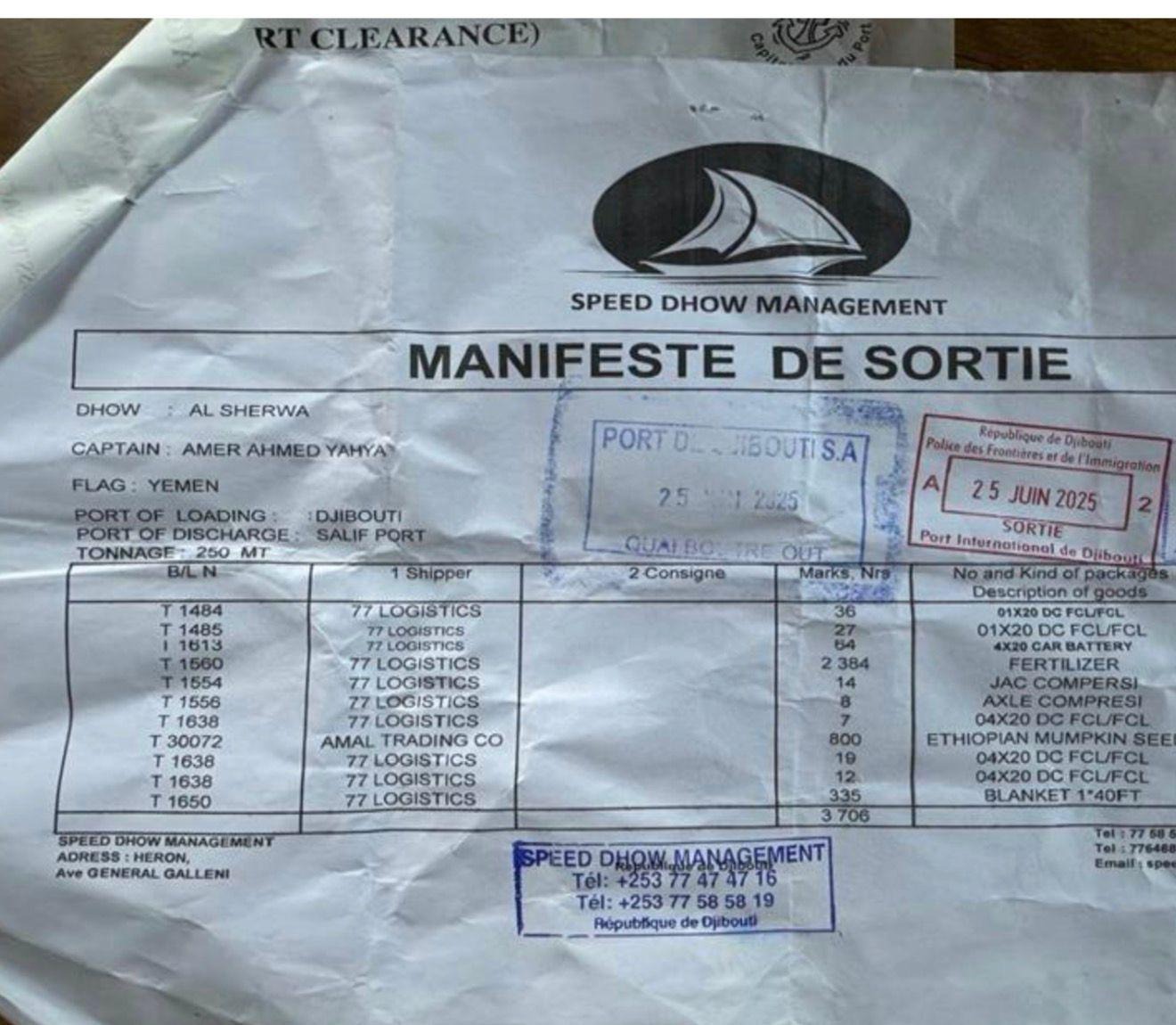
Yemeni officials claim that one dhow seized in 2025 by the local National Resistance Forces on the Red Sea coast, the Al-Sherwa, was carrying 750 tons of military hardware. The interdiction was the largest arms seizure since the beginning of the Yemen war, and included hundreds of advanced Iranian missiles and missile components, drone engines, radar, and communications equipment.50 The dhow’s captain claimed that the Al-Sherwa had completed approximately twelve voyages from Djibouti to the Houthi-controlled Yemeni port of Salif since early 2024.51 Figure 2, below, shows the ship’s manifest, found when the vessel was being searched after its capture, which includes a number of cargoes facilitated by 77 Logistics.
Figure 2
The Al-Sherwa’s 750-ton shipment was just one of many that have made it to Yemen in the last few years. Between 2023 and 2025, two Djibouti-based companies linked to the Houthis via interdictions records imported an estimated 7,500–8,500 tons of ammonium nitrate and other chemicals to Djibouti by commercial transport.52 They then used commercial shippers, dhows, and other small ships to move the chemicals, along with millions of electronic detonators (of the kind used in Houthi improvised explosive devices and drones), to Houthi-controlled areas in Yemen.53
Western officials and regional sources told the authors that Djiboutian ports and other officials are likely involved in smuggling, but that their involvement is “just business” and doesn’t have a deeper political or ideological motivation.54 Djiboutian authorities, for their part, deny that they are complicit in Houthi smuggling and claim that they are investigating the shipments and Houthi networks in their country.55 Whatever the case, Djibouti indirectly benefitted from the 2023–25 Houthi attacks on Red Sea shipping, which drove a surge in transshipment activity through its ports. During that time, major commercial shipping lines offloaded containers in Djibouti for onward distribution on smaller boats, rather than risking direct transit of the Red Sea.56
3. Leveraging the Network: Expanding Ties Across the Red Sea
The Houthis’ control over the licit and illicit economy in northern Yemen has provided the group with other benefits, including a new recruitment base. Yemen has long served as the primary transit corridor for the hundreds of thousands of East African migrants attempting the overland journey to Gulf labor markets, with migrants crossing the Bab al-Mandab strait or the Gulf of Aden by dhow or skiff before making their way north through Houthi-controlled territory. As they have consolidated their control over the networks that oversee migrant smuggling, the Houthis have tapped into the large Sana’a-based African diaspora as a recruitment pool for smuggling, intelligence-gathering, and fighters; and as a bridgehead to potential alliances in the Horn of Africa and its neighborhood.
In Sana’a, the Houthis reportedly work with local African diaspora community leaders, known as aqils, and representatives of key diaspora communities, whom they task with identifying young Arabic-speaking African men and women who could be useful to the group.57 Offered incentives like cooking gas, food, and opportunities to bring their families to Yemen, these people are sent on six-week training courses where they are assessed for their capabilities and ideological alignment with the movement. Some are recruited to fight for the Houthis. Others are used to smuggle people and goods, including drugs, over the Saudi border. And others still are trained as intelligence operatives before being sent home to gather information and recruit others.58
“Many of these Africans have become part of the Houthi system,” said an African community leader who was based in Sana’a until recently. “As fighters alongside the Houthis, they are given freedom of movement and various facilitation measures, and some have gone on to manage drug-smuggling networks into Saudi Arabia in cooperation with senior Houthi leaders who facilitate and protect these operations.”59
In parallel, the Houthis have tried to build ties with peripheral African groups across the Red Sea and the Gulf of Aden by using information gleaned from Sana’a-based migrants to map out potential allies. In Africa, the Houthis have sought direct contact with members, groups, or organizations connected to the following ethnic populations, tribes, and communities:
- the Warsangeli clan of northeastern Somalia;
- the Afar people, who live along the borders of Djibouti, Eritrea, and Ethiopia;
- the cross-border Ogaden clan, an ethnic Somali community spanning Kenya, Somalia, and Ethiopia;
- Ethiopia’s Oromo people;
- the Tigrayan people in Eritrea and Ethiopia;
- the Rashaida, an Arabic ethnic group that lives in an area that straddles the Sudanese–Eritrean border, whom the Houthis cooperate with on smuggling, along with other Sudanese groups;
- and the Beni-Amer tribal confederation, which similarly spans the frontiers between Eritrea, Ethiopia, and Sudan.60
Figure 3 shows a simplified map of some key areas where the Houthis are allegedly recruiting, and of training sites inside Yemen.
Figure 3
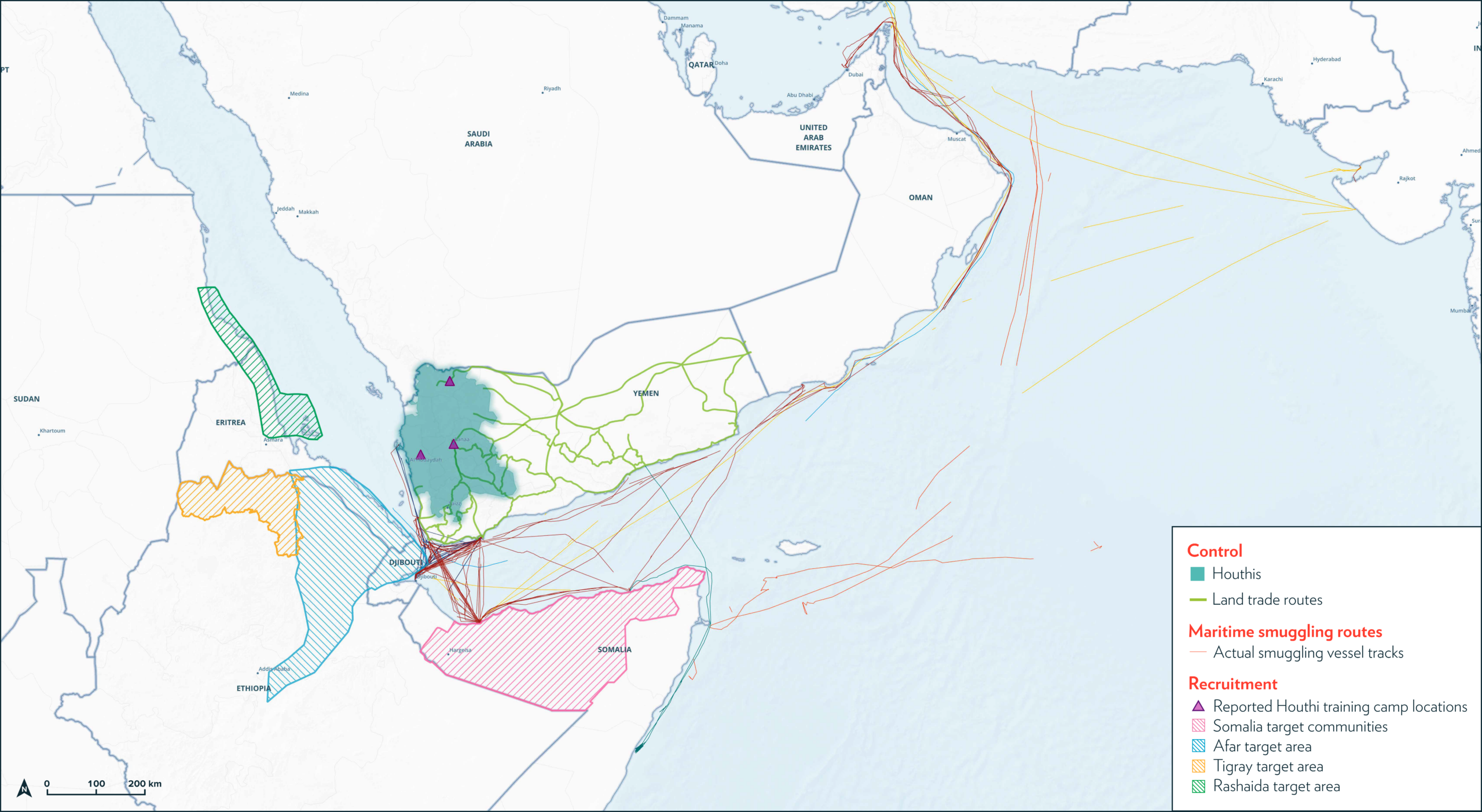
The communities the Houthis target share a broad social profile. They inhabit borderlands whose populations have historical trade, family, and religious ties to the Arabian Peninsula, occupy marginal positions within the often-fractured structure of the states that nominally claim them, and, in most cases, practice Sunni Islam. They are situated along major smuggling routes and political fault lines. And in some cases—though not all—community leaders cultivated by the Houthis are Hashemites, who describe themselves as descendants of the Prophet Mohammed. (The Houthis believe that only Hashemites have the ultimate right to rule the umma, or Muslim body politic.)
It is not clear how much success the Houthis have had with each of these groups. But the Houthis have set up sites in Yemen to train both locally cultivated African recruits and others scouted from their home countries, among them al-Shabaab fighters.61 And they have set up “summer camps” for the children of migrants based in Yemen, where they are indoctrinated in Houthi ideology.62
“The impact of the [summer camp] courses on recruits is significant. One enters the course and comes out a different person—even the look in his eyes changes. They begin to influence their families and communities with commitment and zeal,” said the African community leader who was formerly based in Sana’a. “These recruitment patterns are systematic and dangerous.”63 The Afar and al-Shabaab cases, below, provide evidence of training for fighters from at least two such groups.
A Warning Sign
The earliest and best-documented example of Houthi cultivation of an African community—even though the attempt ultimately failed—is of their relationship with members of the Afar, a marginalized people spread across Eritrea, Djibouti, and Ethiopia. The following account is based on the authors’ research; as with Houthi outreach into Somalia, many of the details presented here are based on reports from sources that the researchers could not independently corroborate but which, taken together, create a clear picture of attempted Houthi network expansion.
The Afar have long-standing ties to Yemen, which is a short hop across the Bab al-Mandab strait from their home territory.64 The Houthis built their ties with the Afar through Mohammed Alawsan, a young Afari previously affiliated with the Red Sea Afar Democratic Organization (RSADO), an Eritrean insurgent group established in 1999 to pursue self-determination for the Afar people.65 Alawsan was allegedly expelled from RSADO for converting to Shiism, and adopting views that were seen as extreme within both the organization and the broader Afari community, which adheres predominantly to Shafi’i Sunni Islam. Through ties with the Iranian embassy in Addis Ababa, Alawsan repeatedly tried to push RSADO toward collaboration with Iran.66
Alawsan began visiting Yemen in 2011 and moved there permanently at the beginning of the Yemeni civil war in 2014. By 2016, the Houthis had provided him with his own training base inside Yemen and appointed him supervisor of a growing local Afari community. Alawsan and a number of Afaris (estimates range from tens to hundreds) traveled by small boat, in groups of two or three, from Obock in northern Djibouti to Houthi-controlled areas in Yemen.
The Houthis promised the Afari faction financial, political, and military support, including training in Iran. The goal of the training, according to testimony from a recruit captured by Yemeni-government-aligned forces based along Yemen’s Red Sea coast, was to prepare the recruits for rebellion in the Afar region in order to achieve Afari self-determination.67
The Houthis were heavy-handed with their new allies, however. Afari recruits were subjected to ideological indoctrination that many resisted and were deployed to the front lines of the Yemen war, where they suffered significant casualties. In response, Alawsan organized protests and a strike. In 2024, the Houthis arrested Alawsan and his followers and tortured them; later that year, the group executed him. In early 2025, Afari tribal leaders negotiated with the Houthis to release Alawsan’s body and secure the return of surviving Afari recruits to their communities.68 But the relationship between the Afari faction and the Houthis had clearly soured.
The Houthis appear undeterred by the falling out. RSADO leaders report that the Houthis continue to attempt to recruit Afaris, sending messages through Eritrean opposition figures offering training and weapons in exchange for opening a channel of communication. An Afari leader described outreach from the Houthis that had taken place in the years since Alawsan’s death, most recently in 2026:
The [Houthi] messages were sent through some Eritrean opposition figures who have relations with the Houthis. The Houthis told us that they care about our area. They told us that our areas will become a hot conflict spot for Western [powers] and Zionists. They offered training and weapons to help us counter these ambitions and protect our land. Although we are in desperate need of this kind of support, we know it will only entangle us in a larger conflict and undermine our legitimate cause. We also know that Iran and the Houthis will bring instability to the region and our areas.69
Al-Shabaab: From Arms to Brothers in Arms?
Houthi ambition to cultivate allies in the Horn of Africa to counter the United States and Israel might appear fanciful. But the group’s evolving relationship with al-Shabaab provides the claim with a degree of credibility.
Al-Shabaab, an al-Qaeda affiliate, controls large parts of central and southern Somalia. The group was pushed out of Mogadishu by African Union peacekeepers in 2011 and lost further ground during a government campaign launched in 2022. But al-Shabaab reversed most of its losses in a sweeping offensive in early 2025 and now controls more than 20 percent of the country’s territory, which may be more than the federal government in Mogadishu does. The group may believe it can take more ground if African peacekeepers wind down their presence, a process that is likely to be accelerated by the United States’ decision to withdraw financial support for the peacekeeping mission there.70
Al-Shabaab has a specific weakness: it has long struggled to protect itself from drone and other aerial attacks.
Al-Shabaab has a specific weakness: it has long struggled to protect itself from drone and other aerial attacks. Until recently, these attacks were primarily from U.S. and other foreign-operated drones and aircraft. But the Federal Government of Somalia’s offensive air capacity has expanded since a UN arms embargo was lifted in 2023.71 These vulnerabilities may help explain why, in early 2024, al-Shabaab decided to open channels of communication with the Houthis with the aim of purchasing or otherwise negotiating access to antiaircraft weapons and drones.72
Al-Shabaab is no doubt impressed by the Houthis’ ability to beat back air attacks and launch their own cross-border strikes. Since 2019, the Yemeni militants have used locally assembled Saqr surface-to-air missiles, a variant of the widely-proliferated Iranian 358 system, to shoot down somewhere between seventeen and twenty-five advanced U.S. MQ-9 Reaper drones, the same unmanned aerial vehicle (UAV) system the United States has used to repeatedly and successfully target al-Shabaab.73 Al-Shabaab, current and former Western officials said, has long harbored an interest in these missiles, and in the long-range drones the Houthis have used to target the Gulf states, Israel, and U.S. Navy vessels.74
Since 2024, a series of reports have emerged of Houthi–al-Shabaab discussions around an arrangement that would give the Somali group access to at least some of these capabilities. An early meeting between the Houthis and al-Shabaab reportedly took place in Sana’a in March 2024, and was attended by senior representatives of both sides, including Yasin Kilwe, the head of al-Shabaab in Puntland, and Abdulwahid Naji Abu Ras, the Houthis’ deputy foreign minister and the official responsible for the group’s Africa portfolio.75 Between June and July 2024, al-Shabaab then hosted Houthi representatives, as well as an Iranian national, in Somalia to discuss the procurement and use of explosive drones. These meetings may have been with al-Shabaab’s top leader, Emir Ahmed Diriye.
The Samatar Evidence Trail
A growing body of evidence supports claims of a deepening Houthi–al-Shabaab relationship. The strongest evidence comes from the testimony of Ahmed Elmi Samatar, the al-Shabaab operative captured in Mukalla in 2024. Sometime in September 2024, security forces in the southern Yemeni city of Mukalla arrested Samatar, allegedly during the transport of al-Shabaab fighters for training in Houthi areas.76 (A video recovered from Samatar’s mobile phone shows a group of men, allegedly Somalis, in the rear of a pickup truck, who Yemeni officials claim were al-Shabaab members.77)
While in detention, Samatar confessed to acting as a liaison between al-Shabaab and the Houthis.78 Samatar appears to have played a prominent role in the acquisition of arms and, potentially, drones for al-Shabaab, and two email addresses affiliated with him were connected to user profiles on the Chinese e-commerce platforms AliExpress and DHGate, which are commonly used to purchase electronics and other commercially available items, including dual-use equipment.79 Regional and Western intelligence officials believe that Samatar’s relationship with the Houthis likely started with arms deals he brokered.
However Samatar’s involvement began, he came to act as a bridge between the two groups. He was likely involved in the transportation of a group of senior al-Shabaab members to Yemen during Ramadan 2024 (in March or April), which, along with travel records obtained by project researchers, suggests that he may have played a role in coordinating the initial meetings between Houthi and al-Shabaab delegations in Sana’a in March 2024.80
Interrogation notes made by Yemeni authorities and obtained by project researchers describe Samatar’s travel, from June 8 to 22, 2024, through towns under al-Shabaab control, including Jilib.81 During this period, Samatar appears to have been coordinating the movement of a group of “guests,” who provided al-Shabaab members with training in improvised explosive device (IED) manufacturing, drone modification, and weapons maintenance. Samatar also appears to have met local al-Shabaab officials, arranged transport, and handled administrative and operational tasks. These Yemeni guests included two Houthi military engineers whose mission was to provide specialized training to al-Shabaab in the Juba Valley.82 A screenshot of a Yemeni passport database record for one of these individuals names him as Mohammed Gaber Balghaith Farag Makki, born in 1984 in Yemen’s Hajjah governorate, with his occupation given as “commercial manager.”83
During interrogations in Yemen, Samatar recounted attending meetings in which tasks included “finalizing a weapons document” and “selecting men for training.” Samatar also claimed that he had facilitated travel for what may have been as many as four hundred Somali nationals to Houthi-controlled areas of Yemen for military and ideological training.
Sustained Ties
Samatar’s detention does not appear to have disrupted the relationship between the Houthis and al-Shabaab. In February 2026, a Somali national named Abdishakur Yahye Ali (nicknamed “the Joker”) was killed in an apparent U.S. drone strike in al-Ghayda, in eastern Yemen.84 In his hotel room, Yemeni security forces found a Yemeni passport issued in 2023 by the Houthis’ de facto authorities in Sana’a. Ali appears to have primarily been a Houthi affiliate who took over Samatar’s role as Houthi–al-Shabaab liaison. He began living in Sana’a at least as early as July 2023, and attended Houthi events there, as well as a five-day ideological training course, of the kind described above, at the city’s Martyrs’ Mosque, in December 2023.85
According to a regional security source, Ali’s relationship with al-Shabaab began only around March 2024, around the time the group started coordinating with the Houthis. A Yemeni intelligence report asserts that Ali had by then already been living in an apartment in the Haddah district of Sana’a, where he was installed by the Houthi security official Abu Muhammad al-Baraq under instructions from Abdulwahid Naji Abu Ras, the Houthi deputy foreign minister and head of the Africa portfolio mentioned above.86
From his station in Yemen, Ali oversaw the preparation and repackaging of weapons before transporting them to Mukalla for onward shipment to Bossaso.87 The consignments reportedly included small arms, anti-tank missiles, drones, thermal optics, and explosive materials.88 Photographs reviewed by a researcher for this project show Ali in a storeroom surrounded by what appear to be reels of detonating cord.89 The same researcher also reviewed images of remittance forms for financial transactions conducted by Ali that are claimed to be linked to his al-Shabaab arms procurement work, though it has not been possible to independently verify whether materials paid for in this transaction were ultimately shipped to Somalia.90
Samatar was released from custody in Aden in November 2025, reportedly as part of a prisoner exchange, although details of the exchange remain unclear.91 He traveled to Hargeisa, Somaliland, and subsequently returned to Jilib, where he remained at the time of writing, according to Somali intelligence sources, whose claims are corroborated by mobile phone location data.92
Room for Growth
It is difficult to know what concessions the Houthis and al-Shabaab have been able to extract from each other. Al-Shabaab wants access to Houthi weapons, drone technology—the kind of capabilities that could permanently shift the balance of power in Somalia. In return, the Houthis reportedly want approval to recruit fighters in Somalia and permission to establish a physical presence near al-Shabaab’s de facto capital of Jilib.93 The Houthis have also, reportedly, asked for permission to install communications and surveillance equipment on Somali territory, which would extend the operational range of their missile and drone systems.94
Yet to date, there is limited tangible evidence that the Houthis have transferred advanced military capabilities to al-Shabaab.95 This may reflect a lack of trust between the two groups, or a lack of al-Shabaab absorptive capacity. It may equally be due to a deliberate decision by al-Shabaab to hide new capabilities until it has reason to use them. But the relationship has been sustained and has yielded some results. Yemeni, Somali, and other security officials estimate that between 120 and several hundred al-Shabaab fighters have been trained by the Houthis—at camps in Yemen—in combined small arms, IED manufacture, and basic drone use.96
If the Houthis do provide al-Shabaab with advanced weapons, it may entrench the relationship between the two groups, especially if the transfers improve al-Shabaab’s position in Somalia. Al-Shabaab lacks a viable alternative supplier for antiaircraft missiles and advanced drone technology. If it gets what it wants from the Houthis, it may find it hard to switch away from the relationship, as it becomes locked into the benefits of the wider Axis ecosystem.
External Drivers
Other external factors may give the Houthis and al-Shabaab more reasons to cooperate in the future, even if those factors are not the original driving force behind the groups’ relationship. A growing Israeli and Emirati footprint in Somaliland and Puntland could provide impetus for a hardening of Houthi–al-Shabaab ties, for example. Since the Houthis began launching missile and drone strikes on Israel in late 2023, Israeli intelligence reportedly established a dedicated Yemen unit made up of personnel drawn from multiple intelligence directorates. Bloomberg reported in March 2026 that Israel was actively planning a permanent military base in Somaliland with the explicit purpose of targeting the Houthis, with Somaliland officials confirming that they would allow Israel to “gather intelligence on and conduct operations against” the Yemeni group.97 Israel had already become the first country to recognize Somaliland’s independence, in December 2025.98 Then, during the 2026 U.S.–Israeli war on Iran, Israel reportedly established a fighter jet refueling station in Somaliland.99
The Emirates has had a presence in Somaliland since signing an agreement with authorities there in 2017 and is reportedly building a major airbase near the port of Berbera.100 Across the wider region, the Emirates has also funded and trained counterterrorism forces operating against both al-Shabaab and the local Islamic State franchise. Most notable among the Emirati-trained forces is the Puntland Maritime Police Force, based in Bossaso.101
Al-Shabaab and the Houthis increasingly view Emirati and Israeli policy in the region as interlocking, a perspective reinforced by reports of Emirati–Israeli coordination across the network of bases the Emirates has built along the Somali coast. This combination of an emerging Israeli presence in Somaliland working alongside the established Emiratis was not the original impetus for the relationship between the Houthis and al-Shabaab. But it gives the two groups a shared adversary in their own backyard, and incentive to coordinate more closely against it.
4. Red Sea Reach: The Houthis and IRGC in Sudan and Eritrea
During the early years of the Yemen war, Houthi smuggling and outreach operations were concentrated in the Gulf of Aden, where the Yemeni coastline is controlled by the government. But shifting regional geopolitics may also be opening up new supply routes and relationships for the group on the African side of the Red Sea, in Eritrea and Sudan, opposite Houthi-controlled ports. In this case, the relationships are directly facilitated by the IRGC but could, over time, evolve into deeper ties that further embed the group in the contentious tangle of competition and cooperation that has made the Horn of Africa so volatile in recent years. As in Somalia, Houthi and IRGC ties in Eritrea and Sudan may be bolstered by a combination of mutual needs and shared foes, in this case primarily in the form of the Emirates. The deeper the Houthis become woven into this tangle of competing interests, embedding themselves in other conflict ecosystems, the harder it will be to pull them out of it.
Supplying Sudan
Sudan is the site of multiple, overlapping crises, including a devastating civil war that began in April 2023 and the world’s biggest humanitarian emergency. The principal belligerents of the war are the SAF (the country’s official army), which controls much of eastern Sudan, including its Red Sea ports; and the paramilitary Rapid Support Forces (RSF), which controls much of western Sudan. Both groups are coalitions formed of diverse networks of affiliated subgroups with their own individual agendas. Both the SAF and the RSF have an array of foreign sponsors, and both have committed a series of well-documented war crimes.102
The civil war in Sudan created an opening for Iranian engagement at relatively low cost. Tehran enjoyed close ties with the regime of Omar al-Bashir (leader of Sudan 1989–2019) and cooperated closely with the Sudanese military until Khartoum cut official ties in 2016 after an attack on the Saudi embassy in Tehran. (The attack was blamed on Iranian sectarianism, and Khartoum’s decision to cut ties with Tehran was reportedly a show of Sunni solidarity with Saudi Arabia.)103
But in 2023, desperate for arms and drones after the Emirates reportedly threw its weight behind their RSF adversaries, the SAF restored ties with Tehran. Iran began supplying the SAF with Mohajer-6 drones, ammunition, and radar systems. IRGC operatives are also reportedly deployed alongside SAF-aligned factions as trainers and operators. The SAF recapture of much of Khartoum in early 2025 was significantly attributed to improved drone capability, with Iranian platforms playing a central role.104
Iranian support was primarily channeled through an SAF faction made up of veterans of the Sudanese Islamic Movement, the politico-security establishment that governed Sudan under Bashir and was essentially dismantled after his overthrow in 2019. Some of the faction’s members had retained senior positions within the SAF and have used them to further the faction’s cause. One such person is Mirghani Idris Suleiman, who now heads the state-run arms manufacturer Defense Industries System. The faction has reportedly directed its support toward a set of volunteer brigades fighting alongside the army, the most prominent of them being the notorious al-Baraa ibn Malik Brigade. The United States sanctioned Suleiman in October 2024 for his role in SAF arms acquisitions, including from Iran and Russia.105 Washington also sanctioned the al-Baraa ibn Malik Brigade in September 2025, again citing connections to Iran.106
The Houthis entered this relationship as Iran’s junior partners sometime in mid-2024, reportedly transferring at least three shipments of small arms and light weapons to the SAF on Iran’s behalf.107 Numerous sources now claim Houthi operatives are present in Port Sudan, using it as a transport, logistical, and financial hub, with arms and people moving both ways across the Red Sea.
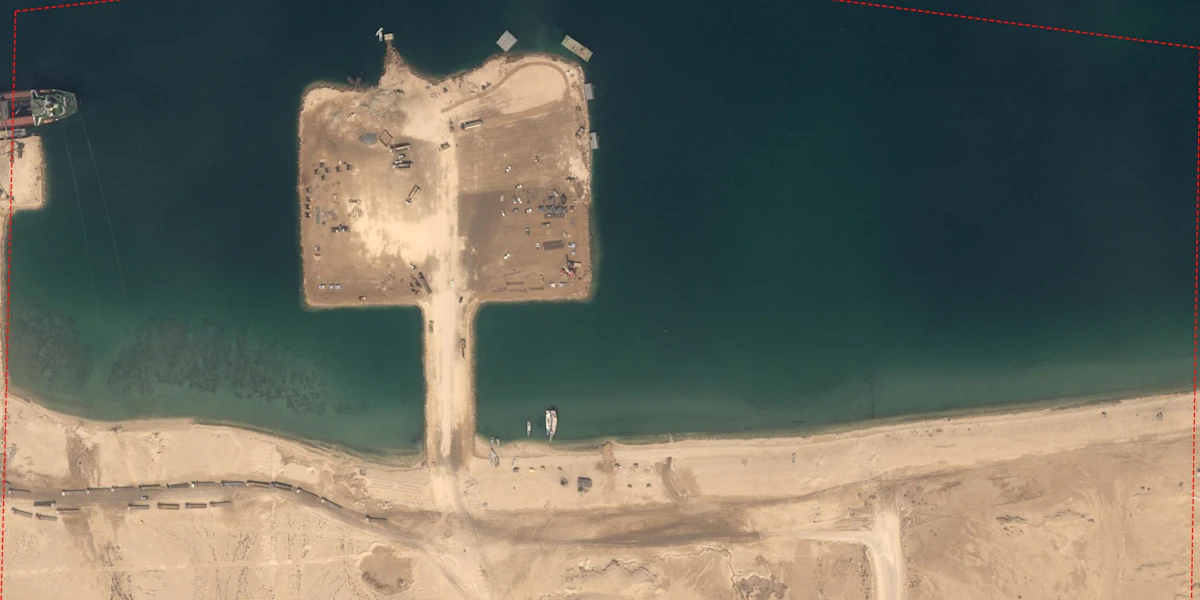
A growing body of evidence supports these claims, though it is not definitive. The movements of multiple vessels tracked via AIS, satellite imagery, and other remote tools match the timing of Yemeni and regional security officials’ descriptions of arms transfers from Sudan to Yemen. In one case, a roll-on, roll-off vessel that had previously maintained a regular Jeddah–Port Sudan commercial route disabled its AIS off Port Sudan in May–June 2025, transited to Yemen after several stops in Egyptian and Saudi waters, and eventually docked east of the Ras Issa oil terminal in Yemen, at an informal berth that was constructed after American airstrikes had damaged Hodeidah’s cargo facilities.
Figure 4
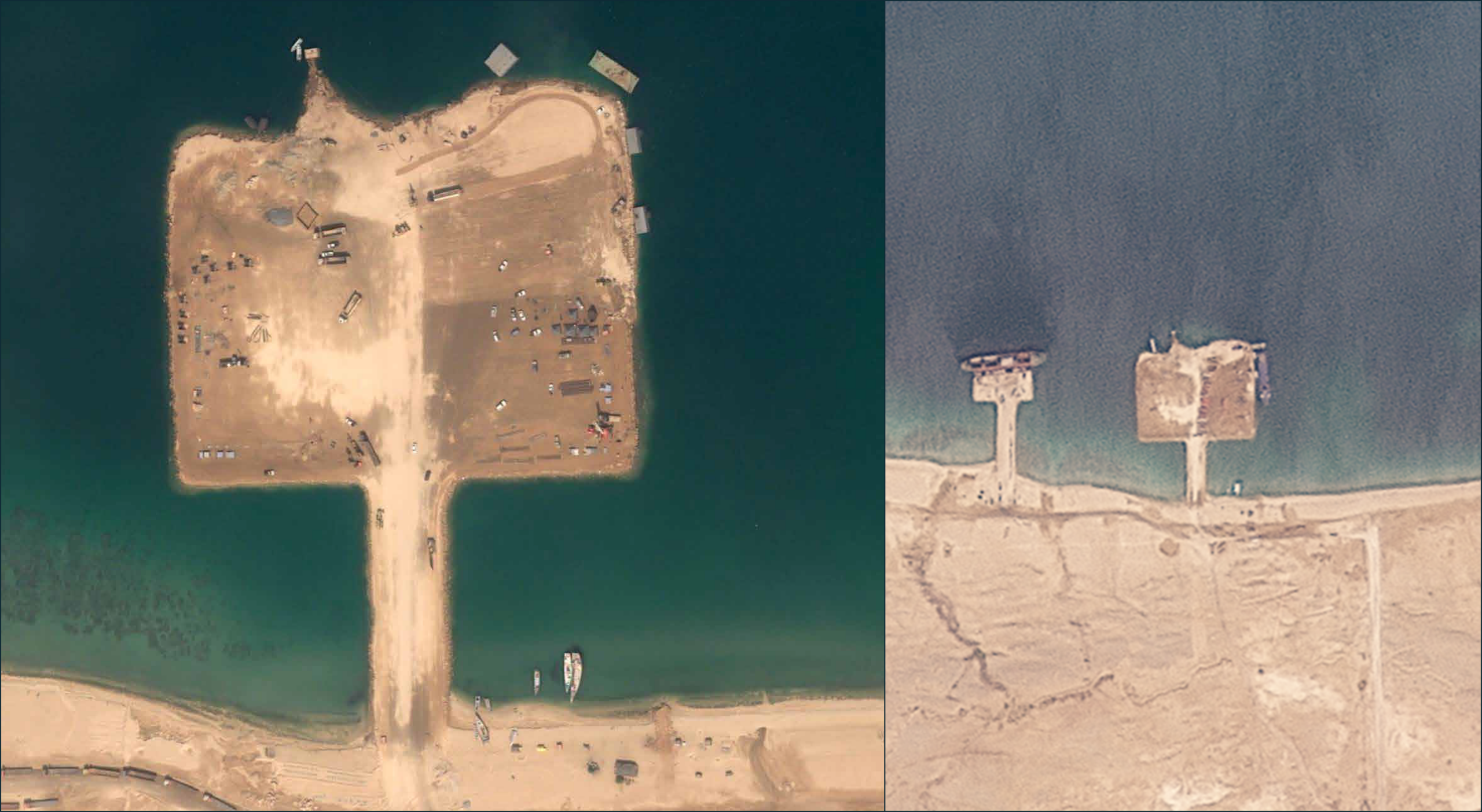
Satellite imagery (Figure 4) shows that the Houthis established a security cordon before the vessel arrived. Its estimated 3,500-ton cargo does not appear in formal import records.108 Yemeni officials claim the vessel was carrying arms. SAF forces from a different faction than the Islamist network the Houthis and Iran work with are also said by multiple sources to have seized a shipment of small arms in May 2026 that those sources believe originated in Yemen and was destined both for the Houthis’ allies within the SAF, and for Hamas in Gaza.109
While numerous regional and Yemeni sources claim that Houthi, IRGC and other Axis operatives are travelling in and out of Yemen via Sudan’s Red Sea coast, this has not yet been definitively proven. Mobility analysis, which uses anonymized mobile phone data to track human activity, shows that, in August 2025, at least one individual traveled from Egypt to Port Sudan by air, and then to a Houthi-controlled informal landing site on the Red Sea coast.110
The Houthis may be pushing toward deeper strategic alignments. Multiple sources claim that they have sent veteran engineers and operatives to train Sudanese forces.
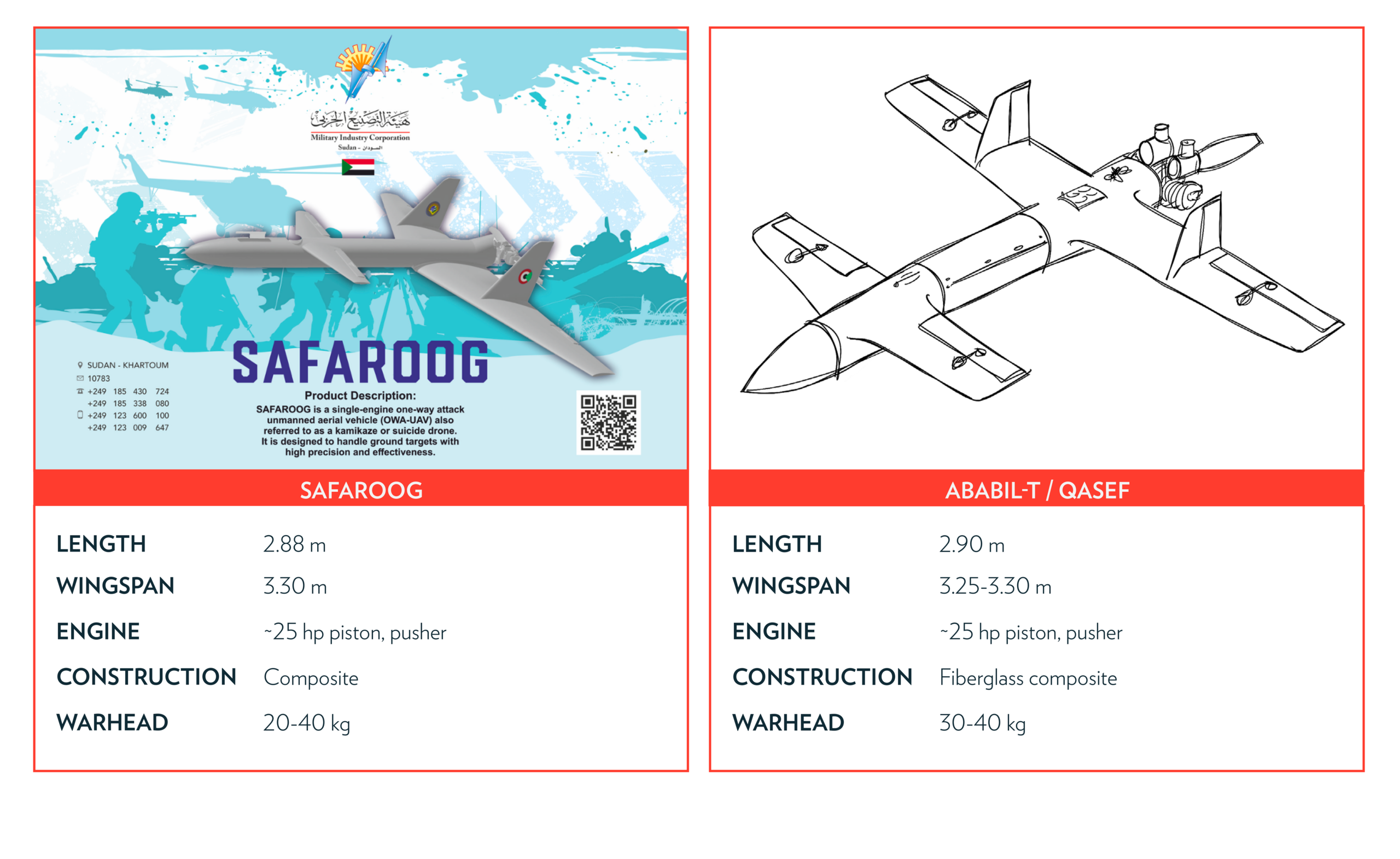
For now, the Houthi presence in Sudan appears to be mainly logistical and transactional. For the Houthis, it provides the group with a new supply route as others come under growing scrutiny. But the Houthis may be pushing toward deeper strategic alignments. Multiple sources claim that the Houthis have sent veteran engineers and operatives to train Sudanese forces in the use and manufacturing of Iranian UAV systems alongside the IRGC.111 It is not possible to verify this claim, but recent developments have at least made it more plausible. In July 2025, Sudan’s state-owned Military Industrial Corporation (also known as Defense Industries System, run by the sanctioned Islamist leader Suleiman) unveiled what it claimed was an indigenously manufactured UAV, the Safaroog.112 The drone strongly resembles the Iranian Ababil-T, the medium-range one-way attack UAV that the Houthis have used and produced prolifically under the name Qasef-2K.
Side-by-side comparison (see Figure 5, below) shows that the form, dimensions, engine configuration, and construction of the Ababil-T and Safaroog are nearly identical, and arms experts assess that the Safaroog is likely an Ababil-T variant.113 The Houthis have no track record building or operating the more complex Mohajer-6 and Ababil-3 UAV systems Iran previously transferred to the SAF. But the Ababil-T sits squarely within their production expertise. They have been building it in Yemen using globally sourced components since at least 2019.114 For this reason, they are obvious candidates to train SAF factions in the manufacture and use of the Safaroog.
Figure 5
Historical Ties
As with al-Shabaab, some Western officials struggle to understand why Sunni Islamists from the SAF would want to work with the Houthis. The SAF sent fighters to support the Saudi-led coalition in Yemen in its fight against the Houthis. And Islah, a Sunni Islamist Yemeni party that, like the SAF, has deep ties to the Muslim Brotherhood, is one of the Houthis’ main adversaries in the Yemen war.
But the Houthis have historical links of their own with the SAF that predate the war. The Yemeni group’s founder, Hussein al-Houthi, was reportedly radicalized in Sudan, where he lived for several years in the 1990s, a time when Khartoum was something of a melting pot for different Islamist groups. Houthi operatives were also, allegedly, based in Sudan during the movement’s six wars with the government between 2004 and 2010.115
The Houthis and the SAF Islamist factions have several reasons for wanting to work together now. The SAF factions are subject to growing scrutiny and sanctions from the United States and others, and want to maintain a prominent position within the SAF coalition. The Houthis offer the faction the promise of arms and the knowledge needed to use and build them that would be a significant asset in the event of intra-SAF conflict.
Eritrean Return
Yemeni and regional sources also claim that the Houthis are reestablishing a footprint in Eritrea, again with Iranian support.116 If these claims are correct, it would mean that the Houthis have built a logistical footprint that runs, intermittently, along the African shores of the Gulf of Aden and the Red Sea from northeastern Somalia to northern Sudan. Efforts to substantiate the claims also show the challenge of tracking these purported relationships in such closed environments.
As with Sudan, the Houthis purportedly have long-standing ties to Eritrea that were paused in the mid-2010s and renewed amid changing regional geopolitics in the 2020s. Eritrean opposition leaders and media reports claim that the IRGC provided the Houthis with training in Eritrea beginning in 2009 at the latest, following the signing that year of a cooperation agreement between Eritrea and Iran.117 After a 2016 fallout between Riyadh and Tehran, Eritrea, like Sudan, aligned with Saudi Arabia and the Emirates, allowing Abu Dhabi to set up a military base in the southern port of Assab to support its Yemen operations. But relations between Abu Dhabi and Asmara cooled as the Emirates aligned itself more closely with Ethiopia—Eritrea’s neighbor and long-time adversary, which has long sought to gain access to or even annex portions of Eritrea’s coast, including at Assab. As tensions have increased between Eritrea and Ethiopia, Asmara has restored ties with Tehran and joined it in backing the SAF in the Sudan war. (The Emirates reportedly backs the RSF although Emirati officials deny supporting the group.)
Eritrea now also allegedly serves as yet another smuggling hub for Iranian arms en route to Yemen. Arms routed through Eritrea are transferred between ships around the Dahlak archipelago, a cluster of small islands in the Red Sea, and sent on to Yemen.118 However, an intensive open-source investigation of alleged smuggling sites using satellite imagery and AIS detection software showed little to no activity at named smuggling sites in the Dahlak area. Complicating matters further, Eritrean and Ethiopian sources claim that the Houthis also maintain ties to Eritrean opposition groups.
5. Circumstance or Strategy? Joining Up the Dots
There are two ways of reading Houthi activity in the Gulf of Aden and the Red Sea. The first is as a series of ad hoc arrangements set in place to overcome obstacles, respond to emerging needs and opportunities, and—in the telling of some Yemeni and regional observers—in response to Iranian directives. The second is that the Houthis are implementing a carefully laid-out strategy, with a view to becoming a regional power in the Horn of Africa and its wider neighborhood. These claims are not mutually exclusive, and the evidence assembled for this report points to a more nuanced assessment: that what started out as a happenstance series of initiatives is evolving over time into something more strategic, whose success is by no means guaranteed.
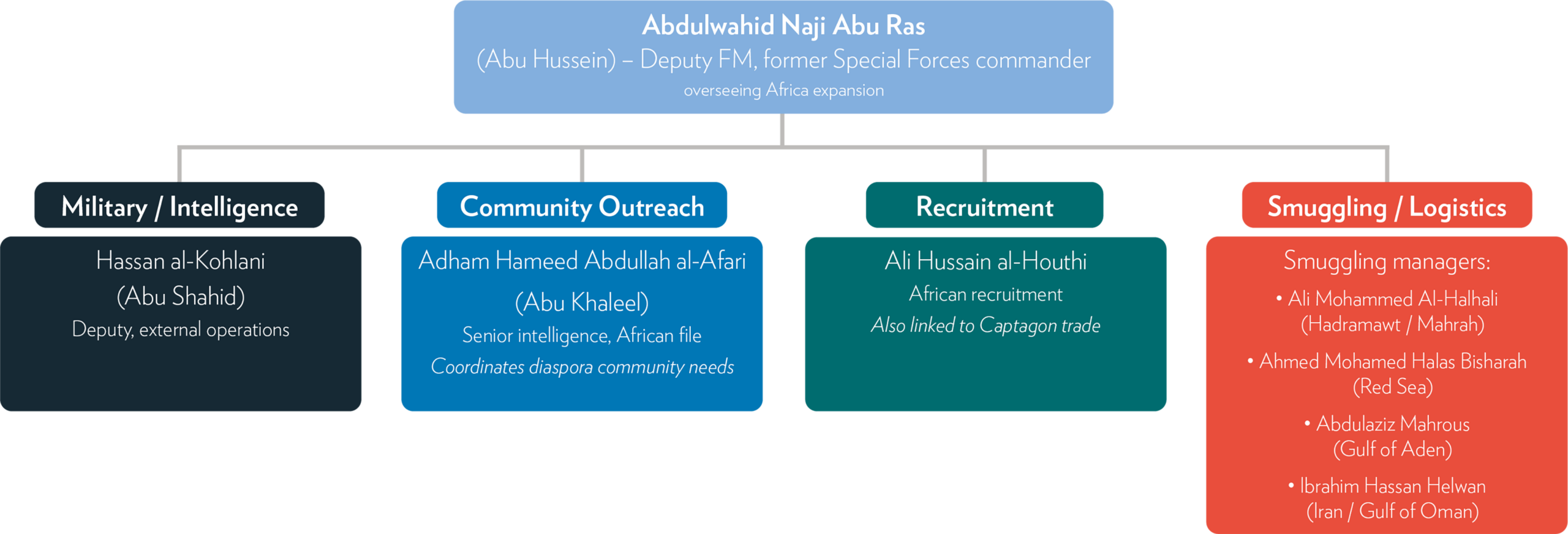
In addition to the research outlined throughout this report, two pieces of evidence support the claim that Houthi positioning in the Horn of Africa and its neighborhood is part of a broader strategic push. First is the fact that Houthi activity cultivating relationships among Yemen’s African neighbors is tightly controlled and managed by a group of senior intelligence operatives in Sana’a, allegedly with close ties to the IRGC. According to Yemeni and regional officials and media reports, this group is overseen by Abdulwahid Naji Abu Ras, the former Houthi Special Forces commander who now serves as the Houthis’ deputy foreign minister, and who is repeatedly named throughout this report by different sources as supervising different elements of the Houthis’ overseas activities.119
The authors’ research and publicly available reporting indicate that Abu Ras oversees a group of senior operatives who manage smuggling networks, community outreach to migrant communities, and regional recruitment. This group coordinates regional outreach efforts as part of a strategy designed to improve the Houthis’ strategic positioning and, according to internal documents, push back and defend against American and Israeli presence in the region.120 Figure 6, below, shows the relationships between Abu Ras and this cell.121
Figure 6
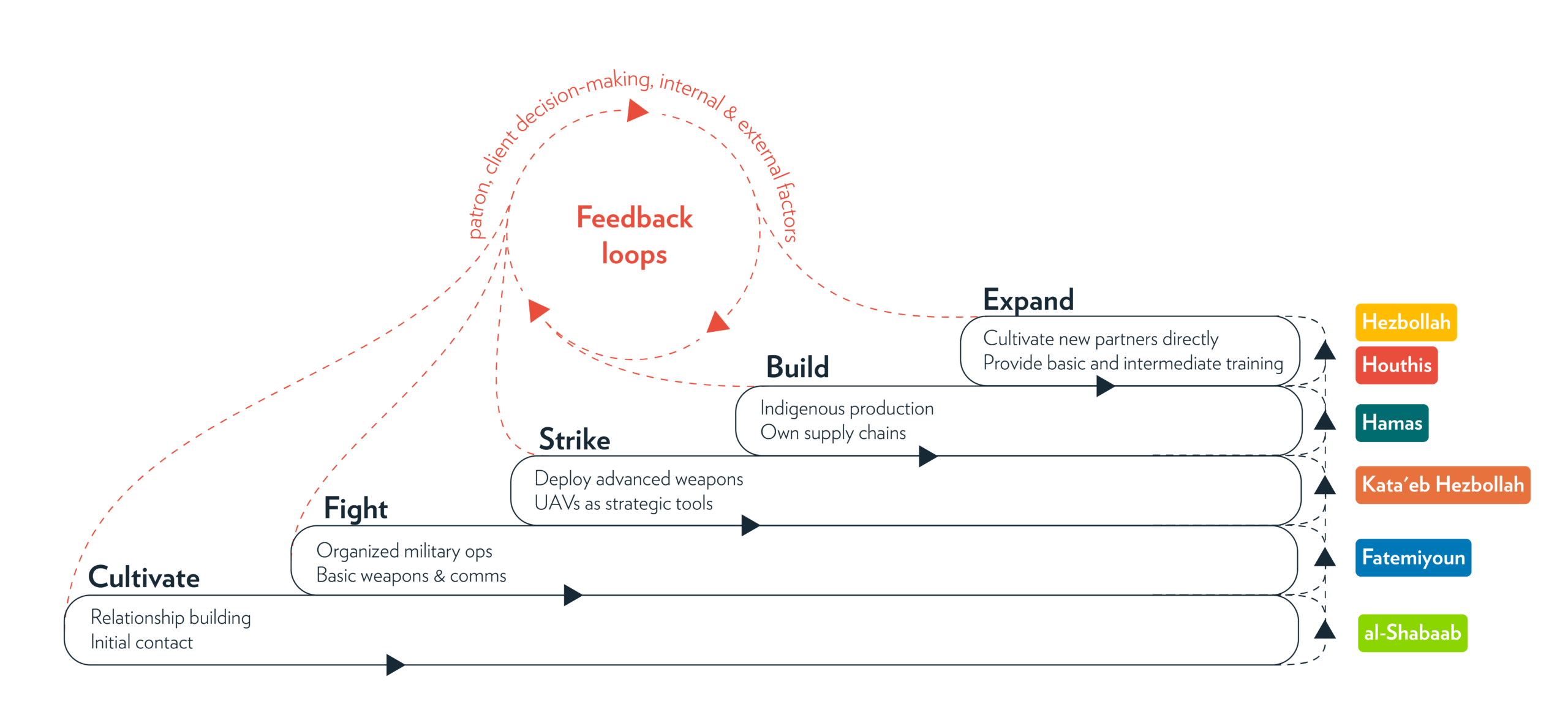
The second piece of evidence suggesting the existence of a broader strategy is the fact that the Houthis appear to be implementing a well-thumbed playbook developed over decades by the IRGC and Hezbollah, which was behind the Houthis’ own rise. The playbook, outlined in detail in the June 2026 Century International report “Beyond the Axis,” starts with cultivation, leveraging existing ties to spread bets among multiple groups, enticing them into cooperation with the promise of help for their local agendas.122 Over time, it evolves into training on how to use and then build increasingly advanced arms systems like long-range drones, placing cultivated groups on a “capability ladder” that both builds group capabilities and draws them into interdependency, gradually converting what start as transactional relationships into something deeper and more durable.123
At a certain point, groups that sustain the relationship cross an important threshold, a “capability tipping point.”
At a certain point, groups that sustain the relationship cross an important threshold, a “capability tipping point”: they build, through an accumulation of knowledge and organic connections, a system whose capabilities are distributed across many nodes throughout the wider ecosystem rather than being concentrated in any one individual node. And in an extremely limited number of cases, groups leverage the magnetic pull of these new capabilities to expand the Axis, as Hezbollah once did with the Houthis and the Houthis are now trying to do with al-Shabaab. Figure 7, below, shows this “capability ladder” and which stage different existing Axis groups have graduated to.
Figure 7
For now, the groups the Houthis are cultivating along the African side of the Gulf of Aden and the Red Sea approach the Yemeni group on a largely transactional basis. Many of the relationships in the Houthi portfolio will not yield significant returns. Some will stall at an early stage, as the Houthi relationship with the Afar did, because the Houthis misjudge their partners or overplay their hand. Other relationships will remain transactional and thin, never deepening into the kind of exchange that produces meaningful capability transfer. But the portfolio model the Houthis have adopted, itself seemingly based on the IRGC-Hezbollah playbook, accepts that not every relationship will pay off, and requires just one or two successes to justify the outlay. As the Houthi case shows, one group rising up the capability ladder can have a huge impact on regional and international security.
The Houthis’ advantage is that they have things that these groups want—arms, technology, know-how, supply chains, and access to Iran. Further, in many cases these groups lack an alternative channel to access any of these benefits. The relationships are transactional, for now. But, as “Beyond the Axis” shows, such seemingly transactional relationships can harden into interdependence over time. In Sudan and Somalia, for example, many of the forces the Houthis are working with lack both military training and the technical skills to build and operate systems like the Ababil-T. Both al-Shabaab and the SAF Islamist networks have been repeatedly sanctioned and have no alternative patron to turn to if they cannot find a modus vivendi with the Houthis.
The bind, for the groups, is that as their capabilities grow, so does their dependence: the autonomy a group gains by learning to build its own weapons is offset by the rising cost of defecting from a network few others will deal with. “Beyond the Axis” documents how this paradox affected Hamas, whose 2012 break with Iran over Syria left it isolated and starved of arms until mutual need pulled both sides back together just a few years later.
Urgent Implications
Regardless of whether the activity documented in this report is part of a joined-up strategy, three urgent implications flow from its findings.
Implication #1: The Houthi supply chain (and, by extension, the Axis’s) is diversifying and becoming more resilient.
In February 2026, Century International published the first report in this project, “From Smugglers to Supply Chains,” documenting the Houthis’ transformation from passive recipients of Iranian arms into manufacturers in their own right, sourcing components and raw materials through globally distributed supply chains. The report notes the possibility of Houthi smuggling networks in Eritrea and Sudan but stops short of asserting that they exist.
Figure 8
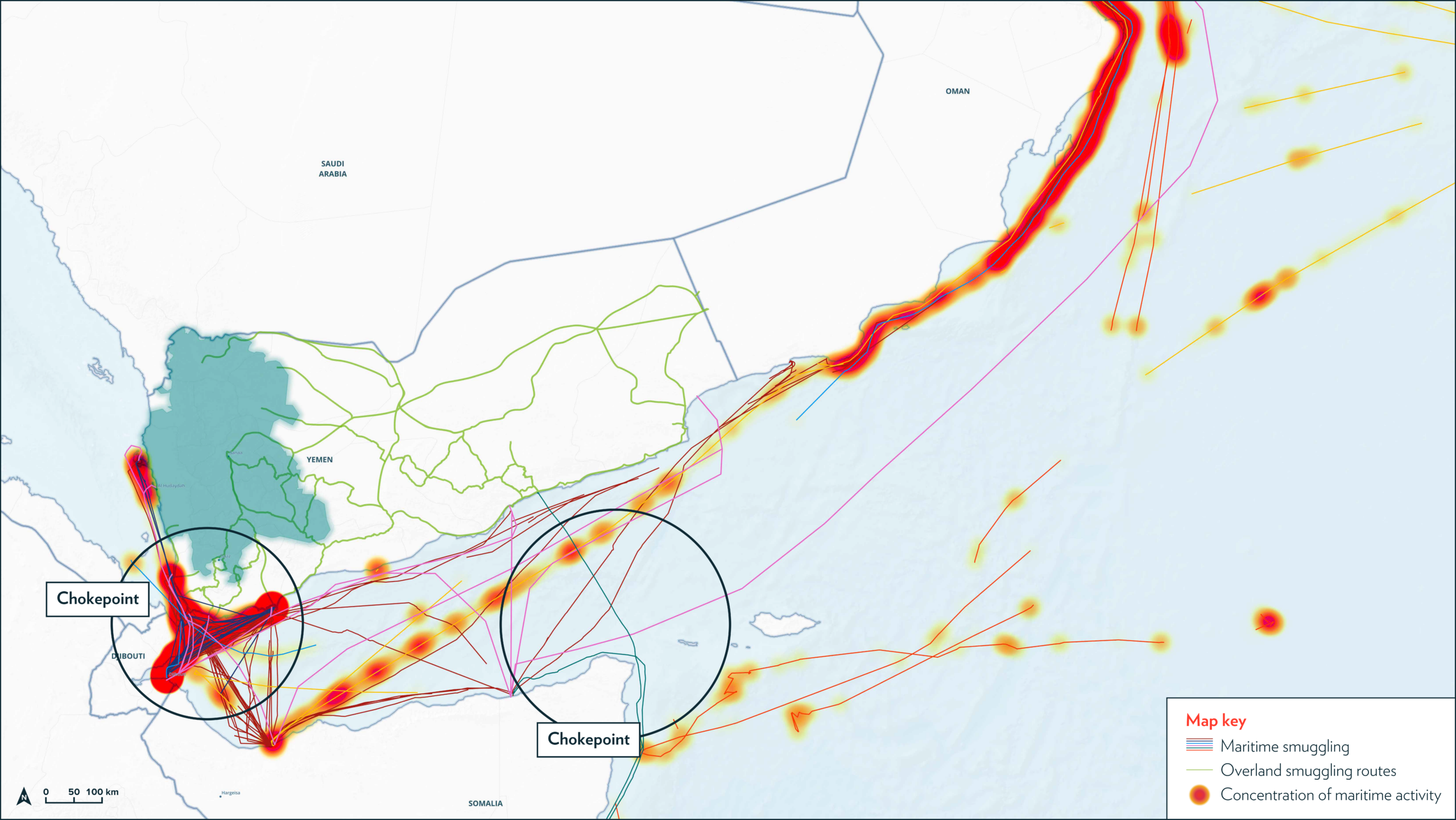
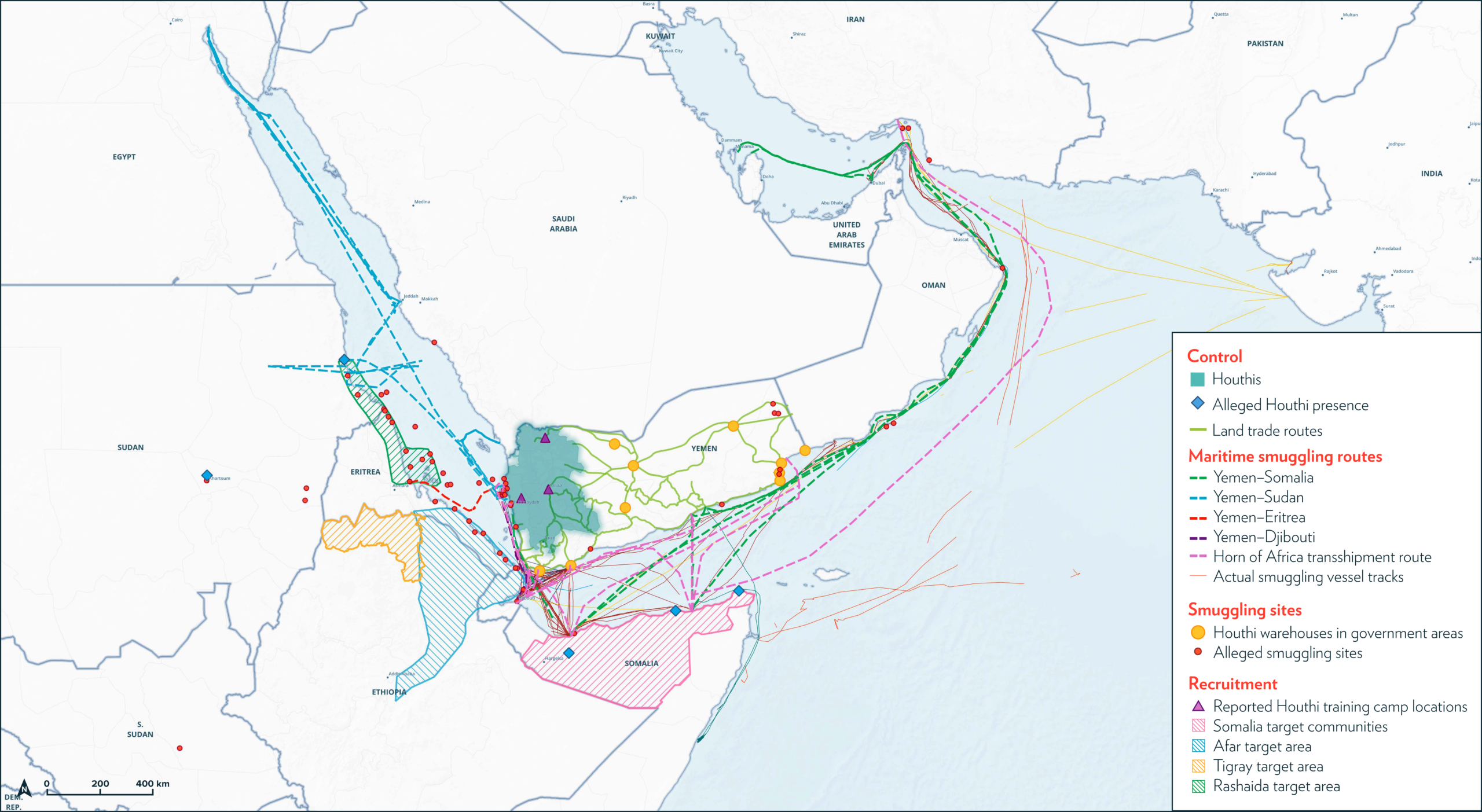
The February 2026 report shows that the Houthis—despite supply chain diversification—remain heavily reliant on vessels entering and passing through the Gulf of Aden and the Bab al-Mandab strait. Figure 8 shows a map tracking known smuggling activity linking the Houthis with Iran, Somalia, and Djibouti, based on actual vessel tracking data. The circles marked “choke point” are areas where there have been repeated interdictions of smuggling vessels by international and local forces.
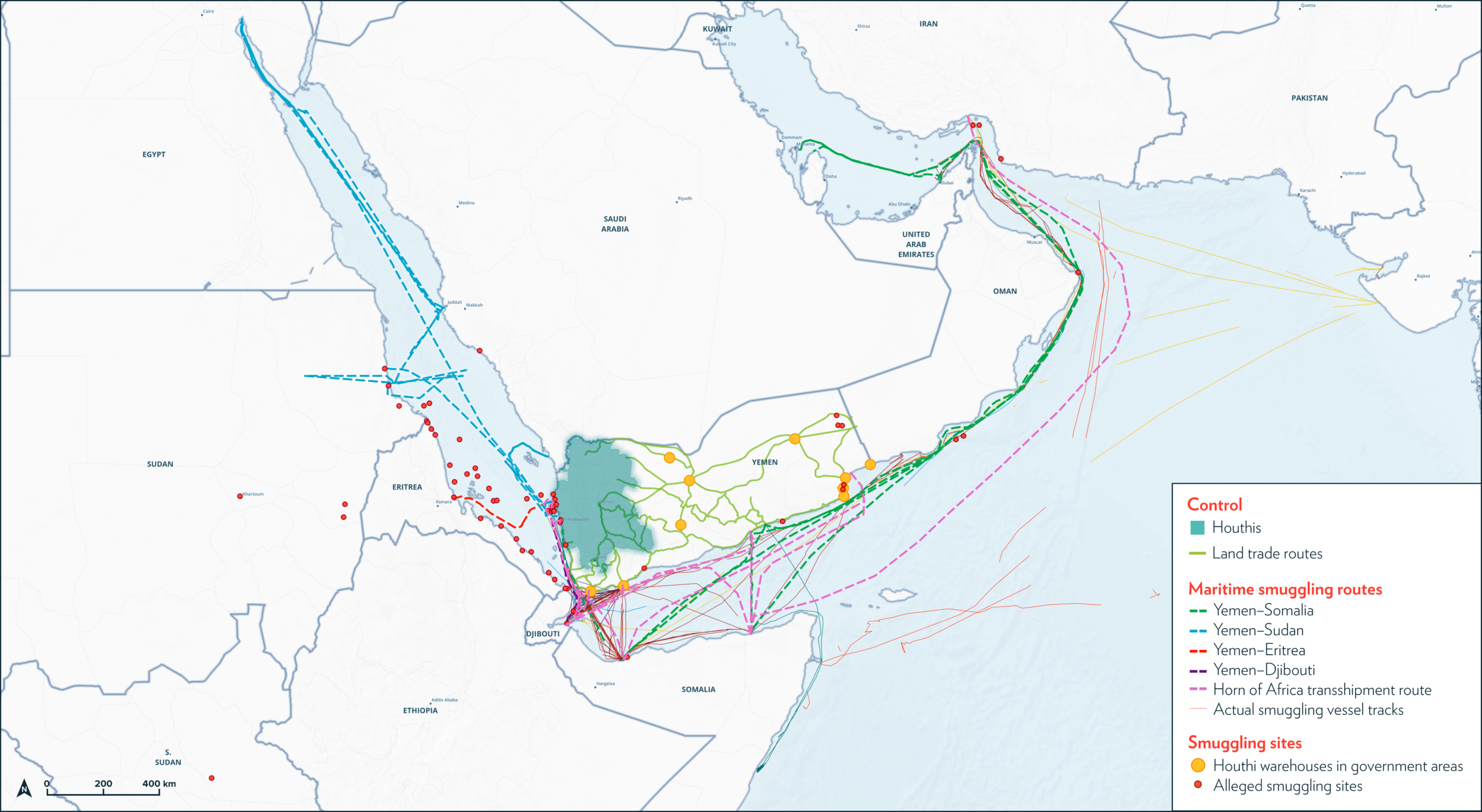
Houthi expansion into the African side of the Red Sea—into Sudan, and potentially Eritrea—would provide the group with additional, redundant supply lines that reduce that vulnerability. Interdiction efforts focused on the Gulf of Aden and Bab al-Mandab alone would no longer constrain Houthi resupply in the same way. As this report has shown, there is now a growing body of evidence that, with IRGC help, the Houthis are in fact smuggling arms to and from the two Red Sea countries. Figure 9 maps out alleged smuggling and transshipment routes used by the Houthis, escaping these past choke points.
Figure 9
Implication #2: There is growing potential for capability breakout among the groups the Houthis are training.
“Beyond the Axis” shows how the IRGC and Hezbollah have turned the training of nonstate armed groups into a graduated process that takes groups from cultivation through basic military training, advanced weapons use, and, eventually, local manufacture. The Houthis themselves are the most recent and most striking demonstration of what the capability ladder can produce. Due to a mix of specific circumstances and the Axis’s increasingly well-honed training process, the group achieved in around ten years what it had taken Hezbollah three decades to develop. If just one or two groups—such as al-Shabaab or the SAF faction described above—were to internalize the ability to build weaponized one-way attack drones, the shift could change the balance of power on the ground in Somalia or Sudan, with profound consequences for local and regional stability.
Implication #3: The Axis of Resistance’s strategy of cultivating new groups has already succeeded in providing the Axis a lifeline in the face of overwhelming force.
In late 2024, the Axis of Resistance appeared to be in freefall. Between September and December of that year, the top leaders of Hezbollah and Hamas were killed, Iranian air defenses were badly damaged, and the regime of Syria’s Bashar al-Assad collapsed in the face of an offensive by former jihadists, cutting off a critical Axis training and staging post, and a key supply line linking Iran with Lebanon.
Later, in February 2026, a U.S.–Israeli military campaign killed Iran’s supreme leader, Ayatollah Ali Khamenei. Iran’s decades-long, region-wide project of power projection, many observers believed, was coming to a sudden and sticky end.
Yet it did not. And as this report shows, as other parts of the Axis were being degraded in 2024, new nodes of connectivity were emerging among violent, ideological, and exploitative armed groups that control territory overlooking much of the Gulf of Aden and the Red Sea. The Axis’s expansion is also helping it reconstitute its supply chains, which were disrupted by the regional conflicts of 2023–26, for example by routing arms first to the Houthis and then to Hamas via Sudan, as described above. Iran’s network of allies, and its supply chains, have evolved from a centrally managed hub-and-spoke into a self-perpetuating ecosystem of interdependent armed actors whose component groups continue to expand even when individual nodes come under stress, and who can quickly route around supply disruptions.
6. Bridging the Gulf: Conclusion and Recommendations
A decade ago, a debate raged among researchers, diplomats, spies, and ordinary Yemenis. The Houthis had seized Sana’a, Yemen’s capital, and survived an intensive Saudi- and Emirati-led bombing campaign and repeated ground offensives by the coalition’s local allies, aimed at dislodging the Houthis from the northwest of the country.
One side of the debate claimed that the Houthis were an Iranian lab-grown proxy in the mold of Hezbollah. The other claimed that, while the Houthis received some support from Iran, they were a home-grown and autonomous group.
Neither claim precisely captured what was really happening. The IRGC backed the Houthis through the late 2000s and early 2010s. But it also spread its bets across many other Yemeni groups: businessmen, Sunni Islamists, even southern secessionists (the Houthis’ adversaries). The group that did the most to build the Houthis’ early military capabilities was not Iran but rather Hezbollah, which had graduated to the top of the capability ladder and was playing an increasingly important role in cultivating, managing, and training new members of the expanding Axis of Resistance. Iranian support increased after the Houthis seized control of their home governorate of Saada in 2011, and only surged after they took the capital in coalition with Yemen’s former president, Ali Abdullah Saleh.
The rest is history. The Houthis killed Saleh and cemented their rule over a de facto state governing some 20 million people, survived numerous offensives, and, by 2025, had become the breakout star of the Axis of Resistance, firing missiles and drones at Israel, disrupting Red Sea shipping, and forcing the United States into a truce after a direct confrontation over the waterway.
Today, the Houthis’ growing autonomous capabilities are on a par with those of some states. At the same time, they are increasingly bound to Iran and the Axis through an interdependent relationship. They rely on Tehran for resources, know-how and military technology. As Hamas learned during a yearslong break from Iran and the Axis in the 2010s, another patron is unlikely to provide the same level of support. Iran and other Axis members also rely on the Houthis’ ability to threaten Red Sea shipping and the Bab al-Mandab strait. As “Beyond the Axis” argues, the Houthis are now an increasingly important node in an ecosystem of Axis actors, which is in turn intertwined with and nested within larger global ecosystems of trade. And now, the Houthis are arguably attempting in the Horn of Africa and its neighborhood what the IRGC and Hezbollah did in Yemen over the past two decades, expanding the ecosystem even as it appears to be shrinking elsewhere.
The “Beyond the Axis” Framework
In interviews and during a closed workshop hosted at The Century Foundation in New York in February 2026, multiple American, British, and European diplomatic, intelligence, and military officials expressed alarm over the Axis ecosystem’s outgrowth into the Horn of Africa. They also noted the challenge of tracking and responding to such a wide range of Houthi activities, especially given the involvement of so many different groups spread across such a large swathe of territory.
And indeed, the connections between the Houthis, al-Shabaab, the SAF, and other groups are opaque and hard to track. Dense, long-standing social bonds often link seemingly disparate groups that live in proximity to one another, and the Axis has proven highly adept at exploiting these ties. Then there is the question of prioritization. Each of the relationships in the Houthis’ Red Sea and Gulf of Aden portfolio sits at a different rung on the capability ladder. Some remain at the cultivation stage. They are early, fragile, and susceptible to disruption. Others are more advanced. The al-Shabaab and SAF relationships both have the potential to develop, under the right circumstances, into strategic partnerships with worrying repercussions for the region.
Use the Capability Ladder as a Diagnostic Tool
The Beyond the Axis framework offers some useful tools for policymakers seeking to make sense of, and policy decisions related to, Houthi activity in the Gulf of Aden and the Red Sea. The capability ladder tells policy actors which groups are pre-breakout and which are post-breakout. This matters because the available response options differ sharply between stages. Pre-breakout groups can sometimes be peeled away through credible alternative pathways, sustained intelligence cooperation, and disruption of the training pipelines that move them up the ladder. Post-breakout groups can only be constrained, not dismantled; for them, the policy question is one of containment and managed risk, not reversal. Misreading a group’s stage produces wasted effort or unrealistic expectations—or, worse, persistent conflict. Each rung of the ladder has observable signatures that signal a group’s progression. Figure 10, below, outlines the different stages of the ladder and where specific groups being cultivated by the Houthis in the Horn of Africa and its neighborhood sit on it.
Figure 10
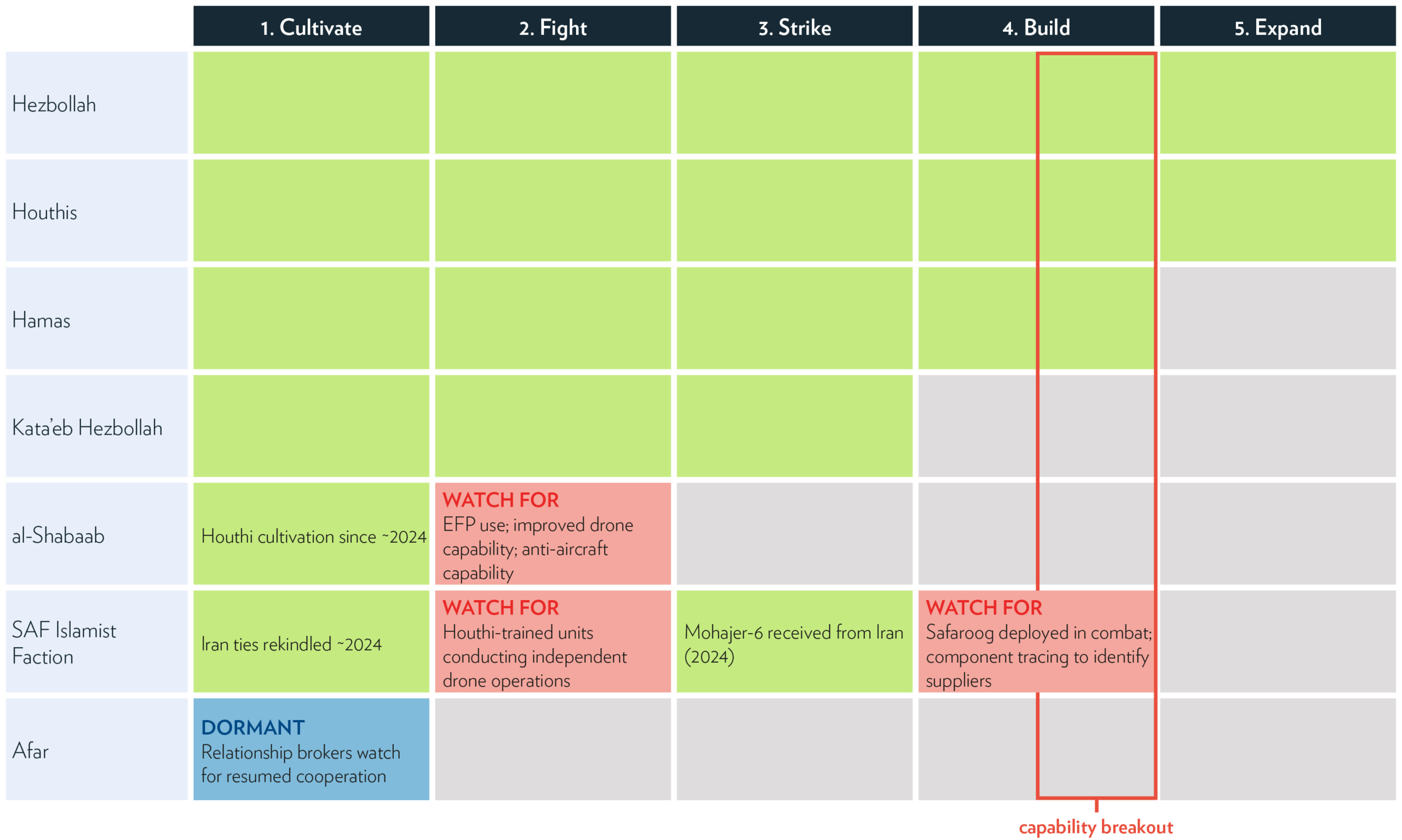
In the case of this report’s findings, three cases warrant particular attention.
Case #1: The Afar and Other Marginalized Communities
The Houthis’ outreach to the Afar has failed, at least for now. But it is part of a pattern of Houthi recruitment of peripheral peoples and is predicated on these African groups’ desperation and lack of alternate patrons. Available evidence also indicates that most of the groups the Houthis are cultivating and training still sit at the lowest rungs of the capability ladder, the stage at which ties are easiest to break.
The response options at this stage are the most promising because many cultivation efforts fail on their own. As the Afar case shows, desperation will only take groups so far. Until interdependence creeps in higher up the ladder, they remain capable of exercising autonomy in decisive moments. Houthi cultivation efforts warrant monitoring for signs that they are transitioning into something more entrenched and long-term. The policy task is therefore twofold: to avoid heavy-handed security responses that would push wavering communities toward the Houthis, as counterterrorism initiatives elsewhere have done in the past; and offer credible alternative pathways that address legitimate grievances and the absence of equitable governance or alternate patrons that make Houthi and wider Axis offers attractive in the first place.
The trade-off of this policy approach is that it demands sustained political attention and resources for peripheral populations in fragile, misgoverned countries that are not always welcoming of calls for better governance.
Case #2: Al-Shabaab, IEDs, and UAVs
Al-Shabaab currently sits somewhere between the Cultivate and Fight stages of the capability ladder. The group has received training but has not yet indigenously absorbed capability, or at least it has not done so visibly. This is the last window of opportunity “Beyond the Axis” identifies in which disruption is still possible.
At this stage, the relationship should be monitored for signs it is advancing, while efforts are made to prevent further progress. The clearest near-term signal of capability transfer would be the appearance of Iranian-pattern explosive devices, antiaircraft missiles, or drones on Somali battlefields. In particular, if “explosively formed penetrators” (armor-piercing bombs) appeared in Somalia, it would indicate the presence of a deepening Houthi relationship. This type of bomb uses a shaped-charge design that Iran developed, refined in Iraq, and subsequently transferred across the Axis network; it is technically distinct from the simpler designs al-Shabaab currently deploys, and its appearance would act like a forensic fingerprint of Houthi or Iranian training.124
Al-Shabaab also would reportedly like to gain access to the Iranian 358 antiaircraft missile that the Houthis call the Saqr. If al-Shabaab starts downing U.S. or Somali drones or aircraft, it could be a sign that the relationship with the Houthis is deepening. Any documented shift in al-Shabaab’s drone use—a shift from the commercial off-the-shelf platforms it currently employs for basic reconnaissance toward purpose-built one-way attack drones of the kind the Houthis manufacture—would also indicate that the relationship has moved from training to active capability transfer.
A few different measures can raise the cost and slow the trajectory of capability transfer: Intelligence sharing and training for the Federal Government of Somalia and the government of Yemen, the African Union peacekeeping force’s successor mission, and the Puntland Maritime Police Force by the United States and other Western and regional stakeholders; sanctions designations targeting named facilitators on both sides of the Gulf of Aden; disruption of training pipelines through Mukalla, Bossaso, and the Sanag region of Somaliland. However, this work would require sustained investment and bureaucratic coordination that might compete with more visible and politically salient counterterrorism priorities.
Case #3: Sudan and the Safaroog
In Sudan, the presence of the Safaroog UAV is the most important indicator that the relationship is evolving. At present, it appears the Safaroog is still an imported item. If Sudanese factions begin assembling or manufacturing the drone themselves, it would confirm that their relationship with the Houthis and Iran has advanced into indigenous production—the Build stage on the ladder. This, in turn, would be evidence of an independent component supply chain. If the components trace to the same Chinese and third-country suppliers, it would be strong evidence of a Houthi-mediated procurement network operating in Sudan, rather than direct Iranian supply. Battlefield deployment against RSF positions would itself be significant; component provenance is the indicator that would most directly and specifically evidence the Houthi role.
The response options at the Build stage are more constrained. An SAF Islamist faction producing its own Safaroog drones at scale is no longer a group whose capability can be disrupted by interdicting individual shipments. Policy would instead need to focus on component tracing: the manufacturing nodes, third-country brokers, and shipping intermediaries that move the supply chain across borders.
“Beyond the Axis” identified this as the multilateral engagement track, with China and the major bridge jurisdictions of Turkey, the Emirates, and Djibouti as the most consequential actors. The challenge is that multilateral engagement is the most diplomatically demanding of the available options, and Western states have difficult relationships with several of the countries in question.
Mapping Regional Fault Lines
Another, even bigger challenge is the broader context in which Houthi expansion is taking place. This report focuses on the Houthis’ expansion across the Gulf of Aden and the Red Sea. But it is important to note that the Houthis, Iran, and their Axis allies are only a handful of actors among the many external powers instrumentalizing the fractured conflict landscape of the Horn of Africa and its neighborhood to gain geopolitical edge.
In fact, the sheer number of local, regional, and international factions and interests at play in the Red Sea and the Gulf of Aden makes the region one of the most complex conflict landscapes on the planet; one where short-termist, narrowly self-interested tactical moves by one actor almost inevitably produce second-order consequences that exacerbate internal fragmentation and intertwine cross-border conflict dynamics.
While the Sudanese conflict is often depicted as a binary struggle between the SAF and the RSF, for example, the two parties, in reality, rely on fluid coalitions of local political and armed factions to fight the war on the ground, and on financial and material support from multiple external backers to sustain the effort. Each backer has its own reasons for supporting one side or the other, but all increasingly appear to treat Sudan as a playing field where winning outright matters less than sapping rivals’ resources.
This dynamic has produced new, complex linkages between Sudan’s internal conflict and other regional rivalries, in particular between Sudan’s neighbors Ethiopia and Eritrea; and between the two biggest Gulf powers, Saudi Arabia and the Emirates. As discussed above, the Emirates, widely seen as the main backer of the RSF, is also a key ally of Sudan’s landlocked neighbor Ethiopia, which has taken on a growing role as a logistical and training hub for the RSF after other supply routes were disrupted. Officials in Eritrea in turn view Ethiopia, which covets the Eritrean port of Assab, as a major threat to Eritrean security. As such, Eritrean and Sudanese officials see cooperation as a way of pushing back against Ethiopia and its Emirati backers.
Saudi Arabia, meanwhile, having sought to present itself as a neutral mediator during the war’s early years, has backed the SAF more robustly since 2025 as part of its own effort to push back against what it views as the Emirates’ destabilizing regional role. That support, along with more strenuous backing from Egypt and Turkey, has helped sustain the SAF and led some of its leaders to conclude they can still win the war outright. Put together, the different agendas at play in Sudan risk transforming a bloody and internationalized conflict that has been confined—until now—to the country’s borders into something much bigger and messier, potentially involving fighting in Ethiopia and Eritrea, too, with different regional powers backing rival blocs.125
By inserting themselves into the conflict, the Houthis are further complicating matters. Houthi and Iranian support for the SAF Islamist faction is becoming a source of friction between the SAF leadership and its international backers; and within the SAF itself. The May 2026 interdiction of an arms shipment from the Houthis to Sudan (see above) came about because of pressure on the SAF leadership from Saudi Arabia and the United States, well-informed Western and Sudanese sources say, with SAF forces only reluctantly intervening. The interdiction deepened the growing tensions between the core SAF leadership and the Islamist faction. If Saudi and U.S. pressure on the SAF to cut ties both with the Houthis and Iran and groups like the Baraa ibn Malik Brigades grows, and these different actors double down on their relationships, the fallout could help lay the groundwork for a messy internal SAF conflict that would only prolong and fragment the national war.
Similarly, Houthi attacks on Red Sea shipping and on Israel itself helped convince Israeli policymakers of the need for a base in the Horn of Africa from which to take the fight back to the Yemeni group. This effort may have led Israel to recognize Somaliland as an independent state in December 2025. This recognition has intensified divides between Hargeisa (Somaliland’s capital) and Mogadishu. It has also given the Houthis and al-Shabaab further reason to cooperate with one another while creating new connections between Somalia’s conflict and Sudan’s, with many of the same regional and international powers backing rival factions.
Conclusion: Intertwining Conflict Ecosystems
The tendrils of conflict and competition are intertwining across the Red Sea and the Gulf of Aden, in ways that could eventually draw the region’s Arab and African littoral states, nonstate actors, and their external patrons into a larger, highly complex regional conflict. With an eye on the future, and borrowing from the IRGC and Hezbollah playbook, the Houthis are slowly building their own networks across the two waterways, accelerating their transition from spoke to hub. In doing so, they are increasing their resilience to external policy interventions, and more deeply embedding the Axis ecosystem—and Yemen—in the region, while creating new conflict fault lines.
There is, it bears repeating, no guarantee any of the bets the Houthis are placing will pay off. Additionally, capability breakout of the kind the Houthis have achieved is rare. But even under the current circumstances, there are strong incentives for armed groups and state actors to work with the Houthis, Iran, and the Axis. And if just one bet does pay off and al-Shabaab or the Sudanese Islamist faction crosses the capability-breakout threshold, the region will have to countenance a major new threat in the form of a hard-to-disrupt, technologically advanced nonstate actor capable of long-range precision strikes on its adversaries.
This possibility may sound far-fetched—but so, too, did the Houthis’ ascent from local insurgents to regional threat. By the time sufficient proof had accumulated that the group was in fact fielding Iranian-made and -designed drones and missiles, and that it had quietly transitioned from a local to a strategic actor—targeting not just its Yemeni rivals but Saudi and Emirati territory—it was almost too late to meaningfully intervene. The group was already building its own drones and indigenous but globalized procurement networks, and developing the dense fabric of human capital that has made it so resilient. The policy options for mitigating the Houthi threat had narrowed, and the costs of intervention had risen, as the direct U.S.–Houthi confrontation in the Red Sea in 2025 demonstrated. Now, Houthi ties across the Red Sea and the Gulf of Aden are making the Houthis more resilient to efforts to prevent them from threatening shipping passing through these same waterways.
The question for policymakers is, therefore, what the Houthi presence in Africa will look like in two or three years, and what their allies’ capabilities will be, if current trajectories continue. The answer depends in part on decisions made now, during the relationship-building phase and before the consolidation of capabilities and relationships.
If the region’s conflicts and the external actors driving them cannot be resolved, and Houthi expansion continues unimpeded, the risks will only deepen, with grave consequences for ordinary people in Yemen and across the region. The challenge for policymakers is to begin thinking—as this project has proposed—beyond artificially imposed borders, and instead in terms of ecosystems. The Beyond the Axis framework provides a way to begin evaluating who is being cultivated, where they sit on the capability ladder, and by extension what policy options are available. From this starting point, more realistic policies can be built.
Acknowledgements
This report is part of “Beyond the Axis,” a Century International project supported by the Cross-Border Conflict Evidence, Policy and Trends (XCEPT) research program, funded by UK International Development. It was produced by a multidisciplinary team of researchers led by Peter Salisbury, who drafted the report alongside Nadwa al-Dawsari and Jay Bahadur, with editorial director Eamon Kircher-Allen. Kevin Mazur led data analysis and worked with Olea Rusten Rugumayo to produce the report’s visuals.
Contributors
Veena Ali-Khan is a journalist at Bloomberg News. Before joining Bloomberg, she was a fellow at Century International, focusing on the Arabian Peninsula, Gulf energy dynamics, and political economy in the Middle East. Earlier, she was the Yemen researcher at the International Crisis Group.
Mohammed al-Basha is a researcher and consultant. The founder of the Basha Report, a U.S.-based risk advisory firm, he specializes in the analysis and visualization of complex security, military, and geopolitical environments.
Nadwa al-Dawsari is a researcher and conflict analyst specializing in Yemen and the broader region. Her work examines Yemen’s conflict dynamics and their regional security implications amid the rise of nonstate armed groups and proxy warfare. She is an associate fellow at the Middle East Institute.
Fatima Ayub is a researcher who has worked at the nexus of conflict, security, and human rights issues in the Middle East and South Asia for more than two decades.
Jay Bahadur is the Nairobi-based codirector of Scopus Insights and a former UN Security Council sanctions monitor covering Somalia and Eritrea. His work focuses on Islamist militancy, maritime arms smuggling, piracy, illegal fishing, and natural resource conflict.
Thanassis Cambanis is an author, a journalist, and the director of Century International. His work focuses on U.S. foreign policy, Arab politics, and social movements in the Middle East.
Jonas Horner is a researcher and analyst who has worked with the European Council on Foreign Relations, the UN, and the International Crisis Group on Sudan and the Horn of Africa.
Eamon Kircher-Allen is editor-in-chief at Century International and was the editorial director for the Beyond the Axis project. He has worked as a journalist in the United States and East Africa, and for more than a decade as a writer, editor, and researcher focusing on economics, the environment, and the Middle East and Africa.
Amanda Long works on violence prevention and national security threat intelligence in the AI space. Previously, she worked as an open-source researcher and policy analyst focused on civilian protection and conflict resolution, including with UNU-CPR, the UN Operations and Crisis Centre, and the U.S. Institute of Peace.
Kevin Mazur is a social scientist and lecturer at the Department of Political Economy at King’s College London. His work blends quantitative and qualitative research methods to examine identities and state-society connections in armed conflict.
Richard Nield is an investigative journalist and analyst specializing in Africa and the Middle East. His work focuses on conflict economies, transnational illicit networks, and corruption, particularly across North and Central Africa and the Horn.
Wolf-Christian Paes is an associate fellow for armed conflict at the International Institute for Strategic Studies. A former arms expert on the UN Panel of Experts and consultant for the UN Office on Drugs and Crime, his work focuses on arms control and sanctions enforcement, as well as on maritime security.
Olea Rusten Rugumayo is a graphic design and communications consultant who specializes in translating complex data, maps, and policy concepts into accessible visuals. She works with clients including the Consultative Group on International Agricultural Research, XCEPT, Chemonics, and the London School of Economics.
Peter Salisbury is the research lead for the Beyond the Axis project. A researcher and writer who studies the political economy of war and peace in the Middle East, he is a fellow at Century International, and an associate adjunct professor at Columbia University’s School of International and Public Affairs.
Henry Thompson is an arms, energy, and community relations expert. A former member of the UN Panel of Experts for Yemen, he has worked globally to advise major international nongovernmental organizations, energy companies, and peacebuilding initiatives.
About XCEPT
XCEPT brings together world-leading experts and local researchers to examine conflict-affected borderlands, how conflicts connect across borders, and the drivers of violent and peaceful behavior, to inform policies and programs that support peace. For more information, visit https://www.xcept-research.org/ or contact us at [email protected]. This is independent research and the views expressed are those of the authors and do not necessarily reflect the UK government’s official policies.
Notes
- Renad Mansour, Hayder Al-Shakeri, and Haid Haid, “The Shape-Shifting ‘Axis of Resistance,’” Chatham House, March 6, 2025, https://www.chathamhouse.org/2025/03/shape-shifting-axis-resistance/02-how-axis-was-formed-and-how-it-has-evolved.
- See Peter Salisbury, “Beyond the Axis,” Century International, June 23, 2026, https://tcf.org/content/report/beyond-the-axis/.
- Veena Ali-Khan, Peter Salisbury, and Henry Thompson, “From Smugglers to Supply Chains: How Yemen’s Houthi Movement Became a Global Threat,” Century International, February 9, 2026, https://tcf.org/content/report/from-smugglers-to-supply-chains-how-yemens-houthi-movement-became-a-global-threat/.
- Peter Salisbury, “Beyond the Axis,” Century International, June 23, 2026, https://tcf.org/content/report/beyond-the-axis/.
- For example, while public reporting and some private sources assert that the Houthis are cooperating with the Somali branch of the Islamic State (ISIS–Somalia), the authors found no corroborating evidence to substantiate the claim.
- Diana Roy, “Another Hormuz? What to Know About the Houthi Threat to the Red Sea,” Council on Foreign Relations, July 20, 2026, https://www.cfr.org/articles/another-hormuz-the-red-seas-threat-to-the-global-economy.
- “Letter Dated 25 March 2003 from the Chairman of the Security Council Committee Established Pursuant to Resolution 751 (1992) Concerning Somalia Addressed to the President of The Security Council,” UN, March 25, 2003, https://reliefweb.int/report/somalia/report-panel-experts-somalia-s2003223.
- Author experiences visiting arms souqs in Yemen. See also “Letter Dated 11 August 2004 From the Chairman of the Security Council Committee Established Pursuant to Resolution 751 (1992) Concerning Somalia Addressed to the President of the Security Council,” UN, August 11, 2004, https://www.securitycouncilreport.org/atf/cf/%7B65BFCF9B-6D27-4E9C-8CD3-CF6E4FF96FF9%7D/SOMALIA%20S2004604.pdf. Derek B. Miller, “Demand, Stockpiles, and Social Controls: Small Arms in Yemen,” Small Arms Survey, May 2003, https://www.smallarmssurvey.org/sites/default/files/resources/SAS-OP09-Yemen.pdf.
- “Illicit Trade in Conflict-Affected Countries of the Middle East and North Africa: Focus on Yemen,” OECD, May 17, 2022, https://www.oecd.org/en/publications/illicit-trade-in-conflict-affected-countries-of-the-middle-east-and-north-africa_f31fd13a-en.html.
- Ginny Hill et al., “Yemen: Corruption, Capital Flight and Global Drivers of Conflict,” Chatham House, September 2013, https://www.chathamhouse.org/sites/default/files/public/Research/Middle%20East/0913r_yemen.pdf.
- Maysaa Shuja Al-Deen, “Entrenched Power: The Houthi System of Governance,” Sana’a Center for Strategic Studies, July 11, 2022, https://sanaacenter.org/the-yemen-review/june-2022/18144.
- Yemeni and regional businessmen, security officials, author interviews, 2023–26.
- Western, Yemeni, and regional officials, author interviews, April–November 2024.
- Maysaa Shuja Al-Deen, “Entrenched Power: The Houthi System of Governance,” Sana’a Center for Strategic Studies, July 11, 2022, https://sanaacenter.org/the-yemen-review/june-2022/18144.
- Yemeni government coast guard official, author interview, October 2025.
- “Final Report of the Panel of Experts on Yemen, UN Security Council, S/2024/731, October 2024,” UN, October 11, 2024. Yemeni, Somali, regional officials, author interviews, 2023–26, private UN and other reports on file with the authors, https://www.ecoi.net/en/file/local/2117585/n2425953.pdf.
- Confidential UN report on file with the authors.
- Yemeni and regional officials believe that the Houthis have been able to import Syrian captagon production expertise, a claim somewhat supported by public reporting. Author interviews, Yemeni, regional officials, 2025–26. The government of Yemen meanwhile claims to have identified a Houthi-controlled captagon laboratory in July 2025. See “Have the Houthis Inherited the Drug Industry from the Assad Regime?,” South24 Center, September 2025, https://south24.net/news/newse.php?nid=4934. But other reporting has cast doubt on these claims. Nick Krohley and Ian Larson, “When Cartels Collapse: The Future of Captagon in the Middle East,” XCEPT, July 2025, https://www.xcept-research.org/wp-content/uploads/2022/11/20250922_XCEPT_When-Cartels-Collapse_PublicReport_July-2025_FINAL.pdf.
- Yemeni security official, author interview, January 2026. See also “Secret File: External Expansion and Horn of Africa of Houthi Terrorism,” Platform for Tracking Organised Crime and Money Laundering, July 2024, report on file.
- In a 2017 report, UN experts wrote that “the region of Puntland remained the primary entry point for illicit flows of weapons into Somalia. . . . larger shipments transported by medium-size ocean- going dhows, originating from the Makran coast of the Islamic Republic of Iran; and smaller, more frequent shipments sourced from Yemen and typically delivered by skiffs capable of making the journey in a single day.” “Report of the Monitoring Group on Somalia and Eritrea Submitted in Accordance with Security Council Resolution 2317 (2016),” UN, November 8, 2017, https://digitallibrary.un.org/record/1317757/files/S_2017_924-EN.pdf.
- Veena Ali-Khan, Peter Salisbury, and Henry Thompson, “From Smugglers to Supply Chains: How Yemen’s Houthi Movement Became a Global Threat,” Century International, February 9, 2026, https://tcf.org/content/report/from-smugglers-to-supply-chains-how-yemens-houthi-movement-became-a-global-threat/.
- Veena Ali-Khan, Peter Salisbury, and Henry Thompson, “From Smugglers to Supply Chains: How Yemen’s Houthi Movement Became a Global Threat,” Century International, February 9, 2026, https://tcf.org/content/report/from-smugglers-to-supply-chains-how-yemens-houthi-movement-became-a-global-threat/.
- According to Yemeni, regional and Western officials, and other sources.
- “Fares Mohammed Mana’a,” UN, October 29, 2014, https://main.un.org/securitycouncil/en/sanctions/751/materials/summaries/individual/fares-mohammed-mana%27a.
- Analysis on file with the authors.
- Three Yemeni security officials, one former Western official, one former UN investigator, author interviews, 2023–26.
- Three Yemeni security officials, one former Western official, one former UN investigator, author interviews, 2023–26.
- Well-informed Yemeni businessman, author interview, January 2026.
- Yemeni coast guard official, senior official from Yemen’s National Resistance Forces, 2025–26. Smuggler video testimony on file with the authors.
- Author interview, senior Yemeni Coast Guard official, October 2021.
- For more details on the Al-Bari 2, see Jay Bahadur, “Snapping Back Against Iran: The Case of the Al-Bari 2 and the UN Arms Embargo,” Global Initiative Against Transnational Crime, November 30, 2020, https://globalinitiative.net/analysis/iran-pb/.
- Call data reviewed by the authors. Halhali claims are based on earlier author research, pro-Yemeni government media and think tank reporting, 2024–25, smuggler testimony on file with the authors and senior Yemeni Coast Guard commander, author interview, 2025.
- The network is alleged to have transported a consignment of arms from Iran to the Houthis as recently as February 2026, which included drones, missile components, and other materiel. Yemeni, Somali security officials and maritime sources, author interviews, 2026.
- Somali sailors, author interviews; social media posts recorded by the authors; Somali and security sources along with call records support the claim that the Salem, Baabad, and Bamalem networks have collaborated to transfer Iranian and other arms to the Houthis on at least four occasions, including a consignment of AK-56-1 rifles, anti-tank missiles, and other arms transported on the Al-Bari 2 dhow.
- Yemeni coast guard official, senior official from Yemen’s National Resistance Forces, author interviews, 2025–26.
- Somali security officials, author interviews, 2025–26.
- Private report on file with the authors; regional security sources, author interviews, 2025–26.
- The alleged contact occurred with actors in the Ras Aseyr region of Puntland. Somali security officials, author interviews, 2025–26.
- Based on assessments by Western and regional security sources. For report of base plan, see Simon Marks, “Israel Plans New Foothold on the Red Sea to Fight the Houthis,” Bloomberg, March 11, 2026, https://www.bloomberg.com/news/features/2026-03-11/israel-eyes-red-sea-base-in-somaliland-to-fight-iran-backed-houthis.
- See “Assessment of the Response to Illicit Weapons Trafficking in the Gulf of Aden and the Red Sea,” UNODC, December 2024.
- Western government official, Yemeni coastguard official, author interviews, 2025–26.
- Yemeni coastguard official, author interview, 2026.
- Yemeni businessmen, contemporaneous and 2026 interviews. Private 2012 assessment of the Yemeni banking sector on file with the author.
- Yemeni businessmen, contemporaneous and 2026 interviews.
- “Brokering a Truce in Yemen’s Economic Conflict,” International Crisis Group, January 20, 2022.
- Yemeni and Western official sources interviews, 2025–26, and partial transcript of local authorities’ 2024 interview with the Houthi operative.
- One Yemeni official and one Western investigator, author interviews, 2025–26.
- As named by Yemeni security officials. Yemeni security official, author interview, 2026.
- Shipping manifest on file with the authors. For Guelleh family ownership of 77 Logistics, see “Djibouti Ports Corridor Road: A New Firm Set Up by Hadi,” Africa Intelligence, March 10, 2017, https://www.africaintelligence.com/eastern-africa-and-the-horn/2017/03/10/djibouti-ports-corridor-road-a-new-firm-set-up-by-hadi,108225505-bre; “Les dirigeants de Djibouti accusés de détenir des biens mal acquis à Paris,” Mediapart, March 6, 2019, https://www.mediapart.fr/journal/international/060319/les-dirigeants-de-djibouti-accuses-de-detenir-des-biens-mal-acquis-paris. National Resistance Forces also allege that the company is owned by the Guelleh family, citing their own intelligence.
- National Resistance Forces official, author interview, January 2026. Private National Resistance Forces report on the seizure on file with the authors.
- National Resistance Forces official, author interview, January 2026. Smuggler testimony on file with the authors.
- As documented in Veena Ali-Khan, Peter Salisbury, and Henry Thompson, “From Smugglers to Supply Chains: How Yemen’s Houthi Movement Became a Global Threat,” Century International, February 9, 2026, https://tcf.org/content/report/from-smugglers-to-supply-chains-how-yemens-houthi-movement-became-a-global-threat/.
- Author analysis of import records via Sayari.
- Yemeni businessmen, three Western officials, author interviews, 2026.
- Djiboutian official, email correspondence with the authors, 2026.
- Transshipment volumes at Djibouti increased from 19 percent in early December 2023 to 60 percent in April 2024, according to the Middle East Institute. The head of Djibouti Ports and Free Zone told Bloomberg that Djibouti had been “doing good business because of the bad luck of others.” Lloyd’s List Intelligence noted a 59 percent increase in vessel callings at Djibouti in the first half of 2024, with preliminary volume figures showing a roughly 77 percent increase. See Ahmed Abdi, “Djibouti Dodges Scrutiny Despite China, Iran, Houthi Ties and Links to Illicit Activities,” Middle East Institute, August 7, 2024; and Linton Nightingale, “Red Sea Reroutings Uproot Traditional Transhipment Trends,” Lloyd’s List, September 5, 2024, https://www.lloydslist.com/LL1150516/Red-Sea-reroutings-uproot-traditional-transhipment-trends.
- According to Yemeni security officials, African migrants formerly based in Yemen, and other well-informed sources based in Yemen. Yemeni government officials and Yemenis formerly based in northern Yemen, author interviews, 2025–26.
- Regional intelligence briefing reviewed by the authors, November 2025; “Houthi Weapons and Fighter Smuggling in Africa: Part Two,” Platform for Tracking Organized Crime and Money Laundering in Yemen, 2024, report on file with the authors.
- Formerly Sana’a-based African community leader, author interview, April 2026.
- Yemeni officials, Somali researchers, and a specialist Western investigator with knowledge of the matter, author interviews, 2024–26.
- By 2025, four named training centers for African recruits had been documented: Bajel (Hodeidah governorate), under Yousef al-Madani; al-Jawf, under Badr Bazara’ah; and two facilities in Saada, under Motlaq al-Marrani and Hassan Dabeesh, respectively. Martyrs’ Mosque in Sana’a is reportedly used for ideological indoctrination prior to deployment: Yemeni government officials and Yemenis formerly based in northern Yemen, author interviews, 2025. Cultural courses at the mosque were documented in 2023, according to the same sources.
- Former members of the African community in northern Yemen, Yemeni intelligence officials, author interviews, 2025–26.
- Formerly Sana’a-based African community leader, author interview, April 2026.
- Afari factions based themselves in Yemen during and after the Djiboutian civil war of the early 1990s, which pitted the Afar against the politically dominant, ethnically Somali Issa clan. Alexandre Lauret, “Passer les frontières dans la corne de l’Afrique,” EchoGéo, 2021, https://journals.openedition.org/echogeo/20232’ “Hardline FRUD Leader Returns from Exile,” New Humanitarian, March 30, 2000, https://www.thenewhumanitarian.org/report/13266/djibouti-hardline-frud-leader-returns-exile. Ahmed Dini Ahmed, leader of the hardline FRUD-Combattant faction, spent nine years in exile in Yemen before returning to Djibouti following a peace deal in February 2000.
- Afar community sources and RSADO senior leadership, author interviews, 2025.
- Afar community sources and RSADO senior leadership, author interviews, 2025.
- Afar community sources and RSADO senior leadership, author interviews, 2025. Beyond the Axis project research records 150-plus Afari fighters trained, according to two Afari community members with direct knowledge, author interviews, 2025. Ali Ahmed Mohammed Yaidi, an Eritrean recruit captured by the National Resistance Forces, confirmed in confessions posted by National Resistance Forces military media in February 2025 that he was recruited in Djibouti by Mohammed Ali Moussa, transported with nine others by dhow to Hodeidah, and received by Alawsan and senior Houthi leaders; recruits underwent two months of ideological indoctrination in Hodeidah and then one month in Sana’a, before being returned to Hodeidah.
- RSADO leadership, author interviews, 2025. Afari tribal leaders’ letters of February 14, 2025.
- Eritrea-based Afari leader, author interview, 2026.
- Matt Bryden, “Somalia at Risk of Becoming a Jihadist State,” Africa Center for Strategic Studies, November 17, 2025. On the 2022 government campaign, see “Al Shabaab,” Congressional Research Service, updated February 2023. On the drawdown of African Union forces, see Jason Warner, “Flailing State: The Resurgence of al-Shabaab in Somalia,” War on the Rocks, June 3, 2025.
- The UN Security Council lifted the arms embargo on the Federal Government of Somalia in December 2023. See “UN Security Council, Resolution 2714,” UN, December 1, 2023, https://main.un.org/securitycouncil/en/content/sres2714-2023. Turkey has since delivered Bayraktar TB2 and Akinci combat drones, T129 ATAK attack helicopters, and deployed approximately five hundred troops to support air operations. “Turkey Delivers T129 Atak Helicopters to Somalia,” Middle East Eye, June 4, 2025.
- According to Western, Yemeni, Somali, and other regional officials and Arabic language media reporting.
- Thomas Newdick, “What Air Defenses Do the Houthis in Yemen Actually Have?,” War Zone, April 23, 2025. On MQ-9 losses, U.S. defense officials confirmed at least seventeen Reaper losses over Yemen since October 2023; the Houthis claim to have downed more than twenty since 2017. See “Yemen’s Houthi Rebels Claim They Shot Down Another American Drone,” Associated Press/Military.com, April 1, 2025.
- Two former and two current Western officials, one regional official, author interviews, 2025–26.
- “Al-Shabaab and the Houthis: Details of the Meeting and Its Outcomes,” (in Arabic), anbaajassim.com, February 2026 (article on file with authors, though the website was offline at the time of publication). The report is based on what the article’s author describes as internal al-Shabaab documents, including Somali-language meeting notes.
- Stamps in Samatar’s passport, images of which the authors have on file, indicate that Samatar departed a Somali port, likely Bossaso, on September 15, 2024, and subsequently entered Yemen via Mukalla’s seaport on an unspecified date in the same month. His arrest occurred sometime thereafter, though the exact date is unknown. Yemeni security officials claim that he was detained while transporting Somali recruits for training, but this is disputed by other sources.
- A project researcher was shown the video by a Western investigator, and the video is on file with the authors; however, authors could not verify its authenticity. The video depicts a group of young men in the rear of a pickup truck who, Yemeni officials claim, were al-Shabaab members, while a voice off-camera remarks in Arabic, “look how many there are.”
- Western, Somali, and Yemeni officials, author interviews 2025–26, and “Letter Dated 15 October 2025 From the Panel of Experts on Yemen Addressed to the President of the Security Council,” UN, October 15, 2025, https://digitallibrary.un.org/record/4091746?v=pdf.
- International and regional security sources, author interviews, January–March 2026. According to a Western security source, Samatar was likely “involved in drone procurement or training.” Researcher open-source investigation of Samatar’s email address, on file with the authors.
- Somali intelligence official, author interview, March 2026. Stamps in Samatar’s passport indicate that he entered Yemen via the port of Aden on March 1, 2024, and departed through Aden International Airport on April 25, 2024. Photographs of passport ID and stamped pages on file with the authors.
- The period of Samatar’s reported movements closely aligns with reporting from Western officials with knowledge of the matter, indicating that between June 18 and 27, 2024, al-Shabaab emir Ahmed Diriye and his deputy, Abdirahman Mohamed Warsame (also known as “Mahad Karate”) hosted an unspecified number of Houthi officials from Yemen to discuss the procurement of explosive drones. Author interviews, 2025–26.
- According to an investigator for the UN Panel of Experts; member of the panel, author interview, February 2026.
- Digital border records on file with the authors.
- According to his Somali passport, issued in Ankara, Turkey, Ali was born on February 25, 1987, in Mogadishu. He was also in possession of a Yemeni passport issued in Sana’a in 2023 under the alias Abdul Qadir Yahya Ali Ahmed al-Zabidi.
- Yemeni officials, author interviews 2025–26, and Yemeni intelligence report on file with the authors.
- Yemeni officials, author interviews 2025–26, and Yemeni intelligence report on file with the authors. The same document is the source for the claim that Ali was installed in the Haddah apartment under instructions from Abdulwahid Naji Abu Ras; al-Shabaab relationship detail via author interview with a regional security source in Nairobi, February 2026.
- Yemeni local media reporting, 2026, reviewed by the authors. Corroborated by Yemeni and regional security officials, author interviews, 2026.
- Yemeni and regional security officials, author interviews, 2025–26.
- Image reviewed by project researcher, provided by regional security source, 2026.
- Remittance forms reviewed by project researcher, provided by regional security source, 2026.
- Regional security source, communication with the authors, 2026.
- Somali intelligence source, regional security source, in communication with the authors, 2026.
- “Al-Shabaab and the Houthis: Details of the Meeting and Its Outcomes,” (in Arabic), anbaajassim.com, February 2026 (article on file with the authors; the website was offline at time of publication). The report is based on what the article’s author describes as internal al-Shabaab documents, including Somali-language meeting notes.
- “Al-Shabaab and the Houthis: Details of the Meeting and Its Outcomes,” (in Arabic), anbaajassim.com, February 2026 (article on file with the authors; the website was offline at time of publication).
- In August 2024, Puntland security forces seized five first-person-view (FPV) drones in Garowe that had been modified to deliver explosive ordnance, allegedly for al-Shabaab. This represents the only publicly reported seizure of al-Shabaab explosive drones to date. Somali officials report that the drones were imported from Yemen, but there is no evidence indicating a direct link to the Houthis.
- Al-Shabaab members selected for Houthi training have consistently been reported to travel to Yemen in groups of around thirty, the UN Panel of Experts on Somalia reported in late 2025, in line with claims made by Western, Yemeni, and Somali officials in 2025–26 author interviews. In 2024, four such groups traveled to Yemen for training, according to the same sources. A regional security source indicated that an al-Shabaab insider had provided an audio recording documenting his journey from Somalia to Yemen, including arrival at a Houthi training facility near Hodeidah. According to this source, three additional tranches had traveled for training, each comprising precisely thirty-three individuals. See “UN Panel of Experts on Somalia, Report of the Panel of Experts Pursuant to Resolution 2713 (2023) Submitted in Accordance with Resolution 2776 (2025),” UN, November 28, 2025, https://docs.un.org/en/S/2025/777.
- Simon Marks, “Israel Plans New Foothold on the Red Sea to Fight the Houthis,” Bloomberg, 11 March 2026, https://www.bloomberg.com/news/features/2026-03-11/israel-eyes-red-sea-base-in-somaliland-to-fight-iran-backed-houthis.
- Abdirahman Ali Dhimbil, Wedaeli Chibelushi, “Israel’s Foreign Minister on Historic Visit to Somaliland,” BBC, January 6, 2026.
- “Israel Reportedly Deployed Elite Forces in Azerbaijan, Operated Somaliland Base, During Iran War,” Times of Israel, June 5, 2026, https://www.timesofisrael.com/israel-put-elite-forces-in-azerbaijan-operated-somaliland-base-during-iran-war-report/.
- “DP World Marks Start of Concession in Somaliland,” Gulf News, March 2, 2017, https://d.docs.live.net/64C2EDE27490D8E6/XCEPT/BEYOND%20THE%20AXIS%20DRAFTING/FINAL%20REVIEW%20COPY/HOUTHIS%20IN%20AFRICA/,%20https:/gulfnews.com/business/dp-world-marks-start-of-concession-in-somaliland-1.2025756.
- Alexander Cornwell, “UAE to Train Somaliland Forces Under Military Base Deal,” Reuters, March 16, 2018, https://www.reuters.com/article/world/uae-to-train-somaliland-forces-under-military-base-deal-somaliland-president-idUSKCN1GR2ZH/.
- “Sudan: After 2 Years of War, Global Action Needed,” Human Rights Watch, April 13, 2025, https://www.hrw.org/news/2025/04/13/sudan-after-2-years-war-global-action-needed.
- Tareq Alotaiba, “Sudan Is Iran’s Opening for a Foothold in the Red Sea,” AGSI, March 3, 2025, https://agsi.org/analysis/sudan-is-irans-opening-for-a-foothold-in-the-red-sea/.
- Iran’s supply of Mohajer-6 UAVs to the SAF was documented through data from Flightradar24 tracking of U.S. Office of Foreign Assets Control-sanctioned, IRGC-linked aircraft Fars Air Qeshm (registration EP-FAB) on Tehran–Sudan routes, as reported by “Iran’s Air Bridge to the Sudanese Military,” Sudan War Monitor, October 17, 2024, https://sudanwarmonitor.com/p/evidence-iran-weapons-deliveries; and Yemeni and regional security officials, author interviews, 2024–25. For SAF recapture of Khartoum and the role of Iranian platforms, see Jonas Horner, “The Falcons and the Secretary Bird: Arab Gulf States in Sudan’s War,” European Council on Foreign Relations, July 30, 2025, https://ecfr.eu/publication/the-falcons-and-the-secretary-bird-arab-gulf-states-in-sudans-war/; Sudan analyst, author interviews, July 2025.
- “Treasury Sanctions Sudanese Armed Forces Weapons Procurement Director,” U.S. Department of the Treasury, October 24, 2024, https://home.treasury.gov/news/press-releases/jy2672.
- U.S. Department of the Treasury, “Treasury Sanctions Sudanese Islamist Actors to Counter Regional Instability and Support for Iran,” September 12, 2025, https://home.treasury.gov/news/press-releases/sb0246.
- Yemeni, Western and regional officials, author interviews, 2025–26. See also Declan Walsh and Christoph Koettl, “How a U.S. Ally Uses Aid as a Cover in War,” New York Times, September 21, 2024, https://www.nytimes.com/2024/09/21/world/africa/uae-sudan-civil-war.html. The article states that “the Houthis of Yemen sent shiploads of weapons to Sudan’s military, at Iran’s behest.” The Houthis denied sending military aid.
- Author analysis of private ports record, on file with the authors.
- A Sudanese official, two Western officials, two security researchers, author, consultant, and researcher interviews, May and June 2026.
- Author analysis of AIS vessel tracking data (Global Fishing Watch), Planet Labs satellite imagery, and Emdyn mobility data, 2024–25, on file with the authors, and Planet Labs imagery corroborated by Yemeni official sources. In early 2024 Yemeni authorities say that they documented three large fishing boats transporting over 7,000 weapons plus mortars from Hodeidah to Sudan; author interviews, 2025.
- Yemeni, Western and regional officials, Sudan-based researcher, international security consultant, Port Sudan-based sources, author interviews, 2025–26.
- Military Industrial Corporation promotional material, International Defence Industry Fair, Istanbul, July 2025. Military Industrial Corporation representatives told Jane’s Defence Weekly at the event that the system is already in Sudanese service.
- Arms experts, author interviews, January and February 2026.
- Veena Ali-Khan, Peter Salisbury, and Henry Thompson, “From Smugglers to Supply Chains: How Yemen’s Houthi Movement Became a Global Threat,” Century International, February 9, 2026, https://tcf.org/content/report/from-smugglers-to-supply-chains-how-yemens-houthi-movement-became-a-global-threat/.
- Hussein al-Houthi fled to Sudan in 1994 following Yemen’s north–south civil war that summer, during which he protested the northern military offensive. While in Sudan, he allegedly contacted the Iranian Embassy there, which arranged travel to Iran. He returned to Yemen several years later with a newly adopted revolutionary outlook. Yemeni official, author interview, 2026.
- Yemeni security officials, regional security officials, Eritrean opposition sources, author interviews, 2025–26.
- Yemeni security officials, regional security officials, Eritrean opposition sources, author interviews, 2025–26.
- Two Yemeni government security officials, one Eritrean opposition source, author interviews, 2025–26.
- Yemeni, regional officials, formerly Sana’a-based African community leader, author interviews, 2025–26. See also “The Secret File of the Houthis’ External Expansion Path in the Horn of Africa” (in Arabic), P.T.O.C. Yemen, February 2024, https://ptocyem.net/ar/organized-crimes/30.html.
- A purported internal Houthi security-service meeting record published by a Yemeni outlet (undated), and independently provided to the authors (and not independently authenticated, but consistent with the command structure described above), frames the African push as a deliberate effort to build intelligence and operational footholds across the Horn that can be “activated at the appropriate time” in support of the wider resistance, and to act in the Red Sea and the Horn should the group come under external pressure.
- All depicted relationships are purported and could not be independently verified; see explanation of sourcing in previous footnote.
- Peter Salisbury, “Beyond the Axis,” Century International, June 23, 2026, https://tcf.org/content/report/beyond-the-axis/.
- Peter Salisbury, “Beyond the Axis,” Century International, June 23, 2026, https://tcf.org/content/report/beyond-the-axis/.
- Peter Salisbury, “Beyond the Axis,” Century International, June 23, 2026, https://tcf.org/content/report/beyond-the-axis/.
- Alan Boswell, “As the Horn of Africa Nears Boiling Point, Time for Urgent Diplomacy,” International Crisis Group, July 17, 2026, https://www.crisisgroup.org/cmt/africa/horn-africa/horn-africa-nears-boiling-point-time-urgent-diplomacy.